The Sarla Bhat Case: Though Delayed, A Glimmer Of Hope For Justice
The filing of a chargesheet in the 1990 murder of nurse Sarla Bhat marks a significant step towards justice after 36 years. The piece argues that while the allegations must be tested in court, the investigation highlights the need to pursue other unresolved terrorism cases and strengthen public faith in the criminal justice system.

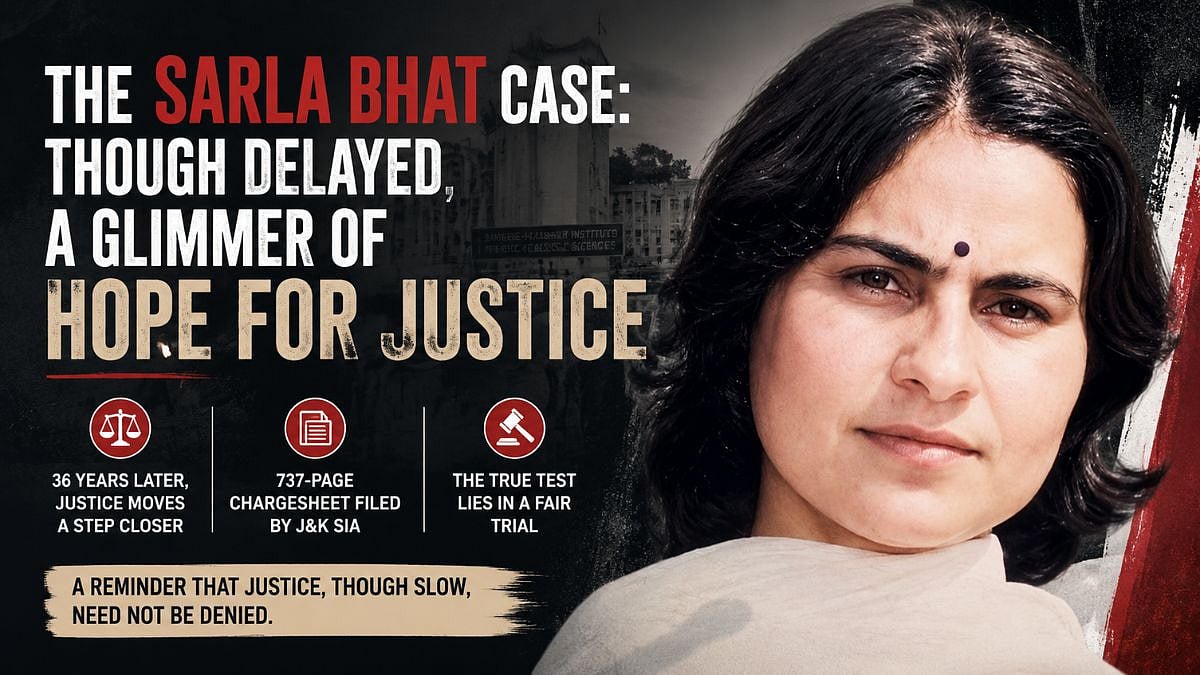
The chargesheet in the Sarla Bhat murder case has renewed debate over accountability in long-pending terrorism cases | AI Generated Image
The filing of a 737-page chargesheet by the Jammu and Kashmir State Investigation Agency (SIA) in the 1990 murder of government nurse Sarla Bhat is a reminder that justice, though painfully slow, need not be permanently denied. It has taken 36 long years for investigators to bring the case to this stage.
The delay is extraordinary, but the very fact that the law has finally caught up with one of Kashmir's darkest crimes offers a measure of reassurance to all who believe in the rule of law. The investigation deserves appreciation for the sheer perseverance it demanded. Reconstructing a murder after more than three decades is no ordinary task.
Witnesses had grown old, many crossing the age of 70, while some had died before they could testify. Memories had faded, records had to be retrieved, and forensic as well as electronic evidence painstakingly assembled. The officers who revived a case that had remained dormant for decades deserve credit for piecing together what they believe is a watertight case.
Trial Will Be The True Test
The true test, however, lies ahead. Filing a chargesheet is one thing; securing a conviction is quite another. Every allegation must withstand rigorous judicial scrutiny and cross-examination. Only a fair trial can determine the guilt of the accused. Yet, if the investigation has indeed established an unbroken chain of evidence, the prosecution has every reason to be confident.
Sarla Bhat's story makes the investigation particularly significant. At a time when terrorism had engulfed the Valley and fear had driven many Kashmiri Pandits to flee, she chose to remain at her post as a nurse at the Sher-i-Kashmir Institute of Medical Sciences.
She continued to discharge her professional duty, irrespective of who her patients were, despite repeated threats. According to the chargesheet, the allegation that she acted as a police informer was entirely fabricated to justify her murder. If proved in court, it would expose not merely a cold-blooded killing but a calculated act of terror intended to intimidate an entire community.
Need For Wider Accountability
The naming of jailed JKLF chief Yasin Malik as the alleged mastermind underscores the seriousness of the case. If the evidence sustains the charge, it will reinforce the principle that neither the passage of time nor political considerations can shield those responsible for terrorist crimes.
More importantly, this investigation should not remain an isolated success. Many killings linked to the militancy of the 1990s, and terrorist attacks elsewhere, continue to remain unresolved. Justice demands that these cases too be reopened, investigated with equal diligence and brought before the courts.
The families of countless victims have waited far too long. Their faith in the criminal justice system can be restored only when every effort is made to ensure that those responsible, however influential or elusive, are finally held accountable.
RECENT STORIES
-
-
-
-
-