The Quality Of Higher Education In India Is Reflected In The Student-Teacher Ratio
The ‘State of Working India 2026’ report has highlighted worsening student-teacher ratios in Indian colleges, warning of declining education quality. While student enrolment has risen sharply since 2010, faculty recruitment has failed to keep pace, particularly in northern states and public institutions.

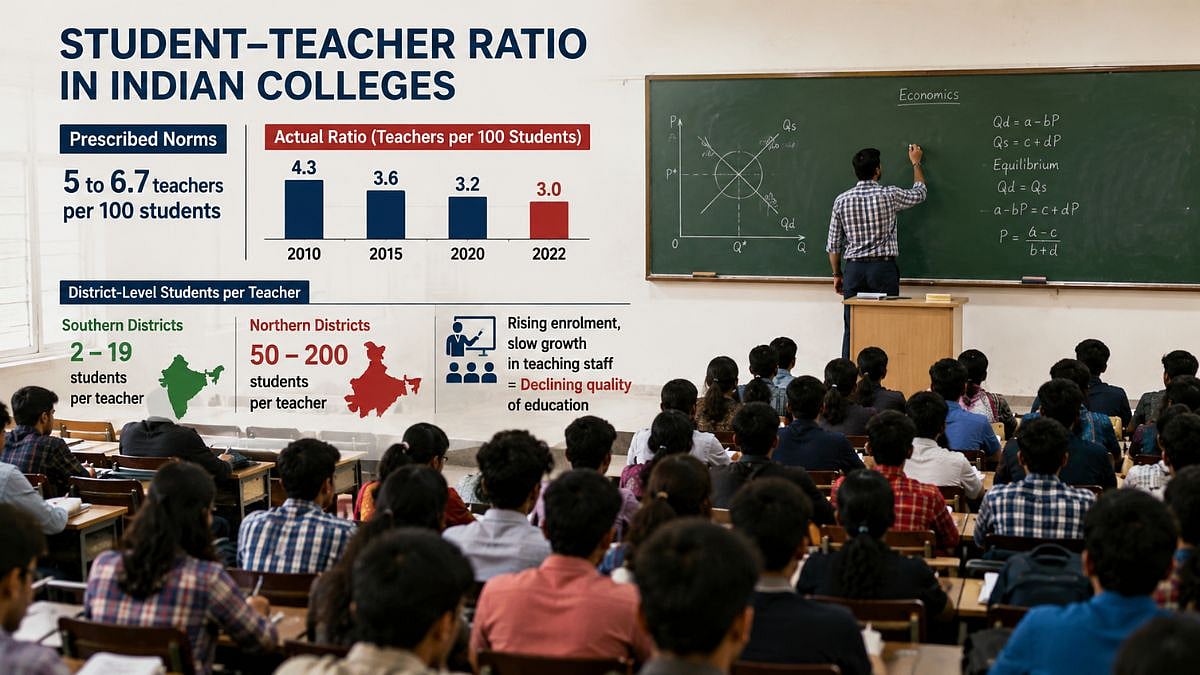
Rising student enrolment and inadequate faculty recruitment are widening the student-teacher gap in colleges across India | AI Generated Representational Image
In the previous column (April 17), I summed up one key finding of the report The State of Working India, 2026 (SWI26), released by Aziz Premji University, Bengaluru, regarding who gets to study what in college. In this column, I will sum up another key aspect of the report: the quality of higher education in India as reflected in the student-teacher ratio in colleges across the country.
The teacher-student ratio is a key component of learning at every level of education. After all, it is well established that education is best imparted in person. Thus, the physical presence of a teacher in a classroom is a key aspect of how much and how well students learn in any institution. Higher education is no exception. In this context, the student-teacher ratio in a discipline in a higher education institution becomes an approximation for the quality of education imparted.
Prescribed norms versus reality
In India, the All India Council for Technical Education prescribes norms for faculty requirement across technical disciplines — engineering, technology, design, applied arts and crafts, management and computer applications — for both undergraduate and graduate courses. At the postgraduate level, generally, there are fewer students per teacher. Therefore, the norm ranges from 1:25 to 1:15, that is, 25 to 15 students per teacher. For non-technical courses, the UGC prescribes a ratio of one teacher per 20 students.
While the link between the student-teacher ratio and learning outcomes is not clearly established, given the prescribed norms, it is useful to see the extent to which colleges have been able to meet these requirements. While the AISHE report collects data about the number of students enrolled and the number of teachers appointed across different types of higher education institutions, SWI26 restricts its analysis to colleges alone and includes teachers at all levels of seniority and both regular and contractual employees.
Between the years 2010 and 2022, the number of students enrolled in colleges increased from 112 lakh to 322 lakh (nearly 2.7 times), while the number of teachers increased from 5 lakh to 12 lakh (nearly 2.2 times). If we reverse the ratio, from student-teacher to teacher-student, that is the number of teachers available per student, the higher the ratio, the better it is.
As per the prescribed norms, the teacher-student ratio should be 5 to 6.7 teachers per 100 students. But from available data, the ratio has ranged from nearly 4 to 3 teachers and has never reached the prescribed norms. In fact, the highest ratio was 4.3 in 2010, and it has steadily decreased since then. As the number of enrolled students increased, the number of teachers per student steadily declined. In 2022, on average, the recorded ratio was 3 teachers per 100 students, much below the prescribed norms.
Regional disparities remain stark
Further, even as the number of institutions has steadily increased, the student-teacher ratio has consistently declined. This trend holds true for both private and public institutions, though, in general, public colleges have a much higher student-teacher ratio than private colleges.
Moving away from the all-India average and trends, the report looks at the district-level student-teacher ratio (students per teacher: the higher the number, the lower the quality) across India at three points in time — 2011, 2016 and 2021. In 2011, the national average number of students per teacher was 24.3. In 2016, it increased to 35.4 (became worse), and by 2021, it was still 32.
In 2011, most southern districts had a low student-teacher ratio ranging from 2 to 19 students per teacher. In districts in Gujarat, Rajasthan and Punjab, the ratio ranged from 18 to 27 students per teacher. However, in districts of Uttar Pradesh and Bihar, the ratio ranged from 50 to 200 students per teacher.
Between 2011 and 2016, the student-teacher ratio increased across all districts, even in southern and western districts of Kerala, Karnataka, Rajasthan and Gujarat. More recently, between 2016 and 2021, there has been some improvement in the student-teacher ratio in northern districts, especially in districts of Uttar Pradesh, but, broadly, the northern districts continue to have a very high number of students per teacher compared to districts in the south.
However, even in the south and districts in Gujarat and Rajasthan, the student-teacher ratio has steadily worsened over time with an increase in the number of students in both these states.
Teacher recruitment remains inadequate
The report then examines the increase in the number of teachers with the enrolment of an additional 100 students. In southern districts, the increase in teacher numbers has ranged between 3 and 10 per 100 students (these districts witnessed a high increase in college density as well as enrolment). Thus, the student-teacher ratio has not worsened. However, in central and northern regions, the number of teachers has either remained unchanged or reduced alongside an increase in enrolment.
The report also finds that while, on average, the number of teachers has increased within colleges, irrespective of the year, the actual increase in the number of teachers per 100 students lies between 0.5 and 0.9. Between 2010 and 2015, while the number of higher education institutions saw a large increase along with an enormous increase in the enrolment of students across all colleges, the increase in teachers’ numbers was marginal.
In the past few years, while the increment has improved, it is still quite below the norms. Further, the incremental increase has been much lower for public colleges compared to private colleges.
In other words, the decline in the quality of education in our colleges, as reflected in the student-teacher ratio, continues to be a serious concern.
Vrijendra taught in a Mumbai college for more than 30 years and has been associated with democratic rights groups in the city.
RECENT STORIES
-
-
-
-
-