The Politics Of Emergency: NCERT’s Lesson On History
NCERT's inclusion of the Emergency in a Class 9 textbook has revived debate over how contemporary history should be taught. The author argues that while the Emergency deserves critical study, history education should remain balanced and fact-based rather than politically selective, encouraging democratic understanding through objective presentation.

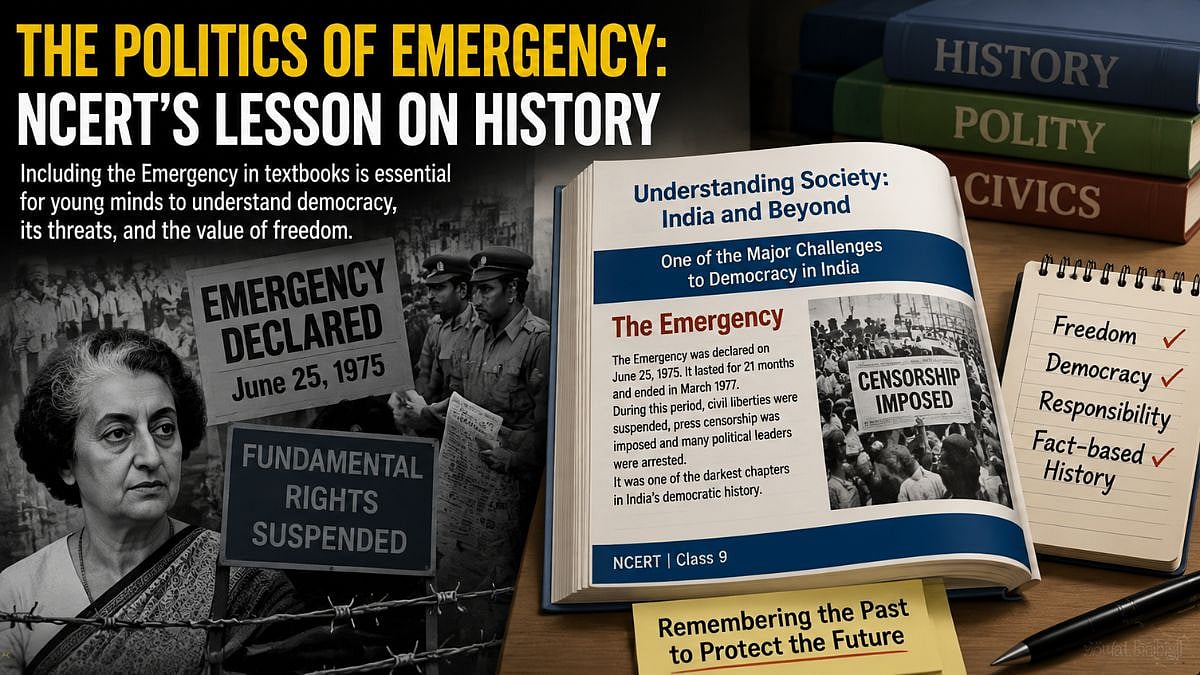
The opinion piece examines the political debate surrounding NCERT's treatment of the Emergency in school textbooks | AI Generated Representational Image
There can be no argument, either academic or political, for keeping certain aspects of India’s contemporary history and politics out of textbooks, especially at the high school level. Yet, there cannot but be disconcertment about the manner in which the powers that be in India today project the Emergency that was declared in June 1975 and was lifted 21 months later, in March 1977. For public consumption, it is all about the dark chapter in India’s contemporary history—which it indeed was—that deserves full condemnation and its architect, the Congress party, censure, unmindful that several elements of the authoritarianism witnessed then, wittingly or unwittingly, prevail now too. It is but natural, then, that India’s Education Minister Dharmendra Pradhan, under fire for the massive mess in the National Eligibility-cum-Entrance Test (NEET) and CBSE marking, resorted to using the dark chapter as a diversionary tactic.
Emergency In Textbooks
Referring to the National Council of Educational Research and Training (NCERT) introducing the Emergency in its Class 9 textbook in a chapter titled “Understanding Society: India and Beyond”, which presented it as “one of the major challenges to democracy in India”, Pradhan asserted that the NCERT has done the right thing because “future generations should know and understand such ‘dark deeds’ so that such a situation does not arise again”. The timing, on the anniversary of the declaration of the Emergency, underscored the politics behind the move, suggesting that had it not been for the BJP being in power, this would not have seen the light of day in classrooms. It was an incorrect and unfair impression to create, given that the Emergency was included in the NCERT Class 12 textbook nearly 20 years ago, in 2007, when the Congress-led UPA government was in power.
Political Context
Over the years, there have been Congress leaders who expressed regret in various ways. India’s Leader of the Opposition Rahul Gandhi was clear in his condemnation in 2021 that the Emergency declared by his grandmother, then Prime Minister Indira Gandhi, was “a mistake” and that several things that happened during that period were “wrong”. That the UPA government did not intervene to prevent the chapter on the Emergency from being included in a textbook in 2007 is testimony to its clear-eyed, democratic and liberal character. That the then Education Minister, Arjun Singh, made no changes to the chapter approved by the panel of subject experts, as detailed by one of its members, Yogendra Yadav, adds credibility to how the party owned the dark period but understood its importance as a lesson for future generations. Will the BJP government allow its embarrassing episodes in textbooks?
History And Responsibility
What will be included in textbooks is usually a matter of politics, but a government must go beyond narrow political confines to understand responsibility, citizenship and fact-based history—and ensure that India’s young understand it too.
Published on: Monday, June 29, 2026, 09:44 PM ISTRECENT STORIES
-
-
-
-
-