The Dwindling Minority In India’s Electoral Politics
A debate over declining Muslim representation in India's electoral politics has intensified after BJP's rise since 2014, the article notes. It says Muslim lawmakers have remained underrepresented historically, with analysts linking the recent decline to changing political dynamics and Hindutva politics.

The Dwindling Minority In India’s Electoral Politics | AI
Muslim representation, or the lack of it, in India’s electoral politics has been a subject of debate for decades. But the debate has become more intense after the BJP came to power at the centre in 2014. The electoral marginalisation of Muslims is not restricted to the saffron party alone; other parties have also been equally reluctant to field Muslim candidates due to the fear of being charged with “minority appeasement” since the ruling dispensation succeeded in decisively shifting the electoral discourse to the right of the ideological spectrum. Even though electoral dynamics have increasingly shifted towards the “Hindu versus the rest” polarisation model, “secular” parties like the Congress and others still count on the Muslim vote. But not the BJP, which has aggressively cultivated its own vote bank and frequently wins elections without relying on large shares of Muslim votes.
Opponents of the BJP accuse it of being anti-Muslim, who make up around 15 per cent of India's population, according to the 2011 Census. The party is also accused of being quite loath to field Muslim candidates even in constituencies where Muslim voters make up a significant chunk of the electorate. For instance, it did not field any in India’s largest state, Uttar Pradesh, in three successive elections in 2014, 2017 and 2019, though Muslims make up 19 per cent of the state’s population. As an anchor of India’s right-wing politics centred around Hindu nationalism and cultural conservatism, the BJP’s march to political dominance is a result of the success of its electoral and ideological strategy that seeks to subsume diverse and fragmented castes under a unified Hindu identity.
Perhaps steering away from Muslims helps the BJP burnish its pro-Hindu credentials and cements its hold over the majority community voters to win elections. It is unlikely that the saffron party, an ideologically driven organisation, will abandon its winning formula that has ensured a successful transition of many of its core ideological agendas from the fringes to the mainstream. In recent years, the unambiguous divide between the BJP and “secular” parties has become so stark that elections are fought less on nuts-and-bolts governance issues but more on polarising rhetoric and communal politics. The 2024 general election and the recent assembly elections in West Bengal and Assam are prime examples.
Almost all political parties are guilty of exploiting religion and caste to build vote banks over the decades, more so after the late 1980s and 1990s, when they became central to winning elections. This era broke the post-Independence dominance of broad, cross-communal parties and ushered in an aggressive era of identity and social justice mobilisation. Alongside the rise of caste politics, the 1980s also saw the rise of aggressive religious nationalism with the BJP scaling up its national presence by turning religious identity and majoritarian mobilisation into an effective electoral strategy. In the 2014 general election, which propelled Prime Minister Narendra Modi to power, the BJP had fielded just seven Muslim candidates out of the 428 seats it contested. But none were elected.
The BJP has had no Muslim MP among its ranks in the lower house of Parliament elected in 2019 as well. From Uttar Pradesh in the 2019 general election, the BJP won 71 of the state’s 80 parliamentary seats, but the winners did not feature any Muslim candidates, though UP has the largest absolute number of Muslims of any state in India. In the current Lok Sabha, there is not even a single Muslim MP in the BJP-led ruling NDA dispensation. While Muslim representation in India's legislative bodies has always been low, it has seen an accelerated decline in the past 12 years, coinciding with the BJP’s rise to power at the centre in several states.
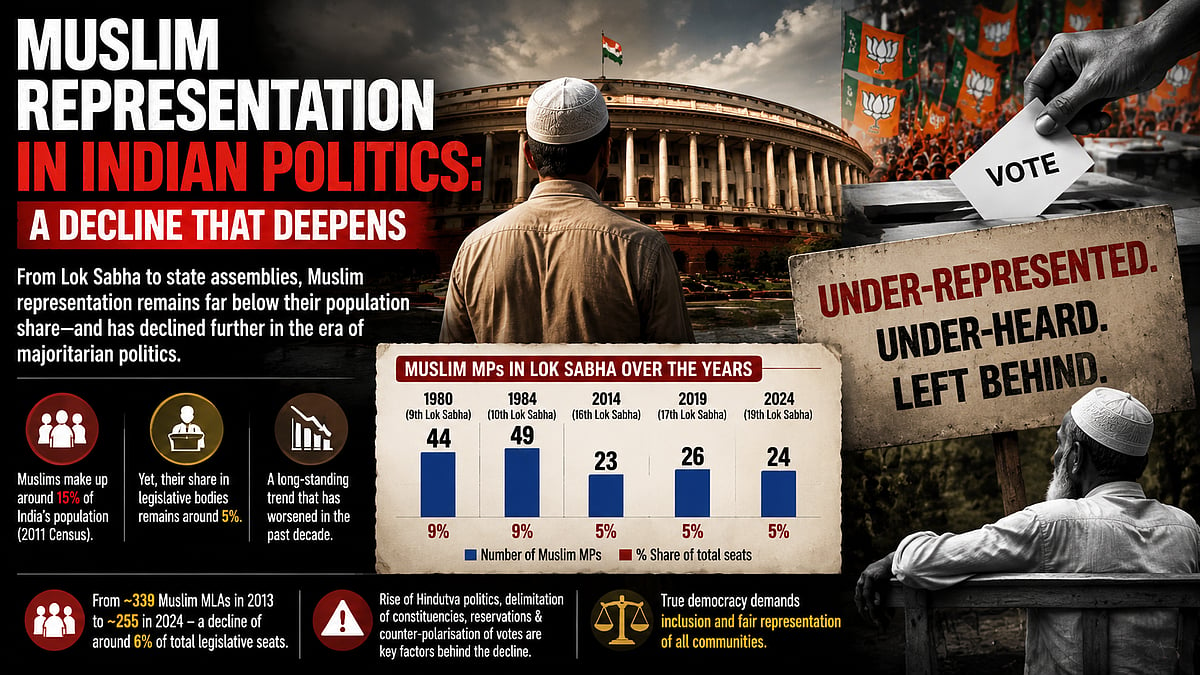
The recent assembly elections in West Bengal, Assam, Kerala, Tamil Nadu, and Puducherry reflected the same wider trend of the decline in the number of Muslim MLAs—only 107 are Muslims, down from 112 elected in 2021 assembly polls. On the whole, according to reports, Muslim MLAs account for a small percentage of elected legislators in proportion to the community in India’s population. Total representation in absolute numbers has reportedly seen a downward trend in various large states over the past decade, falling from roughly 339 MLAs nationwide in 2013 to around 255 now, representing roughly 6 per cent of total legislative seats. According to political analysts, the rise of Hindutva politics has a direct correlation with the decline in the number of Muslim MLAs.
The under-representation of Muslims in legislative bodies in relation to their population is not a new phenomenon but has been a consistent trend since the first general election in 1952. The share of Muslim MPs has historically remained around 5 per cent, with some exceptions like in the 1980 and 1984 elections when their share went up to 9 per cent. Political observers note that the constant decline in the number of lawmakers from the minority community is also because of the manner in which the socio-political scenario has evolved in the country since Independence. However, they emphasise that the dip has become more noticeable after the electoral rise of the BJP. The 16th Lok Sabha (2014-2019) witnessed a drop to just 23 MPs from 30 in the 15th Lok Sabha. In 2019, only 26 Muslim candidates were elected, and in the current Lok Sabha, only 24 are Muslim MPs.
What is disconcerting is that the growth of majoritarian politics, analysts note, has resulted in the non-BJP parties looking at Muslim candidates as a liability even though they appeal to the community for its votes. This means that while the Muslim vote bank is valued, the so-called “secular” parties are wary of fielding Muslim candidates. Other factors that are said to have contributed to the decline in the number of Muslim representations in the Lok Sabha and state assemblies include delimitation of constituencies, resulting in the diminishing significance of the Muslim electorate; reservation of seats with a sizeable Muslim community for Scheduled Caste and Scheduled Tribes; and counter-polarisation of majority votes which works against Muslim candidates.
The repercussions of this exclusion, according to experts, are serious and can make the community feel alienated and marginalised. The ongoing debate surrounding voter roll revision, delimitation anxieties, and citizenship verification has further fuelled a climate of political marginalisation and insecurity for minority voters.
The writer is a senior independent Mumbai-based journalist. He tweets at @ali_chougule.
RECENT STORIES
-
-
-
-
-