The Deepening Energy Crisis Is A Wake-Up Call For India
The article argues that global energy disruptions caused by geopolitical tensions could affect supplies and prices. It says India should diversify energy sources, develop alternative supply routes and accelerate electric vehicle adoption to improve long-term energy security.

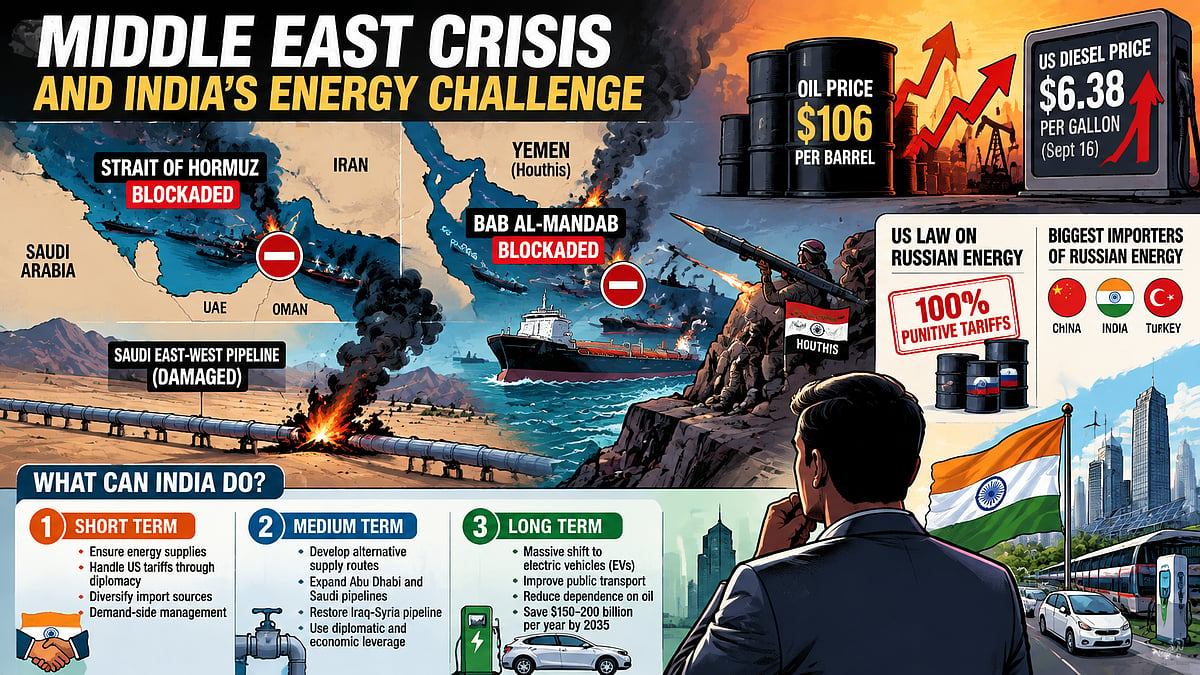
The Deepening Energy Crisis Is A Wake-Up Call For India | AI
Seven months have passed since the launch of Operation Epic Fury by the United States and Israel on Feb 28. The Strait of Hormuz continues to be blockaded; Iran's persistent attacks on oil tankers and merchant ships passing through the Strait have effectively imposed an embargo on sea transport, severely disrupting energy supplies. The United States recently stated that a billion barrels of oil have been transported through the Strait in the past two months. But the exact situation is not known, and energy supplies through the Strait are uncertain, volatile, and could be disrupted easily given the asymmetric warfare Iran seems to have mastered.
The East-West pipeline, carrying 7 mbd of crude oil from the Abqaiq oil field on the Persian Gulf coast to Yanbu on the Red Sea, has played a pivotal role in mitigating energy supply chain disruption since the outbreak of hostilities. The strategic reserves in various countries, oil in transit before supply interruption, commercial storage with refineries the world over, and effective demand-side management by many countries, notably China, dampened the impact of energy shortages for a few months. Now, continued disruption is bound to have more serious consequences, with the supply falling short of demand and the price shooting up considerably.
The entry of Ansar Allah (Houthis) from Yemen into the conflict has worsened the crisis. Significant damage to the East-West pipeline shut down the transport. Given the demonstrated ability of Houthis to carry out missile and drone attacks deep into Saudi Arabia, there is no guarantee that the (oil) pipeline will not be damaged again. The recent seizure of Yemen's western coast by the Houthis, capture of the port of Mokha, and blockade of the Red Sea at the strategic Bab al-Mandab Strait have complicated the situation significantly.
This is the first time in modern history when both the Strait of Hormuz and the Bab al Mandab Strait were effectively blockaded, halting the trade between the Arabian Peninsula, the Persian Gulf, and Asia. Not surprisingly, the oil market responded sharply, and the price of crude oil reached $106 per barrel. In the US, on September 16, the average diesel price reached a record level of $6.38 per gallon.
Now the US has enacted a law which, if implemented, will stop the flow of Russian oil and gas into global energy markets. Russia produces about 10 million bpd of oil and exports about 4.5 to 5 million mbd. Russia also exports about 50 million cubic metres of pipeline gas and about 100,000 tonnes of liquified natural gas per day. Given the perilous state of global energy supplies, if Russian energy does not flow into the global market, the energy costs may rise quite dramatically.
What can India do in the face of this grave crisis? The Graham Law seeks to impose 100% punitive tariffs on countries which buy Russian oil and gas in significant quantities. European countries, which import gas from Russia even now, are exempted because all of them fall below the 15% threshold prescribed in the law. China, India, and Turkey are the biggest importers of Russian energy. Turkey is a NATO member with clout in West Asia and will be exempted. China will probably be exempted from punitive tariff because of its leverage in weaponising and controlling global supply of rare earths and permanent magnets. India is potentially the biggest target of this unfortunate, untimely law.
This is undoubtedly a perilous moment for India. Can we convert this crisis into an opportunity?
First, in the short term, we need to do whatever is necessary to overcome the energy shortages and American tariffs. Given the circumstances, hard lobbying may persuade the US establishment and President Trump because the US will suffer energy price escalation too. In any case, the government will do whatever it takes to diversify energy supplies once again and take serious steps for demand-side management. China has taken significant steps over the past seven months and reduced oil demand by up to 5 mbd. India, being a fractious democracy, did not do much to curtail the demand.
Second, in the medium term, even if the Gulf crisis is resolved and both the Straits are reopened for shipping, there is a dire need to accelerate the efforts to create alternative supply routes. Now that the unthinkable has happened, it may happen anytime in the future. Several projects are in the pipeline—enhancing the capacity of the Abu Dabi Crude Oil Pipeline, expansion of the Saudi East-West pipeline, restoration of the Iraq-Syria pipeline, and potentially other direct routes to the Indian Ocean on the Oman coast, bypassing the Strait of Hormuz. India should lend its diplomatic strength and economic muscle to accelerate the projects.
Third, and most important, in the long term, we should progressively eliminate internal combustion engine-guzzling oil from our transport systems. The electrification of transport is the key. India has over 400 million motor vehicles of all kinds, and they consume 182 billion litres of diesel and petrol per year, or 50 crore litres per day. The number of motor vehicles may double by 2035, leading to a billion litres of consumption per day. Right now, nearly 140 million tonnes of crude is needed to meet the motor vehicle consumption. Massive boosts to electric vehicles through incentives, regulation, battery storage, solar power generation, and daytime fast-charging infrastructure are the needs of the hour.
In China, about 60% of cars and 80% of two-wheelers sold are electric vehicles (EVs); India's share is 7.5% and 10%, respectively. A massive national programme to shift to near 100% EVs by 2035 and an improved, integrated, and reliable public transport to reduce the demand for personal automobiles should be implemented on war footing. That singular step alone will guarantee our long-term energy security and wipe out our trade deficits. If it requires a one-time import of components or equipment, it will only cost about $70-80 billion spread over a decade, but it will save about $150-200 billion per year in terms of energy imports by 2035. There cannot be a better win-win solution.
The author is the founder of Lok Satta movement and Foundation for Democratic Reforms. Email: drjploksatta@gmail.com / Twitter@jp_loksatta
RECENT STORIES
-
-
-
-
-