The Court’s Warning On Hidden Plastics
The Madras High Court has retained its order requiring plastic and PET water bottles, salt and sugar packets to carry warnings about the likely presence of micro- and nano-plastics. The court adopted a precautionary approach, while concerns over plastic pollution and safer packaging alternatives continue to grow.

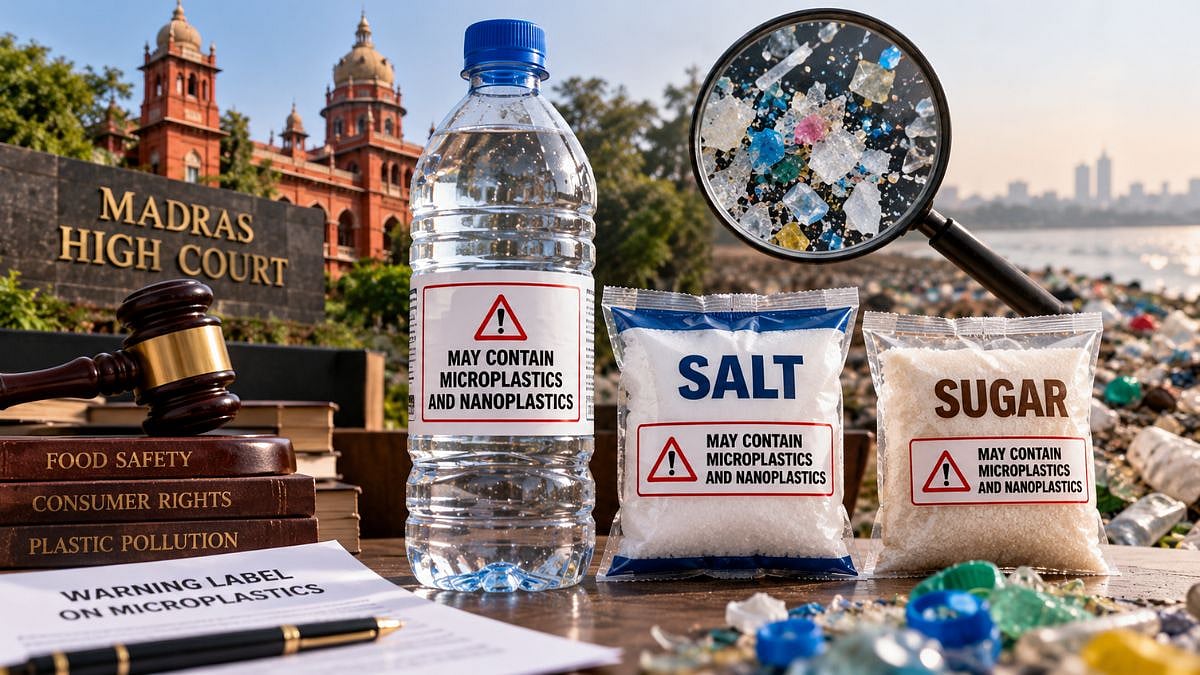
The court has upheld labelling requirements warning consumers about the possible presence of micro- and nano-plastics in plastic packaging | AI Generated Representational Image
The Madras High Court has taken a commendably forward-looking view of food safety by refusing to recall its order that requires plastic/PET water bottles as well as salt and sugar packets to carry a legible warning on the likely presence of micro- and nano-plastics.
There has been a predictable pushback to the earlier order from the food industry, but the regulator, FSSAI, took a retrograde stand by throwing its weight behind the manufacturers rather than the citizens whose health it is mandated to protect.
In the event, the Bench, which has been reviewing pollution and unsustainable activity in the Nilgiris, was unconvinced by the arguments made by the interested parties.
They opposed labelling, citing the lack of conclusive evidence, its premature nature, the need for further research on harms, lack of proportionality of the measure, and even the absence of labelling requirements in other countries.
As the court noted in its latest order, the germane issue is the presence of pollutants in plastic packaging. This was not contested by the parties that opposed the court’s order, and they only sought to put off action citing the lack of conclusive evidence.
Moreover, the FSSAI’s legal responsibilities require consumers to be informed of all potential harm to help them make proper choices. It is wholly appropriate, therefore, that the High Court Bench comprising Justices N. Sathish Kumar and D. Bharatha Chakravarthy adopted the precautionary principle and ordered labelling to be implemented.
Plastic Pollution’s Growing Footprint
Governments around the world now acknowledge that the problem of runaway plastic pollution crossed the point of no-return years ago. The Pacific Ocean has a great garbage patch, with considerable volumes of plastic pollutants from around the world, and millions of tonnes more are being added each year.
Such floating trash islands, representing the uncounted impact of consumerism fuelling GDP growth, have broken up into microplastics and nanoplastics now dispersed in mountains, rivers, drinking water, food, and even human tissues.
Because such pollution is novel in geological time, its impact on humans and animals remains unclear; what is clear is that these artificial materials are alien to biological functioning.
PET bottles made up 92% of the 1.9 million tonnes of this type of plastic used in India in 2024-25. By contrast, a country like Germany uses significant levels of glass bottles and even paper to package food and water, besides labelling food as healthy or unhealthy. India should stop resisting calls for a genuine clean-up and act in mission mode to remove accumulated plastic from rivers, lakes, mountains, and cities.
A shift to eco-friendly materials must be actively encouraged, and the ban on single-use plastic must be enforced with zero tolerance. Labelling to indicate possible presence of microplastic may not offer the consumer much of a choice, but it will likely raise public pressure and nudge the industry to use safer packaging alternatives.
RECENT STORIES
-
-
-
-
-