Taj Mahal's Future Hinges On Balancing Development & Preservation
The Supreme Court has relaxed its 2024 ban on new industries in the Taj Trapezium Zone, allowing pending MSME proposals under strict oversight. While the move balances development and conservation, the editorial stresses that pollution, poor compliance with environmental safeguards, and neglect of the Yamuna remain the biggest threats to preserving the Taj Mahal for future generations.

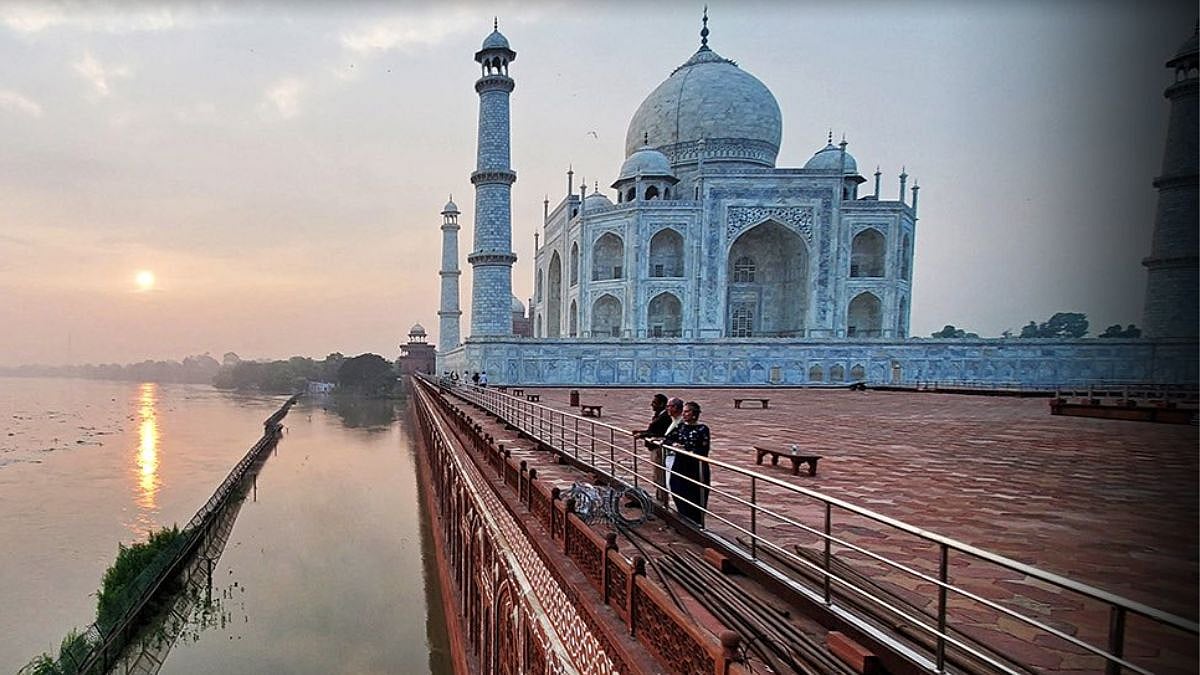
Taj Mahal's Future Hinges On Balancing Development & Preservation | Twitter
The Taj Mahal is unarguably India’s most recognised ancient monument, drawing 6.5 million visitors a year in the pre-pandemic period and grossing Rs 562 crore in ticket revenues since 2015. Yet, it has taken intensive litigation to protect it from pollution and the creeping effects of incompatible industries located around Agra. After strong directions issued three decades ago to relocate polluting industries and curb air pollution that was ruining the marbled vistas, an SC order of 2024 banned new industries in the Taj Trapezium Zone (TTZ). That prohibition has now been diluted by the court, opening a fresh chapter in the saga of this national archaeological treasure.
A bench headed by Chief Justice of India Surya Kant has allowed 410 pending applications for setting up, expansion or relocation of micro, small, and medium industrial establishments to be considered. The TTZ Authority is required to achieve a consensus on each application, considering them with the compulsory participation of the Central Empowered Committee and NEERI, the environmental research institute. The amicus in the case has been given review powers to refer any matter to the court for a final decision. Public oversight is incorporated in the form of a window to object to the decisions.
These are welcome checks, although their efficacy will depend on compliance by the executive. A more fundamental issue is the course of pollution in this part of the country and failure of the authorities to comply with earlier directions for the TTZ, which call for a vision document, a cumulative impact assessment study, and a final report on non-polluting industries.
Governments are under pressure to expand economic opportunity and tax revenues, but short-termism to achieve unidimensional growth produces serious negative effects. It bears emphasis that in spite of the global importance of the Taj, the clean-up effort to stop sewage and toxic chemical dumping into a choked Yamuna in the vicinity has been slow; the impact of the massive sewage treatment plant at Okhla opened last year on levels of sulphurous emissions from the river needs watch. Cleaner river water may reduce the unnatural populations of insects that leave a blue-green residue on the marvellous monument.
These are matters that need continuing oversight and peer review by credentialed researchers. It is evident that a Mughal-era investment such as the Taj has been fetching steady rewards for modern rulers while concern for its upkeep has been underwhelming. Moreover, the integrity of Shah Jahan’s creation was left to a public interest petition to preserve. Even with a rich archaeological heritage, governments have largely failed to showcase India to international tourists, whose patronage of tiger tourism in the country fetches 13 times more revenues than the Archaeological Survey of India’s ticket sales. The money is not the point; preserving heritage for posterity is.
RECENT STORIES
-
-
-
-
-