Suspense Reigns Supreme In Tel Aviv As Netanyahu Struggles To Survive
Benjamin Netanyahu faces an uncertain political future after Israel's Knesset election produced a fractured verdict. His bloc secured 53 seats against the opposition's 48, while Arab coalitions won 19. With neither side reaching the 61-seat majority, power-sharing negotiations or fresh elections remain possible.

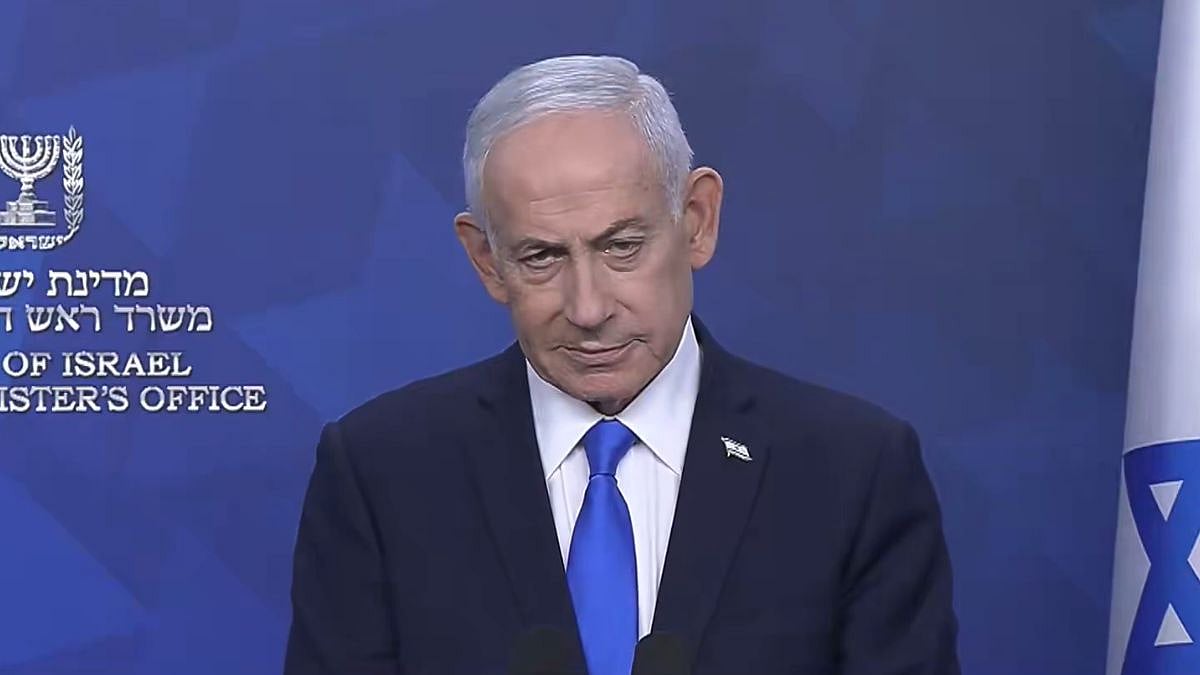
Benjamin Netanyahu faces an uncertain political future as coalition negotiations remain deadlocked following Israel's parliamentary elections | File Photo
It’s been a week since the elections to the Israeli parliament, the Knesset, were held. But the installation of a government, albeit a coalition, is nowhere in sight. This is one of the big ironies of Israeli society. A nation, which has faced only hostility from its neighbours ever since it was born in 1948 and which has successfully warded off efforts from Islamic governments and non-state terrorist actors to wipe out its very existence, is unable to arrive at a consensus over the formation of the next government. In fact, coalition politics has been the hallmark of Israeli society.
October 7 Attack Exposes Deep Divisions
The massacre of over 1,200 innocent Jewish youths by the jihadist Hamas near the Gaza border on October 7, 2023, ought to have united the Jews solidly so that there is no repetition of the horrors of that day. A visit to the site of the musical event, a couple of kilometres from the Gaza border, where a memorial of the slain youths with their photographs has been erected, and interaction with the survivors vividly bring out the horror of that night. But, ironically, that bloody event has only brought the deep fault lines beneath Israeli society to the surface, which was apparent when the counting of the ballot papers threw up a fractured verdict.
Many Israelis were more keen on an enquiry into the “massive failure of intelligence” than taking steps to prevent a recurrence of the Hamas-led terror strike. Many Israelis want to know how the intelligence agencies, who have been carrying out precision decapitation of leaders and generals of Iran in their offices and streets, got no wind of the march of 7,000 well-armed Hamas terrorists across a 12-km-long border at Gaza. To date, no worthwhile enquiry has been conducted into the big let-down by the intelligence agencies.
Fractured Verdict Leaves Israel In Limbo
While the coalition led by the feisty incumbent Prime Minister Benjamin Netanyahu, aka Bibi (77), of the far-right Likud Party managed to bag 53 seats in the 120-member Knesset, the block led by retired chief of the Israeli defence forces and Yashar Party chairman, Gadi Eisenkot (66), captured 48 seats.
What is significant is that Eisenkot formed his Yasar Party only a year ago and in a short span of time has miraculously emerged as a significant political force in Israeli politics. With neither of the warring coalitions able to reach the magical figure of 61 seats in parliament, the country is facing a grimly uncertain future.
The two Arab coalitions—the Islamist Ra'am and the Joint List—between them have secured a record 19 seats. The Arabs constitute about 21% of the total population of 10.1 million, and the distrust of them has deepened sharply post October 7. This is understandable because few of the Arab leaders condemned the genocide of October 7. In fact, some of them have links with the Muslim Brotherhood, an umbrella organisation of radical Islamist organisations, including Hamas.
Arab Parties At Centre Of Coalition Debate
Many of the Arab leaders are keen on having a share in power and, to that extent, are willing to back Eisenkot. But Netanyahu has made such a development next to impossible by observing that a coalition wholly dependent on the support of the Arab parties would strike at the very existence of Israel as a Jewish state.
His supporters, whom this reporter spoke to in Tel Aviv, said that Jews would not approve of anyone taking the support of the Arabs just to grab power and, in fact, would revolt openly. Taking support of the Arabs will undo the gains registered by the Jews in the past seven decades.
A few days before the polls, a survey conducted by the highly respected Israel Democracy Institute revealed that a sizeable majority of Jews were opposed to Arab parties having any role in the new government. Outgoing Finance Minister Bezalen Smotrich has been openly advocating the eviction of Arabs from Israeli soil, while another far-right minister, Itamar Ben-Gvir, has sponsored mass demolition of illegally built homes in Arab-majority towns.
Netanyahu And Eisenkot Face Coalition Choices
If the Arabs, 80% of whom turned up to vote unlike the 53.2% in the last elections held in 2022, are to be kept away, the only other option is to form a coalition, with Netanyahu and Eisenkot coming together and sharing prime ministership for two years each.
Many observers rule out this possibility given the inexplicable visceral hatred for Netanyahu in Eisenkot's camp. But if such a political joint venture is not lost, then the only other alternative is to hold fresh elections, which will entail an expenditure of millions of dollars, and that too at a time when the economy is stretched. But then there is absolutely no guarantee that the new elections would throw up a stable government.
A ray of hope for political stability is the reported willingness of some of the smaller parties in the coalition led by Eisenkot to join hands with Netanyahu. Netanyahu has alleged “vote chori” and has even ordered a probe by the intelligence agency, Shin Bet. Yisrael Beytenu chairman Avigdor Liberman has claimed that the “current political situation leaves sufficient room for negotiations to establish a stable government” without the support of the Arab parties.
President Donald Trump has openly declared his support for Netanyahu. But, irrespective of the outcome of the American polls, Uncle Sam's backing for Israel will continue for strategic reasons. Stakes for Washington in Israel as a key ally in the Arab world are too gargantuan to be ignored.
Global Stakes In Israel's Government Formation
The formation of the new government in Jerusalem is being watched with bated breath in almost all capitals of the world because it will have serious implications, among other things, for Iran, which is a major producer of oil. The stakes of the global economy in the Middle East are too high to be ignored.
New Delhi is also understandably evincing a keen interest in the government formation in Jerusalem because under the leadership of PM Modi and Netanyahu, both nations have entwined themselves deeply in matters of defence and other core areas. India is hoping that Netanyahu would get yet another term so that the strategic objectives of the ties between New Delhi and Jerusalem are achieved in real time.
To get details on exclusive and budget-friendly property deals in Mumbai & surrounding regions, do visit: https://budgetproperties.in/
RECENT STORIES
-
-
-
-
-