Supreme Court’s Order Quashing FIRs Against Protesting CJP Students Is Whimsical
The Supreme Court’s September 1 order quashing FIRs against CJP students who participated in protests has drawn criticism in this opinion piece. The author questions the use of Article 142, the decision to make the order non-precedential and the continued scope for large-scale FIRs against protesters, arguing that broader safeguards for peaceful protest remain necessary.

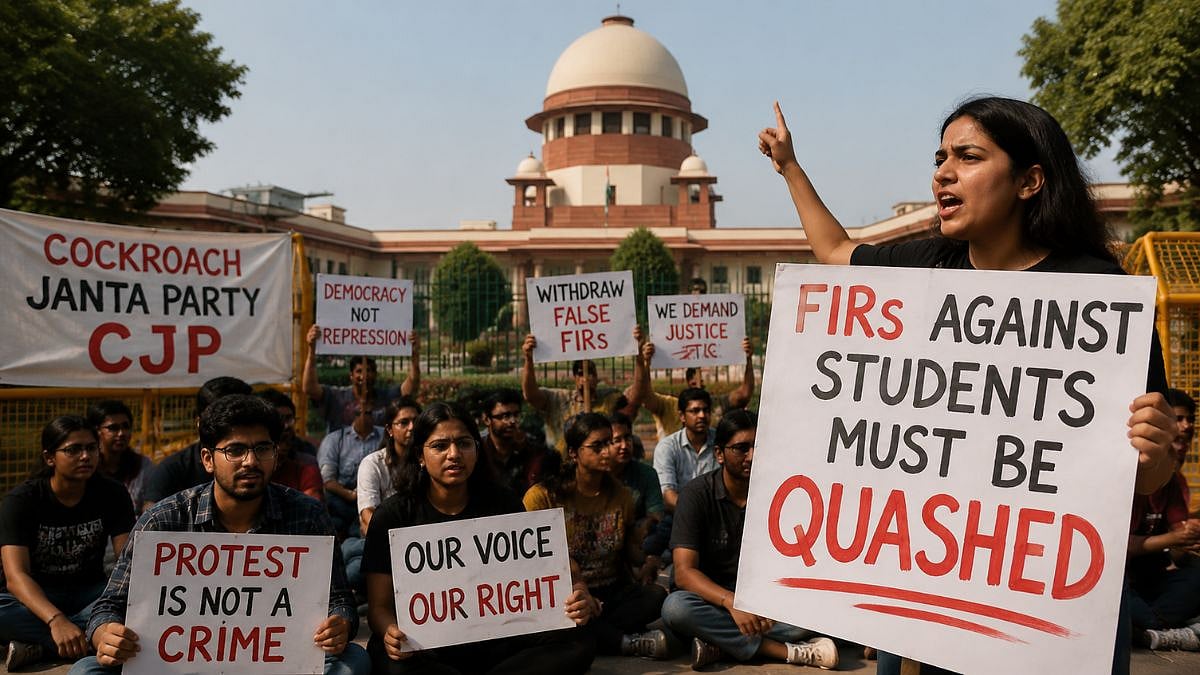
The Supreme Court’s decision to quash FIRs against protesting CJP students has sparked debate over judicial procedure and protest rights | AI Generated Representational Image
The Supreme Court’s September 1 order quashing FIRs registered against students protesting under the banner of the Cockroach Janta Party (CJP) in Jantar Mantar, Delhi, and in some other state capitals, is a walk into a legal quagmire and also a random, impulsive, and unthought-out move that brushes aside judicial protocols and unnecessarily turns settled law upside down. Though the SC has stated that the order cannot be treated as precedent, it is clear that it will give ideas to various judges in future.
Firstly, the SC was wading into a matter that was already settled, namely the government agreement signed by two of its ministers and two representatives of the CJP.
It was based on this agreement that the nationwide protest that resulted in the resignation of then education minister Dharmendra Pradhan was called off. All that the government had to do was to withdraw the FIRs, which it delayed; instead, it approached the SC for a legal sanction. This was a case of seeking a legal stamp of approval on a settled matter.
The SC over-reached and invoked the all-encompassing Article 142, which gives the court extraordinary powers, to quash all the FIRs. At the same time, it complicated matters by allowing the government to carve out FIRs against 2873 protestors who were suspected to have criminal records and take action if required.
Concerns Over Legal Precedent
The SC also complicated matters further by saying that this judgement cannot be treated as precedent, which means that no one, be it the Bar or the Bench, can quote from the order in future litigation. So, as experts have pointed out, the SC has made its own order null and void.
The SC could have used the opportunity to strike down clauses that allow large-scale filing of FIRs against unknown persons, a practice regularised by this government, but instead winks at this impunity.
Concerns Over Protest Crackdowns
Now the government can file large-scale FIRs in the future, too, as it has done recently in the case of the April labourers’ strike in Noida. The Allahabad High Court has yesterday rightly quashed the invocation of the NSA on Akriti Choudhury, a 25-year-old student leader of the Noida labour strike, as being “arbitrary and vague”.
Paranoid and repressive BJP governments have time and again invoked stringent acts against peaceful protestors. The SC had enough opportunity to bring an end to this terrible practice but chose not to do so.
Instead, it reserved for itself the right to dole out instant justice at its own will and pleasure. The CJP order makes it seem that a level of patronage is involved in deciding such important cases involving basic human rights and the repressive power of the state. Nothing has been achieved by the CJP order, since the state is as free as ever to carry on with its repressive measures against peaceful protestors.
RECENT STORIES
-
-
-
-
-