Somnath: A Grand Saga Of Eternal Faith, Resilience And Civilisational Pride
Maharashtra CM Devendra Fadnavis described the 2026 Somnath Swabhiman Parv as a celebration of India’s eternal faith, resilience and civilisational pride. Marking 1,000 years since Mahmud of Ghazni’s invasion, the event highlighted Somnath’s history of reconstruction and cultural continuity.

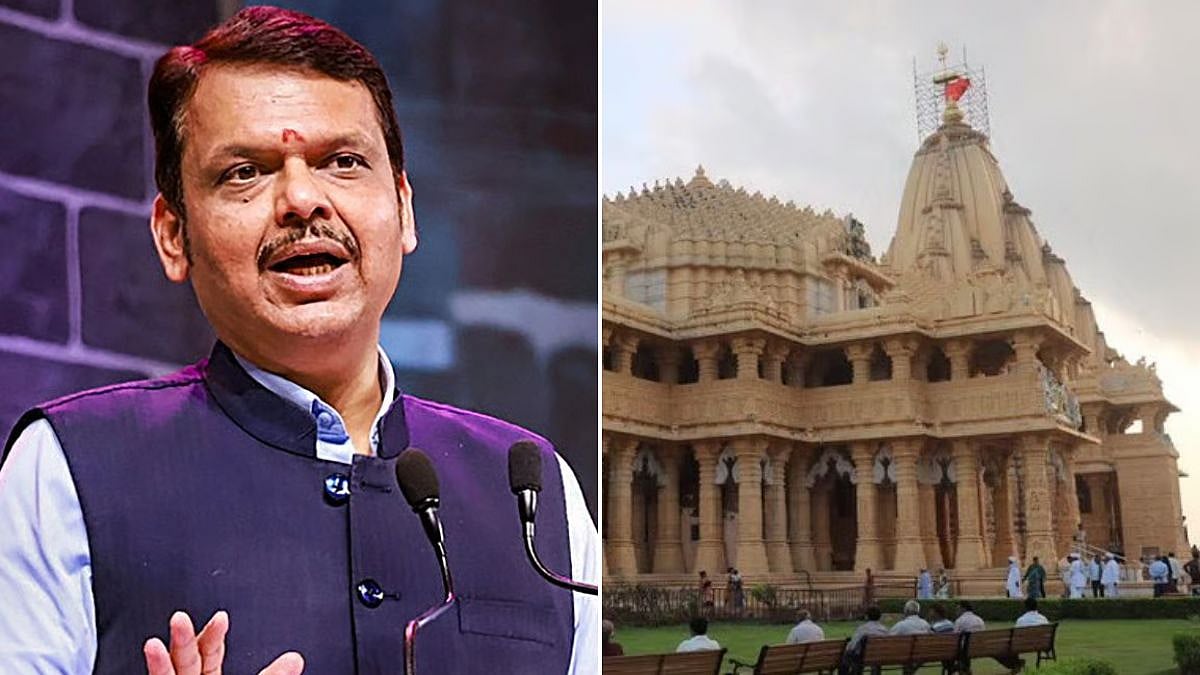
Devendra Fadnavis praises the Somnath Swabhiman Parva for showcasing India’s cultural resilience and historical continuity | File Photo
Somnath Temple is not merely an ancient temple of India, but a living symbol of the country’s enduring civilization, spiritual continuity and collective self-respect. Standing on the shores of the Arabian Sea, this sacred Jyotirlinga is not only a centre of devotion, but also a witness to centuries of invasion, reconstruction, resistance, statecraft and national resurgence. The “Somnath Swabhiman Parv” being commemorated in 2026 has emerged as a defining occasion that presents this long historical journey to a new generation with confidence, balance and cultural pride.
In 1026 CE, Mahmud of Ghazni launched the first major attack on Somnath. The invasion was not merely religious in nature; it was also strategically aimed at controlling prosperous maritime trade routes and the immense wealth associated with the temple. At the time, Prabhas Patan, near present-day Veraval in Gujarat’s Gir Somnath district, was one of the most important ports on India’s western coastline. The Somnath temple represented not just spiritual authority, but also the economic vitality and political influence of the region. Destroying the temple, therefore, was also an attempt to weaken an entire socio-economic and political order.
Even after Emperor Aurangzeb’s orders in 1706, Somnath continued to face repeated attacks and desecration. Idols were broken, structures damaged, yet neither the pilgrimage tradition nor the faith of devotees disappeared. After every assault, local communities, traders, saints, later the Maratha power, and eventually post-Independence national leadership came forward to rebuild and protect Somnath. Thus, the history of Somnath is not merely a history of suffering; it is equally a history of resistance and revival.
Somnath and Maharashtra: A Historical Connection
The relationship between Somnath and Maharashtra is rooted not merely in geography, but in history and political developments. As invaders such as Alauddin Khilji advanced towards Gujarat, attacks on Saurashtra and Somnath became easier. It was during this period that an important historical lesson became evident: whenever political stability in Maharashtra weakened, the security of India’s western coast also came under threat.
The Hindavi Swarajya established by Chhatrapati Shivaji Maharaj was later defended and strengthened through the struggles of Chhatrapati Sambhaji Maharaj, Rajaram Maharaj and Maharani Tarabai. During the Peshwa era, Maratha influence expanded far beyond the Deccan into north-western India. Maratha forces crossed into Gujarat and, within a few decades, Mughal dominance in Kathiawar had significantly declined. In this changing balance of power, Somnath once again came under direct Indian political control.
The Maratha Empire and Somnath: Faith, Power and Strategy
The Maratha connection with Somnath operated simultaneously at cultural, economic and strategic levels. At the cultural level, the contribution of Punyashlok Ahilyadevi Holkar remains one of the most significant chapters in Somnath’s modern history. The Holkar queen of Indore decided in 1783 to rebuild the Somnath temple, which had remained in ruins for nearly a century. The reconstruction was undertaken using her personal treasury.
Ahilyadevi Holkar not only rebuilt the temple but also demonstrated remarkable foresight by constructing the new shrine slightly inland, offering greater protection from sea waves and possible naval attacks. Her decision reflected not only devotion, but also administrative wisdom and strategic thinking.
Ahilyadevi Holkar similarly undertook restoration and development works at several major pilgrimage centres, including Kashi Vishwanath Temple, Gaya and Dwarkadhish Temple. Her larger vision was to restore a civilization that had suffered repeated destruction during medieval invasions. Maratha houses such as the Holkars, Scindias and Bhonsles also played important roles in this broader cultural revival.
Economically, the Marathas viewed the Somnath-Veraval region not merely as a pilgrimage centre, but also as a valuable revenue zone. Income generated through pilgrim taxes, port-related charges and surrounding land revenues helped finance military campaigns in North India, fort maintenance and administrative operations. Consequently, protecting Somnath became important not only emotionally and religiously, but economically as well.
Strategically, Somnath and the Kathiawar region functioned as a western buffer zone for Maratha power. Somnath, Veraval and nearby forts were used as frontline outposts. While the temple’s sanctum represented spirituality, the surrounding settlements and military posts reflected the expanding frontier of an emerging Indian power.
In this broader history, the role of the Gaekwad dynasty deserves special mention. Originating from Maharashtra, the Gaekwads ruled large parts of Gujarat and Kathiawar for an extended period. Local administrative structures, including revenue officials and regional authorities, functioned under their influence. As a result, the day-to-day functioning and broader governance of the Somnath region remained closely linked to Maratha political authority.
When Somnath Came Under British Rule
In the nineteenth century, as the East India Company systematically dismantled Maratha power, temple lands and revenue rights associated with Somnath became an important subject in treaties and political settlements. Agreements between the Gaekwads and the Company government contained several provisions concerning religious institutions and their economic rights.
Eventually, revenue control shifted to the colonial administration, while ritual worship and temple traditions remained with local priests and institutions. Symbolically, this marked the transition of Somnath from Maratha political influence to British administrative control.
Independent India and the Reconstruction of Somnath
After Independence, Sardar Vallabhbhai Patel resolved to rebuild Somnath following the integration of Junagadh into India. The initiative was viewed not merely as a religious project, but as a symbol of national self-respect and civilizational renewal.
At the same time, Jawaharlal Nehru and Mahatma Gandhi expressed reservations about direct state association with religious institutions, emphasising the importance of maintaining a secular framework. However, K. M. Munshi and Sardar Patel argued that while the Indian state would remain secular, it could still honour and preserve the nation’s civilizational memory. The reconstructed Somnath temple, inaugurated in 1951, ultimately emerged from this vision.
The ‘Somnath Swabhiman Parv’ of 2026
In 2026, the “Somnath Swabhiman Parv” has given renewed meaning to this long historical journey. As one thousand years since Mahmud of Ghazni’s first invasion were commemorated, the occasion was observed across the country as a celebration of enduring faith and national consciousness.
With participation from the Gujarat government, the Union government, cultural organisations, saints, scholars and thousands of devotees, the commemorative events acquired a broad national dimension. Between January 8 and 11, 2026, religious ceremonies, continuous chanting, lectures, exhibitions and yatras conveyed a common message — that however many times India may face attempts at destruction, its civilizational spirit continues to endure.
Pilgrimages from across the country and the Swabhiman Yatra launched from Delhi reinforced the idea that Somnath is not merely an issue of Gujarat, but part of India’s collective cultural consciousness. For an increasingly urban and digital generation, the event has also served as a living encounter with history beyond textbooks.
Prime Minister Narendra Modi’s Role
Narendra Modi played a prominent role in the commemorative events. The Prime Minister visited Somnath on January 10 and 11, 2026, participated directly in the celebrations and linked the themes of “self-respect” and “eternal faith” to the aspirations of contemporary India.
Through his speeches and participation, a significant message emerged — that respecting civilizational memory does not mean nurturing hatred against anyone; rather, it reflects the confidence of a nation secure in its identity. In that sense, the celebrations represented not merely a government initiative, but a broader attempt to encourage Indians to engage with history from a position of confidence rather than insecurity.
The Somnath Swabhiman Parv has once again reminded the nation that history is not merely a record of events, but part of a society’s collective consciousness. Historical wounds cannot simply be forgotten, yet remaining trapped in them alone cannot shape the future. If the culture of reconstruction and renewal is to remain alive, the story of Somnath must continue to be told — from Mahmud of Ghazni and Aurangzeb, to Ahilyadevi Holkar and the Gaekwads, from Sardar Patel and K. M. Munshi to contemporary leadership.
The bells of Somnath continue to echo one enduring message: invasions may occur, political powers may change and conflicts may arise, but a civilization that preserves its memory, faith and self-respect cannot be erased by history.
The “Somnath Swabhiman Parv” of 2026 has therefore emerged as a powerful declaration of India’s thousand-year-old resilience, civilizational continuity and cultural confidence.
RECENT STORIES
-
-
-
-
-