Social Media Debate: Why Bans May Fail And India Should Use Platforms To Spread Knowledge Instead
Amid rising calls to regulate social media over addiction and misinformation, experts argue bans may not be effective. The focus should shift to promoting credible, knowledge-driven content through platforms widely used by youth. Leveraging institutions, educators and influencers can help counter fake news and maximise the positive potential of digital ecosystems.

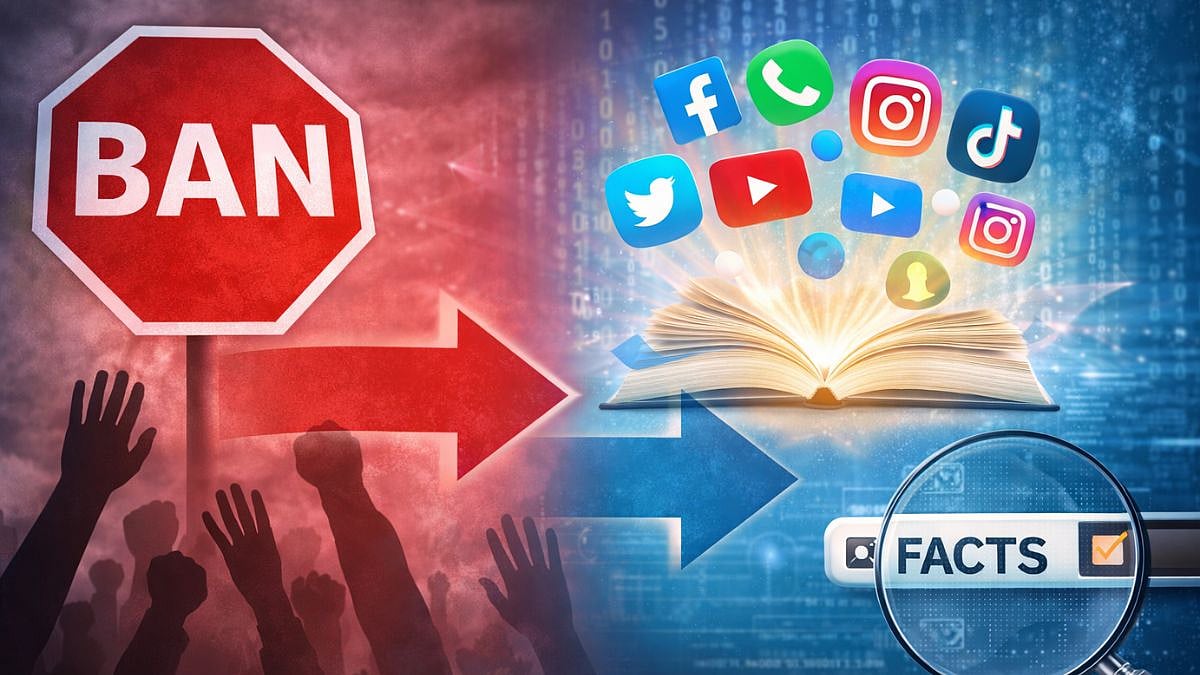
Growing calls to regulate social media highlight need to promote credible content over restrictive measures | AI Generated Representational Image
The debate over social media has entered a new phase. Karnataka's Chief Minister, in his recent budget speech, announced restrictions on social media use for children under sixteen, citing digital addiction and psychological harm from excessive online exposure. Reports indicate other states are contemplating similar measures.
These discussions aren't isolated. Globally, governments grapple with the same issues: Australia has enacted strict laws barring minors from social media, while European nations like France and the UK debate comparable policies. The concerns—mental health crises, cyberbullying, and sleep disruption—are valid and backed by studies from organisations like the Pew Research Center, which show teens spending over seven hours daily on screens.
Debate over regulation and responsibility
Anyone familiar with social networks knows the flood of forwards, unverified claims, and sensational opinions that dominate feeds. Platforms like WhatsApp and X (formerly Twitter) are often blamed for misinformation—"WhatsApp University" captures the chaos of viral hoaxes that sway elections and incite violence, as seen in India's 2020 Delhi riots.
In such a climate, calls to ban or regulate seem inevitable and politically savvy. Leaders score points by promising protection. Yet, a deeper question lingers: Is the platform the villain, or how we wield it?
Social media isn't inherently toxic. Amid torrents of trivia—cat videos, conspiracy theories, and rage bait—one finds nuggets of value: TED Talks clips, citizen journalism from conflict zones, or live ISRO rocket launches. These remind us the medium is neutral, like a knife that can cut bread or harm. Responsibility falls on users, creators, and gatekeepers.
Lessons from history
History echoes this. Gutenberg's printing press in 1440 democratized knowledge, sparking the Renaissance and Reformation. Books proliferated, literacy soared from 10% to near-universal in Europe over centuries. But it also unleashed superstition-filled pamphlets, witch-hunt propaganda, and Martin Luther's inflammatory tracts that fuelled wars. Critics decried it as Satan's tool, yet no ban ensued. The tech endured; society adapted through literacy drives and censorship laws that evolved into free speech protections.
This pattern repeats: radio spread Hitler's hate in 1930s Germany but also FDR's fireside chats uniting America. Television amplified McCarthyism yet delivered civil rights coverage that galvanised change.
Today, social media follows suit. In India, where 500 million users make it the world's largest market, platforms host NASA's black hole visuals, Nobel laureates debunking myths, and Discovery Channel reels on wildlife.
During COVID-19, ISRO shared satellite data on migrant movements, aiding relief efforts. The same Twitter that spreads rumours carries verified health updates from the ICMR.
Need to enrich digital ecosystem
The real challenge isn't banning but enriching the ecosystem. India, with two-thirds of its 1.4 billion people under 35, relies on digital gateways for news—80% of youth get info from Instagram and YouTube, per a 2024 ORF report.
Governments produce troves of public-funded content: NITI Aayog surveys, UGC research papers, and DRDO innovations. Yet these languish in silos—PDFs on obscure sites seen only by elites. A 2023 RTI revealed 70% of ministry reports garner under 1,000 views annually.
Social media offers a fix. Imagine ministries partnering with influencers for Reels explaining farm laws or climate data. Universities could run TikTok series on ancient history, making the Vedas viral. Public institutions—ISRO, IITs, ICMR—could hire young creators to translate reports into infographics.
Pilot programmes exist: the UK's NHS uses TikTok for mental health tips, reaching 1.5 million teens. In India, MyGov's Instagram experiments boosted engagement by 300%. Scaling this democratizes knowledge taxpayers fund, counters fakes with facts, and engages digital natives.
Role of educators and users
Educators and scholars must join. Rather than shunning "frivolous" platforms, they could post threads on quantum physics or election data, like physicist Sabine Hossenfelder does on YouTube. Platforms' algorithms reward quality; thoughtful content gains traction, as seen with Vsauce's 20 million subscribers teaching science playfully.
Navigating this requires discernment, like Marie Curie's radium hunt. She sifted 8 tons of pitchblende for a gram of the element, enduring burns and poverty. Social media demands similar effort: curate feeds, verify sources via Alt News or Boom Live, and seek signal amid noise. Tools like NewsGuard rate site reliability; browser extensions flag fakes.
Beyond regulation: improving content quality
Ultimately, digital culture mirrors us. If millions peddle lies, toxicity thrives—as in the 2024 US elections, flooded with deepfakes. But shared wisdom prevails elsewhere: Brazil's fact-checkers on WhatsApp curbed Bolsonaro-era misinformation. In India, the task transcends regulation and elevates use. Governments must seed quality content, not just police it. Don't shoot the messenger—arm it with better messages.
Shivaprasad Khened is a veteran science communicator and museum professional based in Mumbai.
RECENT STORIES
-
-
-
-
-