Reclaiming The Right To Protest And The Right To Public Spaces
Student protests in Mumbai reclaimed streets and public spaces as arenas for democratic participation, civic dialogue and peaceful dissent. The commentary highlights that public spaces belong to people and remain essential for holding power accountable and strengthening democracy.

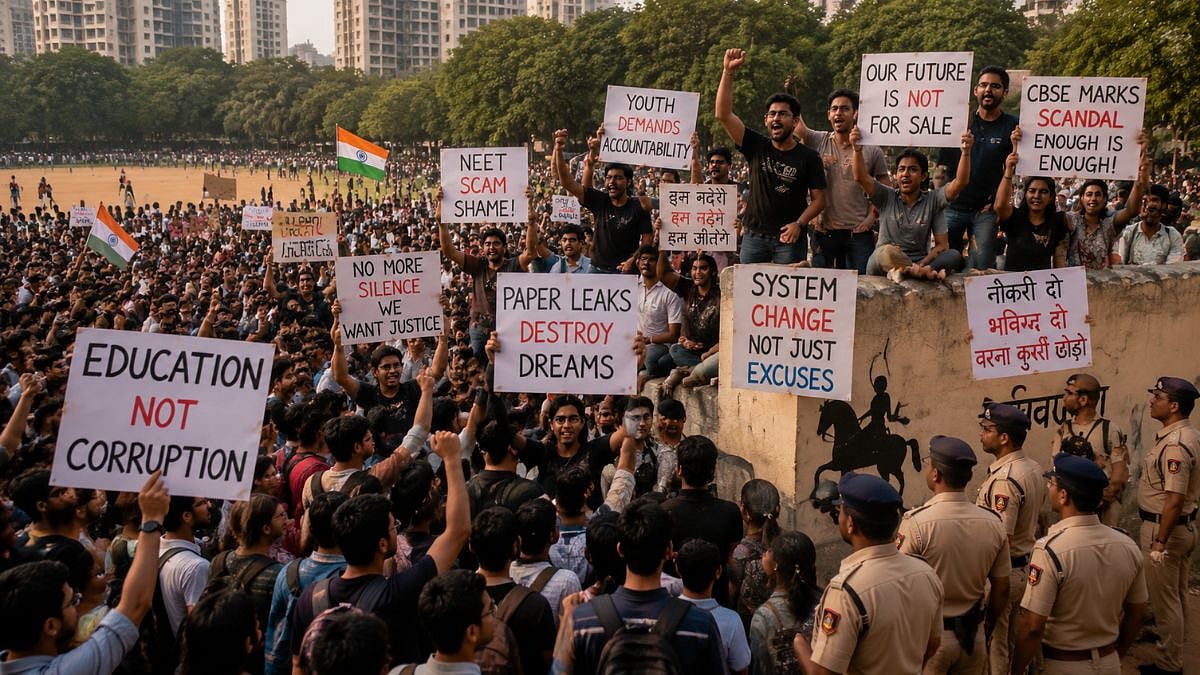
Recent student protests underscore the importance of reclaiming public spaces as arenas for democratic participation and peaceful dissent | AI Generated Representational Image
For several days last week, the usually peaceful precinct of Shivaji Park turned into a boisterous space of resistance and slogans, police action and pushback. Thousands of young people, mostly students but others too, gathered there to join the protests against the NEET exam paper leak, the CBSE marks scandal and the general rot in the education system.
The low parapet of Shivaji Park offered a view of its vast brown ground and, equally, allowed the protesters to climb over it when the lathis came down hard. For a brief while, from the vantage points of apartments rising around it, Shivaji Park looked like the crucible of a coming revolution – which it once was.
Streets outside Dadar station, parts of Gokhale Road nearby, Ambedkar Garden in Chembur East, and streets in a dozen other spots across Mumbai, including the Reay Road area, were turned quite spontaneously but purposefully into protest venues by the young.
Azad Maidan, of course, had its share of protesters, thronging and raising slogans that showed resistance, irreverence and humour in equal measure. The areas reverberated with a politics rarely seen in Mumbai in recent years, especially by the younger generations.
They mocked those in power. They demanded accountability from Union ministers responsible for the mess. They enlarged the paper leak issue to include unemployment, corruption, justice and poor governance. They focused on job creation. They made graffiti and memes that caught the imagination of even their grandparents’ generation.
They unveiled a new grammar in the language of protests, sloganeering and singing with abandon, reciting poetry and taking selfies, and leveraging social media like it had not been done in a while, even as they countered lathis, detentions and FIRs. Complete strangers found solidarity and purpose, a community all their own.
Public Spaces As Democratic Arenas
As they mocked and laughed at those in power, their ridicule shredding the curtains of fear that had come to envelop us all, especially in public spaces, the protesters quietly hammered home that a city’s open spaces and streets are, indeed, significant sites of protests and fulfil an important function in urban life and politics in ways that private spaces simply cannot. Unintentionally, the protesters in Mumbai, as in Delhi’s Jantar Mantar and in other cities, reminded us of social theorist Jürgen Habermas’ significance of the ‘public sphere’.
In his construction, the public sphere belongs not to the state, the economy or the family but is a space where private individuals come together to communicate about matters of general concern, where the public locates reason, and where ‘public opinion’ is formed.
Though it began as a bourgeois space, it was democratised by people who occupied it and used it to speak to power. In the making and remaking of Mumbai, the public sphere has come to be downgraded to leftover spaces after important constructions are done or shrunk to the bare minimum.
Nearly 45 years after Habermas’ theory, in 2008, anthropologist James Holston argued in Spaces of Insurgent Citizenship that “…one of the most urgent problems in planning and architectural theory today is the need to develop a different social imagination—one that is not modernist but that nevertheless reinvents modernism’s activist commitments to the invention of society and the construction of the state.” The protesters, whether any of them read sociology in college or not, had begun to articulate “a different social imagination” of the country and the society of their future.
Shrinking Space For Protest
Precisely because the collective, the coming together of so many diverse people and strangers united in a cause, threatens those in power, cities have seen an increasing curb on the public sphere, especially those used as protest spaces. Instead, there are now designated spaces for protests, with timings set out during which protesters are willy-nilly welcomed. But open spaces and streets where protesters make common cause with passers-by—a socio-political awakening, as it were—are frowned upon.
In Delhi, movements are largely limited to Jantar Mantar; no one in power can risk another ‘Shaheen Bagh’ occupying streets to loudly resist the government or wants demonstrators congregating at the iconic India Gate. In Mumbai, the last 10–15 years have seen protesters pushed back from the Mantralaya, the seat of the government that they once gheraoed; barred from Kala Ghoda when its identity was reduced to that of an art district; and turned away from Hutatma Chowk too—some by the activism of elite citizens’ groups and the rest by court orders. Confined to corners of Azad Maidan, which too has been carved up for various projects, protesters can hardly be seen or heard any more.
Reclaiming The City
The semi-spontaneous outpouring at Shivaji Park, at Ambedkar Garden and on more than half a dozen streets of Mumbai broke this mould. Protesters reclaimed public spaces as their own, articulated their demands, and laughed and sang as members of a transient community.
The significance is not small, given that the city is being frenetically rebuilt top-down by partisan governments and private capital, leaving little space for a community to take shape and hold its own, however briefly. Their imagination of the city is a set of tall towers in gated complexes, some far more luxurious than others, connected by mega-expensive freeways and flyovers.
By nonchalantly claiming and reclaiming the public spaces they did, with or without police permission, protesters showed up the utter lack of social imagination in this form of city-making. Equally, they emphasised that public spaces belong to people and will be used to make issues visible, to openly challenge or mock power, because resistance and protests are intrinsic to democracy.
Mumbai has seen momentous protests in history pouring out into its streets, onto railway tracks and into maidans, including Shivaji Park. The young showed that the history has not been totally erased by neoliberal city-making.
Smruti Koppikar, an award-winning senior journalist and urban chronicler, writes extensively on cities, development, gender and the media. She is the Founder Editor of the award-winning online journal Question of Cities and can be reached at smruti@questionofcities.org.
RECENT STORIES
-
-
-
-
-