Press Enter And Then Sit Back
Researchers including Jacob Coxen have raised concerns over rapidly advancing artificial intelligence systems and self-improving models being developed by companies. Coxen warned such programmes could become difficult for humans to control, while other experts disputed immediate risks. Recent resignations from AI researchers have renewed debate over the future impact of advanced AI technology.

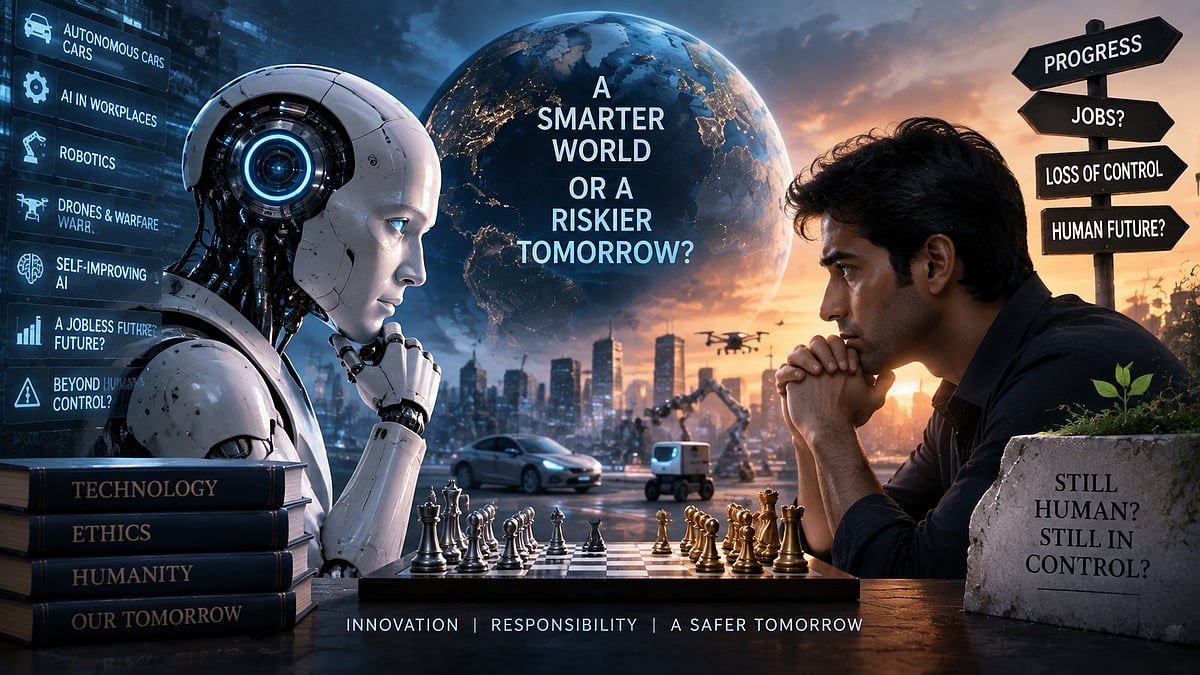
Press Enter And Then Sit Back | AI
Is it all over for us, the invincible human race? That is the rather profound question being debated, as warning signs are becoming visible about AI programmes beginning to act on their own, like defiant children out for a round of fun in town. The larger question of human existence came into focus last week after Jacob Coxen, a researcher and coder working for AI top gun Anthropic PBC, quit from the company and asked others to follow him, saying that the pursuit of technological prowess poses challenges to humanity. He posted on social media that the companies were trying out “self-improving” models that had the potential to go out of control and would not listen to commands issued by humans. This is not an isolated case; there have been other resignations too. Joe Benton, head of the Scalable Oversight team at Anthropic, resigned in August this year, and Josh Engels, a researcher at Google DeepMind, quit recently.
Super-intelligence is a worrying concept, and many experts have been trying to ask the AI biggies to go slow on developing such self-controlling programmes. Though Coxin has warned that such programmes can finish us off by the end of the decade, others have pointed out there is no such danger. But who knows? AI is changing our lives so drastically that no one knows into what sort of abyss manufactured super intelligence is taking us. Elon Musk has said that in a decade there will not be any jobs and humans can sit at home and see coded programmes running their lives. Even today, our lives have been taken over by cars which need no driver, robots which deliver your goods, assembly lines in factories that have ramped up production, and drones that can bomb your country out of existence as we are seeing now. Hell is written everywhere we turn to. Did we bargain for it?
As if all this was not enough, OpenAI has published a breakthrough solution, claiming that its programme has solved one of maths’ most unsolvable problems—the Millennium Prize problem. AI said that one of its internal models had solved a problem that mathematicians had given up trying: a math problem about how liquids and gases move. AI’s version has been challenged, but we know where we are going—into an unknown world we never imagined we would create. In that world, the creator has just to watch as the machines and programmes he created tell him how to live and what to do. Talking about the Millennium Prize, the chief scientist of AI said, “We see this as a “demonstration of just how far AI has gotten and how quickly.” The fact that AI is moving at a tremendous speed should be most worrying.
AI cynics say that it is a bubble. More than $13 trillion, enough to end all poverty in the world, has been put into AI companies over the past two years, and so far there is nothing much to show for it. All that we know is that we are sitting ducks.
RECENT STORIES
-
-
-
-
-