Opposition Needs To Unite Against The Hindutva Onslaught
BJP’s expanding dominance after recent Assembly elections highlights growing challenges for opposition parties. It underscores the need for unity among regional and national players amid shifting voter trends and evolving political narratives ahead of 2029.

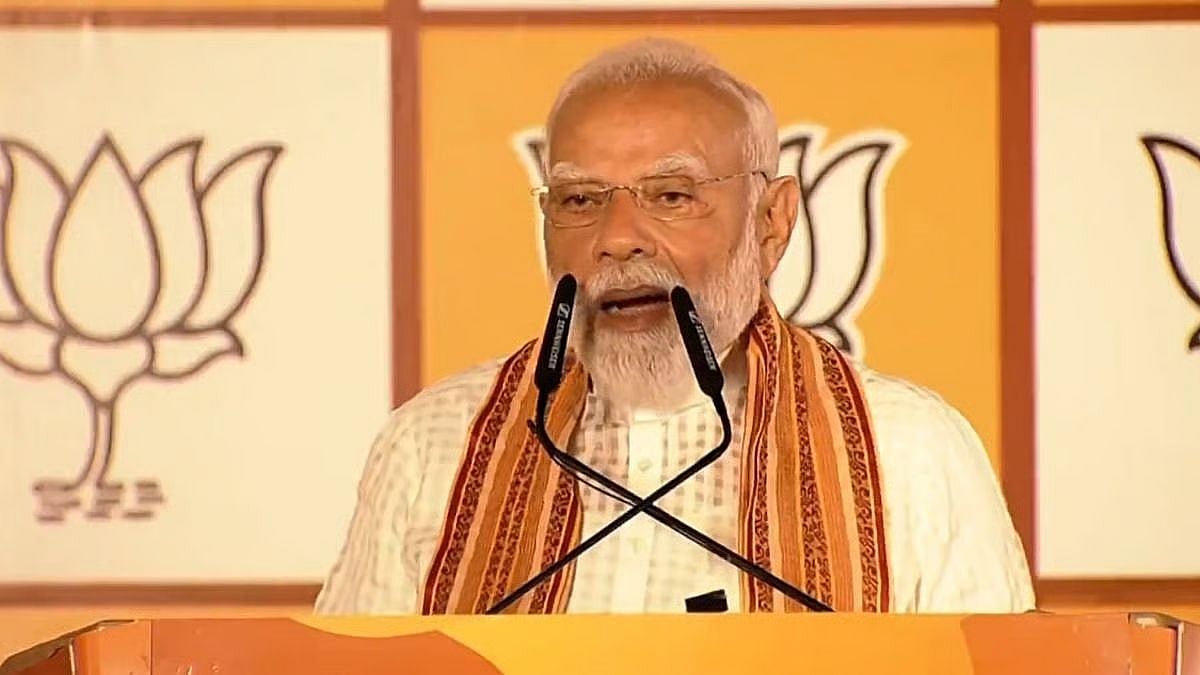
PM Modi | X @narendramodi
The results of the Assembly elections in five states are a warning signal for regional parties and regional identities. It clearly establishes that the march of Hindutva seems to be unstoppable, at least in state elections. MK Stalin and Mamata Banerjee are the two most important spokespersons of regional identities, and in these elections, they tried to evoke regional sentiment to the maximum, but the results tell a different story: they did not cut ice with voters.
Whether this hints at a larger paradigm shift in Indian politics is yet to be seen, but it surely proves that the setback which Hindutva suffered in 2024 was a temporary phenomenon, and if Congress-led secular forces have to reclaim their ground for 2029, then they have to go to the drawing board and redraw a new narrative and a new strategy.
DMK setback and emergence of Vijay
The biggest upset in this electoral contest is the DMK, a cadre-based party with a grand history of electoral success. It was the DMK that demolished the national party, the Congress, in the 1960s, and since then, Congress has never recovered; politics has since revolved around the two Dravidian parties. In this context, the emergence of superstar Vijay is nothing short of a miracle.
After the massive victory of NT Ramarao in united Andhra Pradesh in the 1980s, when he first contested elections and demolished a colossus like Congress, history has repeated itself. Like NTR, Vijay is also a great phenomenon.
This indicates that Tamil Nadu is tired of traditional politics and is looking for an alternative in a greenhorn. What is most surprising is that it is not AIADMK but the DMK that is losing to Vijay. It is the DMK voters who have majorly shifted their allegiance from Stalin to Vijay.
Mamata Banerjee’s defeat and Bengal dynamics
Similarly, Mamata Banerjee's defeat in Bengal is not a good sign for secular politics. In this election, Mamata Banerjee tried to raise the bogey of Bengali identity to counter the BJP’s Hindutva. But she failed. Though she might have complaints that the BJP did not leave a stone unturned to win the election, she might have enough reasons for cribbing about the massive deployment of CAPF in every corner of the state; deletion of 27 lakh votes due to logical discrepancy, which was frowned upon even by the Supreme Court; the arrest of the TMC poll management team’s (IPAC) director a week before the polling and his surprise release just after the second phase of polling; and the unprecedented transfer of more than four hundred senior officers, including the chief secretary, DGP, and home secretary of the state. But the reality is that the TMC has lost its only bastion, and Mamata has no other option but to accept the people’s verdict.
Hindutva’s expansion in key states
The Bengal election is a special milestone in Hindutva’s march. For the RSS, three states, Jammu & Kashmir, Assam, and Bengal, have been a matter of great concern for the RSS/BJP due to a substantial Muslim population. J&K is the only state where Muslims are in the majority. In Assam, Muslims comprise more than 35% of the population, and in Bengal, the figure is almost 28%.
The RSS has resented the fact that Muslims control the levers of power in Assam and Bengal, though Hindus are in the majority. From a national security point of view, the RSS also thinks the presence of such a large number of Muslims in a border state is not good for the country. The BJP has always raised the issue of infiltration from Bangladesh, and in this election too, it has made infiltration a major poll plank.
Amit Shah has promised that if the BJP forms a government in Bengal, then Bangladeshi infiltrators, or ghuspaithias, will be detected, deleted, and deported. Now, the BJP is in the government in both states. And in a way, if electorally the BJP has successfully neutralised Muslims, then ideologically, the RSS has, to a large extent, crossed a historical milestone for the Hindu unity project.
BJP consolidation in Assam and Bengal
If Bengal was the last frontier for the BJP/RSS to win, then winning Assam a third time in a row is an indication of the consolidation of its Hindu unity project. In both states, the BJP had a negligible presence before Modi became the prime minister. In Assam, it piggybacked on the Assam Gan Parishad (AGP) for a very long time, but now it is a massive force. Similarly, in Bengal, the BJP piggybacked on Mamata to carve its niche in the state.
Mamata was with the BJP once she split from Congress in the 1990s. She was also a minister in the Vajpayee government. But once Modi came to power in Delhi, the dynamics of power changed, and in 2019, the BJP surprised everyone by garnering 40.25% of the vote and winning 18 parliamentary seats. And now the BJP has decimated the TMC. This also speaks of the BJP’s smart politics and how it uses regional parties to establish and, ultimately, entrench itself in the power structure.
Opposition’s path forward
Kerala can be a consolation prize for the Opposition. Congress made a comeback in the state after ten years, though it had swept the last two Lok Sabha elections. Still, with the massive defeat of secular forces in Assam and Bengal, opposition parties have to rethink their strategy. They have to reinvent themselves.
Also, they have to realise that divided, they will never be in a position to fight successfully; they have to realise that the BJP is not an ordinary party, it is a party with a killer instinct, with an infinite hunger for victory, and always willing to walk the extra mile to win. Unity of the opposition parties is the only way forward if they dream of defeating the BJP and the march of Hindutva. Will they learn a lesson? That is a million-dollar question.
The writer is Co-Founder, SatyaHindi.com, and author of Hindu Rashtra. He tweets at @ashutosh83B
Published on: Monday, May 04, 2026, 09:43 PM ISTRECENT STORIES
-
-
-
-
-