Nature, And Disasters, Know No Political Boundaries
An opinion article examines Nepal’s devastating floods and argues that Himalayan nations need stronger climate cooperation. It says shared river basins across China, Nepal, India, Pakistan and Bangladesh require better warning systems and data sharing.

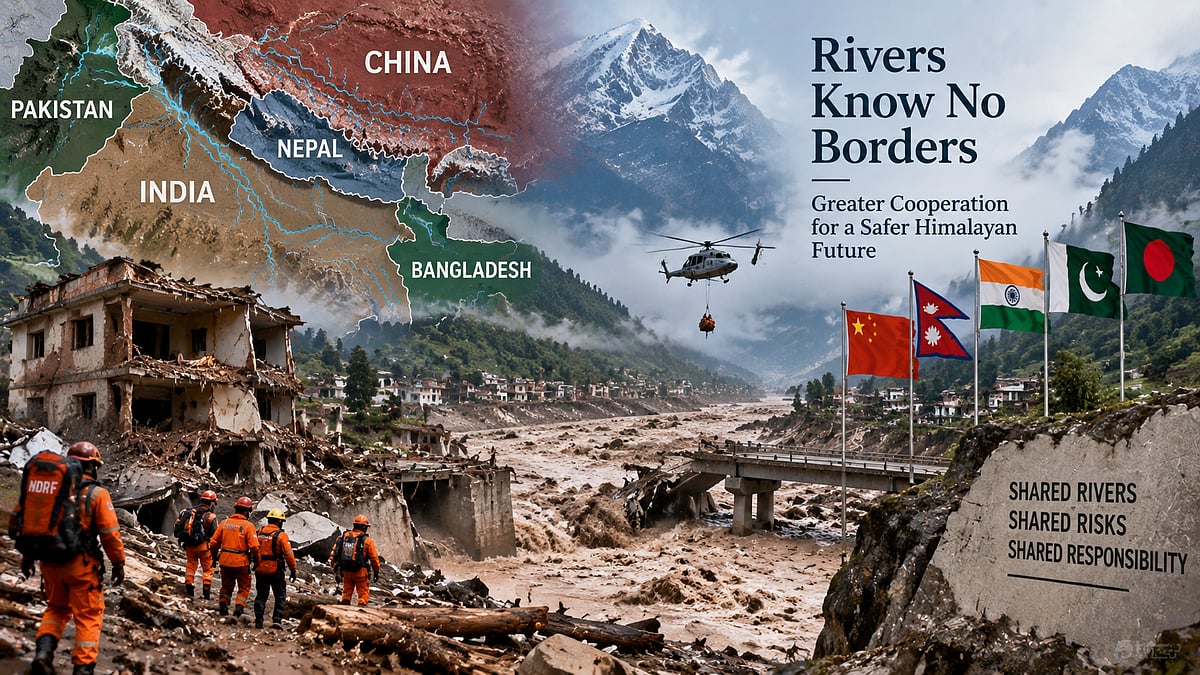
Nature, And Disasters, Know No Political Boundaries | AI
Nepal’s catastrophic floods have proved once again that nature knows no political boundaries. The Hindu Kush-Himalayan mountains comprise one large mountain chain, extending across Pakistan, Nepal, China, and India. The rivers that emanate from these mountains, too, do not recognise borders.
Five South Asian nations—China, Nepal, India, Pakistan, and Bangladesh—share common river basins. If anything happens in the upper catchment areas of these rivers, the middle and lower catchment areas will be affected adversely. Sadly, there is little climate diplomacy between these five nations at a time when climate change requires joint adaptation and mitigation steps be taken on a war footing across these nations. This lack of communication and their inability to set up joint early warning alert systems have triggered Nepal’s worst floods in decades, which have left over 1000 people dead and over 5000 missing.
News reports show that on August 26, 2026, a large chunk of ice from an avalanche obstructed the flow of the River Lhende, which emanates from Tibet and flows into Nepal. This obstruction remained unreported from the Chinese end for several hours. It was this obstruction that transformed into a flash flood of such velocity that it destroyed 12 hydropower plants on the Trishuli River, generating 430 megawatts of electricity. Within minutes, the surge of mud and rock and debris destroyed homes, bridges, and dams. Nearly 30,000 homes across almost half of the country have been destroyed, and in some areas up to 80 per cent of the crops have been lost.
Prof. Vimal Khawas, from the Special Centre for the Study of Northeast India at JNU, states, “The trigger for the flood was definitely natural, but the damage that it caused was human-made. It was China's duty to monitor and inform the downstream counterparts, which it did not.”
Politicians need to realise that climate change has destabilised the entire Himalayan region, driving rapid glacial retreat and erratic monsoons, which are resulting in disasters. India has witnessed several major flash flood incidents, including the Kedarnath tragedy in 2013, the Chamoli disaster in 2021, the Sikkim lake burst in 2023, and the tragedy in Dharali in Uttarakhand in 2025. These catastrophes have resulted in the loss of thousands of lives and caused damage running into millions of rupees.
There are apprehensions that China, too, has faced considerable losses, with the Tibetan prime minister-in-exile claiming in a television interview that over 100 Tibetans living on the Chinese side lost their lives in these flash floods.
Unfortunately, China shut down its internet service in Tibet on August 27, and, therefore, little information is emanating from that region. But there is little doubt that a tremendous amount of infrastructural construction is going on across all these countries in this ecologically fragile Himalayan zone. China is expanding its road construction and transport corridors and is building a rail link to Nepal and also constructing large hydropower projects here. Information about these projects in China is not in the public domain. Nepal has focused on the construction of hydropower projects, road construction, and other developmental projects in this ecologically sensitive area. India, despite several warnings from scientists, is also building a series of hydropower projects, dams, and a rail link on their side of the Himalayas. Deforestation and heavy dynamiting have resulted in the destabilisation of slopes, leading to land subsidence and a huge increase in landslides.
The pressure of extracting natural resources in these mountain regions has led to an indiscriminate increase in sand mining along these rivers. A marked increase in vehicular movement has seen a rise in temperatures in the Himalayas.
The melting of glaciers has other fallouts, including the increase in glacial lakes. Satellite images from the ISRO have shown that there are 2,431 glacial lakes in the Indian Himalayas, many of which can overflow at any time. Scientists have warned that there are 21 glacial lakes in Nepal which are ticking time bombs capable of breaking their moraine walls and sending a wall of water, rock, and ice down the valleys below. Environmental experts confirm over 25 glacial lakes on the Chinese side that could directly affect Nepal and the wider region.
Beijing’s approach to sharing hydrological data has been largely transactional. From 2022, China stopped sharing crucial hydrological data with India. This data is key for India’s flood forecasting and water management, especially concerning the Brahmaputra and Sutlej rivers, which originate in China and flow into India. India, too, has been accused by Pakistan of using ‘water as a weapon’. Its decision to hold the Indus Water Treaty in abeyance, following the militant attack in Pahalgam last year, is controversial to say the least, as it will hold millions of people living downstream at ransom.
China’s decision to build three massive dams on the Indus and Brahmaputra rivers is viewed with increasing alarm by ecologists. The Bhasha and Bunji dams are being built on the Indus River in Gilgit-Baltistan. It is also building the world’s largest dam on the lower reaches of the Yarlung Tsangpo River, known as the Brahmaputra River in India. The latter dam will be located just 30 km from the Indian border, thereby increasing their water control leverage over us.
The environmental impact of these hydro projects has not been placed in the public domain. Environmental activist Himanshu Thakkar, a specialist in the study of dams, pointed out, "Large dams change the microclimate of a region. Both the Bhasha and Bunji Dams are much larger than any existing dam in India. In fact, the entire installed hydropower project in Jammu and Kashmir does not equal even the Bhasha Dam, which is the smaller of these two dams. We are still to study just how close India is to the submergence area of these dams because if the river is in flood, then the backwater impact of these dams can come to India.” The impact of the dam on the Brahmaputra is still to be fully assessed.
Massive construction along the flood plains of our rivers across this region has also increased our disaster risk, as was seen in the Nepal catastrophe last month. The fact is that the pace of climate change is far outstripping institutional preparedness. It is imperative, therefore, for these South Asian nations to put aside their political differences and come together to form joint information-sharing protocols. Real-time satellite data must be supported by high-altitude seismic sensors.
We need to create joint ecological research organisations that can do continuous risk mapping and hazard assessments. But most important, it is time that our politicians heed the warnings of our scientific community to ensure we move away from this disaster-prone “developmental” model that is all set to destroy the Himalayas and, along with it, our crucial source of headwaters.
Rashme Sehgal is an author and an independent journalist.
RECENT STORIES
-
-
-
-
-