National Symbols Must Unite, Not Divide The People
The Supreme Court has said citizens cannot face criminal prosecution merely for choosing not to sing Vande Mataram, invoking the constitutional principle established in the Bijoe Emmanuel case. The ruling distinguishes respect for national symbols from compelled participation and has renewed debate over freedom of conscience and patriotic expression.

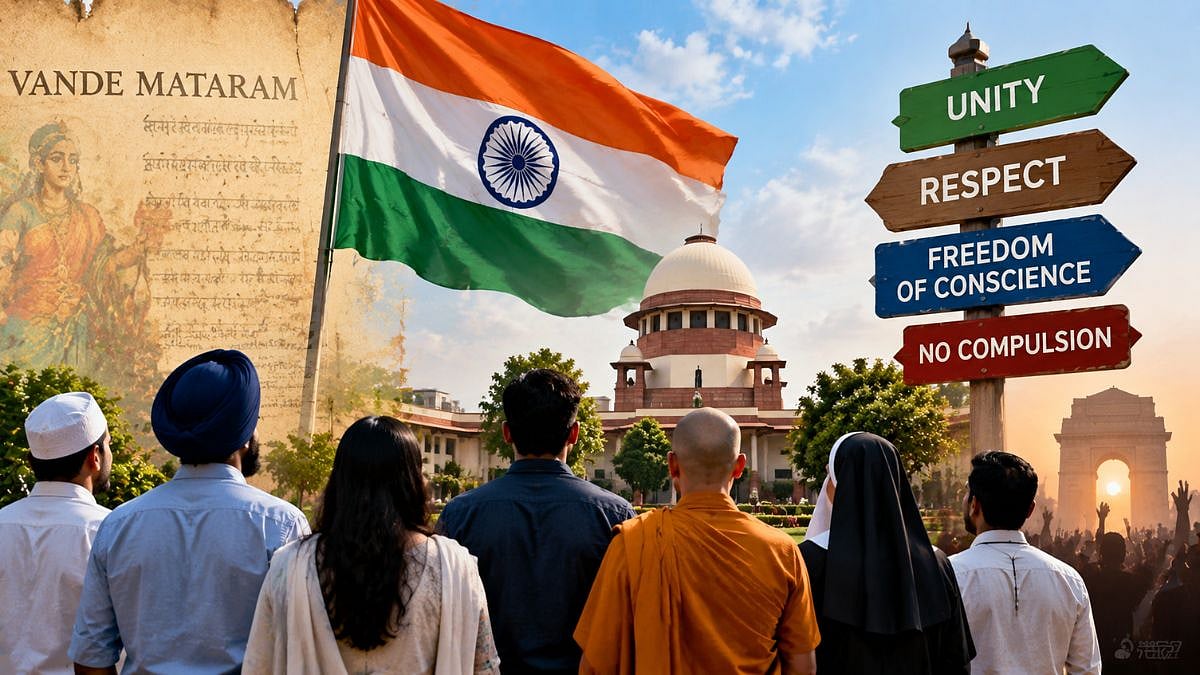
The Supreme Court has examined the balance between national-symbol protocols and citizens' freedom of conscience | AI Generated Representational Image
The Supreme Court has sent an important constitutional message: patriotism cannot be enforced by penalising a person for exercising freedom of conscience. A three-member Bench headed by Chief Justice Surya Kant has observed that those who do not sing Vande Mataram, in whole or in part, should not face criminal prosecution or punishment merely because of their refusal.
The court has drawn upon the principle laid down in the landmark Bijoe Emmanuel case. That case concerned three children belonging to the Jehovah’s Witness faith who declined to sing Jana Gana Mana because their religious convictions prevented them from singing praises to anyone other than God. They were expelled from school.
The Supreme Court came to their rescue because the children had not shown disrespect to the national anthem. They stood respectfully while it was being sung. The judgment established an enduring principle: respect for a national symbol and participation in singing it are not necessarily the same thing.
Vande Mataram And Conscience
The same distinction is relevant to Vande Mataram. The song occupies an honoured place in India’s freedom struggle. Its opening words inspired generations of freedom fighters. But there have also been longstanding reservations about some of its later stanzas, particularly among people whose religious beliefs make certain imagery difficult to accept.
National leaders recognised this problem. Mahatma Gandhi, Subhas Chandra Bose, Sardar Patel, and Rabindranath Tagore were associated with the acceptance or public use of selected portions rather than insisting that the entire poem be sung on every occasion. For more than 75 years, India has lived with this understanding.
The heavens have not fallen because only the accepted portion was sung at public functions. The present controversy, therefore, is not merely about a song. It is about whether the state should turn a national symbol into an instrument of compulsion. The government can prescribe protocols for national symbols, but those protocols cannot override constitutionally protected freedom of conscience.
National Symbols And Unity
There is also a political lesson. National symbols are meant to unite citizens, not become tests by which the loyalty of particular communities is measured. Those who demand compulsory singing should remember that patriotism is not demonstrated by forcing another citizen to make a declaration against his or her conscience.
The political temptation to equate dissent with disloyalty is precisely what constitutional democracy must resist. Governments and political majorities change; fundamental rights are intended to endure. Vande Mataram can remain an honoured symbol of India’s freedom struggle without becoming a compulsory declaration of patriotism.
Indeed, the Supreme Court’s intervention makes a larger point: a confident nation does not need to criminalise conscientious dissent. Patriotism loses its meaning when it is demanded by the state rather than freely expressed by the citizen.
RECENT STORIES
-
-
-
-
-