Narendrabhai@25: A Karmayogi Who Is Unafraid Of Rocking The Boat
Prime Minister Narendra Modi’s 25 years in public service have been shaped by major political and policy decisions, including Article 370, the Ram Temple, UCC, SIR, COVID-19 management, foreign policy and defence production, reflecting his willingness to challenge the status quo.

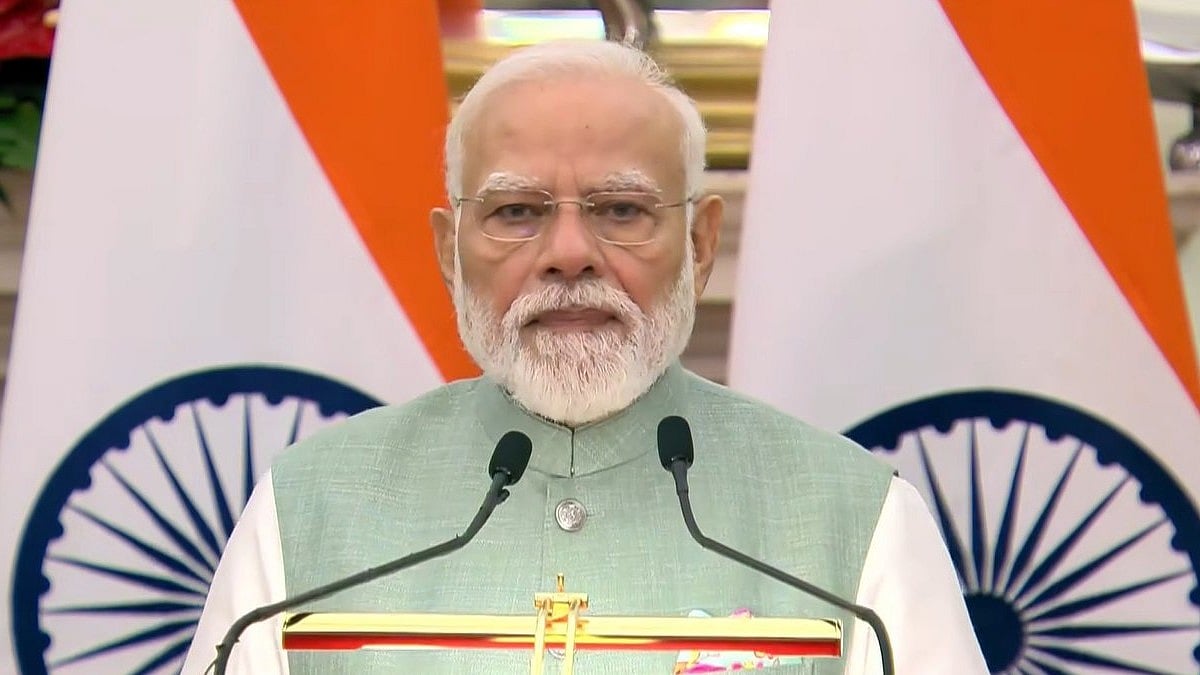
Narendra Modi's 25-year public life is examined through his political journey, policy decisions and approach to challenging the status quo | File Photo
Two back-to-back achievements—the longest-elected Prime Minister of India and completion of 25 years of distinguished, selfless service to the nation, including 13 years as the chief minister of Gujarat. That is Narendra Modi for you. He must have been a thinking person even while hawking chai on the platforms of Vadnagar railway station because the decision to become a pracharak of the RSS couldn’t have come overnight. In that role, he travelled far and wide in the country and became well-versed with its geography, diverse culture, and economics. He also acquired the gift of the gab and an oratorial ability to keep multitudes enthralled, regaling them with witticisms as well as impending crises.
Rocking The Political Boat
While his stewardship of Gujarat was indeed his launching pad for national politics as well as geopolitics, it is his role as the Prime Minister of a complex nation that has won him plaudits both nationally and internationally. Even his detractors admit that his quality of head and heart, more than anything else, is his fearlessness in rocking the boat, the shibboleths, and challenging the status quo. His party, the BJP, as well as the ideological parent, the RSS, has had three articles of faith—abolition of special status for Jammu and Kashmir (J&K) enshrined in Article 370 of the Indian Constitution, construction of a glorious Shri Ram temple in his birthplace at Ayodhya, UP, and ushering in the Uniform Civil Code (UCC) for the nation.
All three remained unfulfilled for long, but August 5, 2019, marked the beginning of the Modi government showing its steely resolve to walk the talk. Amit Shah, the able home minister of India, announced in the Lok Sabha that he was introducing a constitutional amendment bill to abolish the special status available to J&K. It was an anachronism. How could one state enjoy privileges and entitlements not available to citizens in other states? The oddity of the many laws enacted by the Parliament contained a preamble that the law, while extending to the whole of India, didn’t extend to J&K. Shah and Modi spared the nation and the lawmakers the blushes. Next was the inauguration of the grand Ram Mandir at his birthplace in Ayodhya on January 22, 2024. A nation whose soul was throttled by the pusillanimity in not rocking the boat of the Muslim brothers and sisters at last heaved a sigh of happiness and relief.
Uniform Civil Code Push
The UCC is a work in progress, with the BJP-ruled states choosing to implement it. It is not as if the Modi government has been letting grass grow under its feet on this seminal issue. The legislative ban on triple talaq, a monstrosity against Muslim women that has already been banned in a number of quintessentially Islamic nations, was not done in India for fear of incurring the wrath of fundamentalists and pseudo-secularists. That indeed was the first step in heralding the beginning of the UCC. The second was the Waqf Act 2025, which ended the special property rights of the Waqf boards to bring it in line with the national law. When crimes are punished uniformly no matter what the religion of the perpetrator is, how can there be double standards on civil matters?
Debate Over Voter Revision
The much-maligned Special Intensive Revision (SIR) of the voter list was undertaken by the Modi government, but with a free hand given to the Election Commission of India (ECI). The SIR had been kept in abeyance for decades and brooked no delay, given the fact that electoral rolls need periodic spring cleaning. In a country where the Aadhaar card is available for the asking, one cannot set up store by it as clinching evidence of one’s citizenship. Only citizens enjoy voting rights. In the US, green-card holders cannot vote even though they are allowed permanent residence in that country. Likewise, Aadhaar is not proof of citizenship. In the absence of a national registry of citizens (NRC), the SIR has become a necessity which the Opposition is opposing for reasons of realpolitik.
Security And Public Health
Modi and Shah covered themselves with glory a few months ago by ending the Naxal menace. On a lighter note, and as an aside, it may be said that they would do well to end the street dog menace too, on which the Supreme Court itself is in two minds. In the entire US, which has twice the area of India, you won’t find a single street dog.
On the health front, the Covid disease that rocked the entire world was managed well with Prime Minister Modi leading from the front. Three rounds of vaccinations were completed on a war footing. In geopolitics, too, India gets ensnared willy-nilly. India walks on the proverbial eggshells by being pally with both Russia and the USA. The latter wants India to abandon its time-tested friend Russia for waging war on Ukraine, but India continues to buy crude oil from both Russia and Venezuela, the client state of the US.
Defence And Foreign Policy
On Pakistan, Modi warmed the cockles of the nation by hitting it back with carpet bombing of its terror infrastructure to avenge the deaths of Pahalgam innocents whose wives were widowed with sinister intents by the actual and proxy rulers of Pakistan. He announced a change of tack—the attack on India by its terrorists will be deemed an attack on India by the Pakistani establishment, thereby ending the wiggle room with which the Pakistani establishment mocked us earlier.
On the defence front, we have started exporting arms and ammunition, as opposed to the large-scale imports of even basic arms and ammunition earlier, which gave a lot of scope for over-invoicing along with the sugary prospects of kickbacks being deposited in dubious, secretively numbered foreign bank accounts.
S Murlidharan is a freelance columnist and writes on economics, business, legal and taxation issues.
RECENT STORIES
-
-
-
-
-