Mumbaikars Rise For Ecology, But Are Authorities Listening?
Across Mumbai, citizens and activists are increasingly mobilising to protect mangroves, forests and open spaces from large infrastructure projects. From the Versova–Bhayander coastal road to SGNP and Aarey, residents are raising concerns about ecological damage and questioning whether authorities are listening.

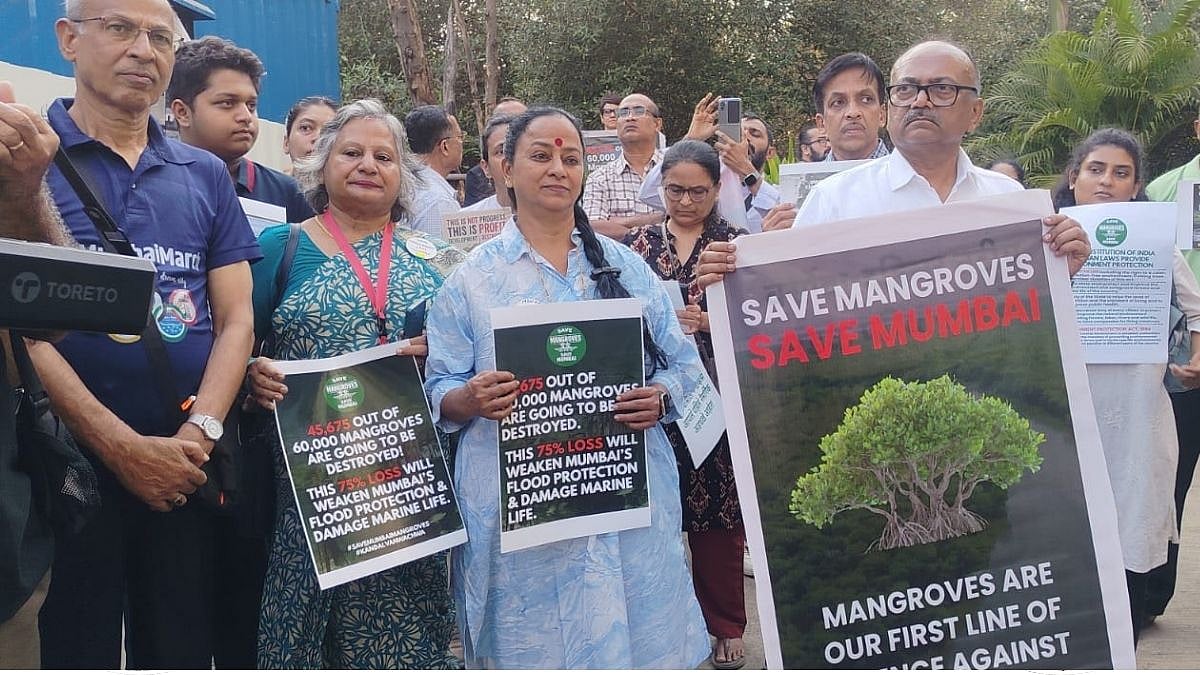
Environmental activists and residents march at Charkop in Kandivali West opposing the cutting of mangroves for the Versova–Bhayandar Link Road project | File Photo
Groups of people across Mumbai, united by nothing other than their desire to give of themselves to protect ecology in the city, have been challenging the authorities for a while now. It is easy to miss these campaigns and actions. Each issue generates its own energy, each story gets reported or told in its own space, and each set of people are forced to focus on one or another.
But what is unfolding across the city is perhaps unprecedented—people of different persuasions and armed with different skills have been standing up to the authorities to save mangroves, the Mahalaxmi Racecourse, the Sanjay Gandhi National Park and its hills, the Aarey forests, and more.
A growing pattern of citizen resistance
Connect the dots. What emerges is a picture of determined resistance by Mumbaikars against the onslaught that the authorities—the Brihanmumbai Municipal Corporation and the state government—have been making on the city’s ecology.
Of course, it is always peddled in the name of ‘development’, and ecologically damaging exclusive infrastructure is tagged as ‘public projects’. The authorities, who should have acted as the custodians and guardians of the city’s ecology, seem hell-bent on ruining it. But people have found it in themselves to stand firm, to challenge the authorities, and to persist in their resistance.
Citizens bringing different skills to the fight
Those who know the law are willing to educate others; those who have professional expertise have decoded project documents and drafted letters to the authorities, including Chief Minister Devendra Fadnavis; those who have protested earlier are guiding the rest; those who are creative have written and recorded songs; those in the area have been keeping a close watch and sharing photos or videos to alert the authorities.
Mumbaikars, pressed for time as we tend to be, have been speaking up for the city’s ecology—in letters, in petitions, in court cases, and with boots on the ground too.
Mangroves under threat in Charkop
Charkop, in Kandivali, is an example. In the past few days, it has seen the noise of machines attacking the mangroves and trees, the thuds of the decimated greens, and the frenzied cacophony of the displaced birds. This should be heart-rending to each one of us, not just environmentalists.
The mangroves, among 45,675 of the 60,000 in the Versova–Bhayander belt, are earmarked for felling; at least 9,000 will be permanently damaged, and compensatory afforestation will be done in the faraway Chandrapur district.
The official documents helpfully inform that there will be a ‘diversion’ of a total of 103.65 hectares of forest land, including the mangroves. Why? Only so that the Versova to Bhayander coastal road can be built to reduce travel time from the present 75 minutes to about 20 minutes.
Questions over the real cost of ‘development’
In a city where highways, including the Western Express Highway connecting these two areas, are gridlocked, resulting in fuel wastage and emissions, any reduction in travel distance or time would be welcome.
But is it not prudent to consider the comprehensive cost, which includes the ecological impact of slashing mangroves that guard the city’s coast? Should we not ask how many, and who, it will really benefit?
The 22.84-kilometre six- or eight-lane road is projected to carry 62,000 cars a day, according to official documents, but this may be an overstretch because there is little data on the current Passenger Car Unit (PCU) metric for this section.
Bear in mind that the BMC’s own Comprehensive Mobility Plan tells us that only 10.9 per cent of Mumbaikars use private vehicles—only a small percentage of these would be travelling from Versova to Bhayander.
Real estate gains versus ecological loss
This set might be excited. The real estate lobby already is; a leading platform has been excitedly claiming that ‘the North is moving South’ and points to an increase of 10–15 per cent in property prices in the Charkop–Kandivali–Malad belt. This is being called the ‘coastal premium’.
But Mumbai’s ecological warriors are unwilling to let all this go unchallenged. From approaching the Bombay High Court, which ironically allowed the felling of the mangroves, to protests on the ground at Charkop and other sites, they have been resisting.
Citizen groups organising resistance
The ‘Save Mangroves Group’, with over 1,000 members, is abuzz through the day and night with ideas as well as clear instructions on how to register objections at the official level, where to meet and protest, how to share information and so on.
They have converged at the mangrove cutting sites and, in an admirable manner, managed to stall or resist the private company and BMC officials. The cause is on social media platforms; the mainstream media has given it some attention too.
Protecting SGNP and Aarey
Like them, Mumbaikars of different persuasions and passions, not necessarily professional environmental activists, have taken up cudgels for one ecological cause or another.
A committed group has been working to protect the Sanjay Gandhi National Park (SGNP) from being opened to construction and development, including eco-tourism facilities in two of its three eco-sensitive zones that form the buffer between the noisy, polluted city and the forest. It has challenged the BMC for its Draft Zonal Plan, attending public participation meetings armed with data.
Another group has been keeping watch over the Aarey area, where more than 2,200 trees were slashed in the dark of a night in 2019 to enable the construction of the car shed of Metro 3.
Lessons from past infrastructure projects
This underground marvel, at a price tag of Rs 37,000 crore, has shown far lower footfalls than projected. As does the Bandra–Worli Sea Link, inaugurated in 2009.
Groups of people have been keeping watch these past few nights for fires that were seen atop the SGNP hills from Powai to Thane and have sprung into action to record and resist.
Architects raise concerns over racecourse plan
Yet another group, the Mumbai Architects Collective, with more than 100 professional planners and architects in its fold, wrote to municipal commissioner Bhushan Gagrani and Chief Minister Fadnavis, protesting—with detailed explanations—the planned redevelopment of the Mahalaxmi Racecourse into a Central Park with underground parking facilities.
The area above the parking facility, they said, would be a concrete slab and would greatly impact rainwater absorption, groundwater recharge and flood mitigation. This is elementary, but it had to be pointed out.
Questions over forest clearances
The mangrove felling for the Versova–Bhayander coastal road, the activists keep repeating, does not have the required clearances; only Stage 1 forest clearance has been given but not the critical Stage 2.
The game seems clear: slash the mangroves before it comes through so that it’s a fait accompli.
Will the authorities listen?
Often, from this side of the picket line, on the larger canvas of the development-driven government, these actions appear futile. But each one shows that Mumbaikars will not take the ecological assault lying down.
Who said Mumbai does not protest? The question is, are the authorities listening?
Smruti Koppikar, an award-winning senior journalist and urban chronicler, writes extensively on cities, development, gender and the media. She is the Founder Editor of the award-winning online journal ‘Question of Cities’ and can be reached at smruti@questionofcities.org.
RECENT STORIES
-
-
-
-
-