Mumbai Gymkhanas: Relics Of The Raj Steeped In Bias
Mumbai's colonial-era gymkhanas and private clubs occupy large tracts of prime public land while limiting access to members. The article questions whether such institutions should continue to enjoy exclusive control over scarce open spaces in a city facing severe land and recreational space constraints.

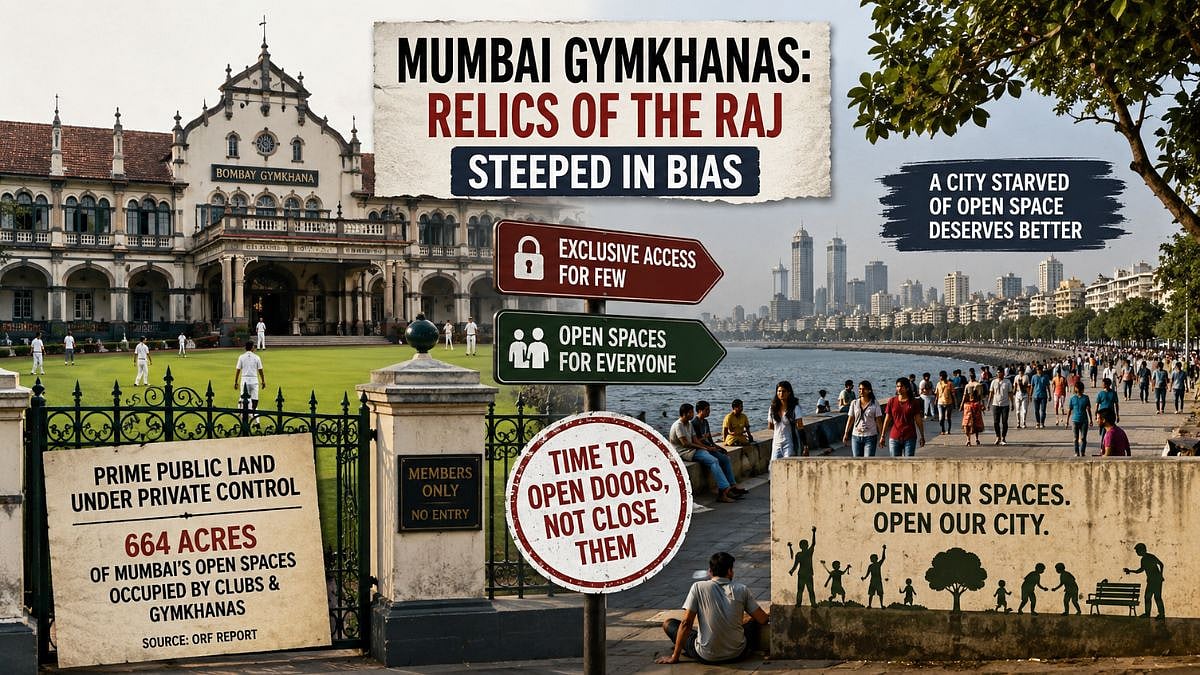
Mumbai's historic gymkhanas are at the centre of a debate over public land use, accessibility and urban development | AI Generated Representational Image
Mumbai, May 28: The ongoing controversy over the central government's notice to Delhi Gymkhana, asking it to hand over the prime property occupied by it, has understandably had its repercussions in Mumbai. Several private clubs, like the Bombay Gymkhana, Wodehouse Gymkhana, Willingdon Club, Islam Gymkhana, Hindu Gymkhana, Catholic Gymkhana et al., have occupied prime government land in South Mumbai since pre-Independence and have been paying paltry rent to the BMC.
According to a research-based report put out by the Observer Research Foundation (ORF), of the total 3,780 acres of open space, as much as 664 acres is collectively occupied by these clubs and gymkhanas. In a city starved of open space, it is nothing short of criminal to let these elitist institutions occupy prime space exclusively.
The report noted that almost one-fifth of the city’s open spaces is accessible only to club members. The membership of these clubs is more of a status symbol and costs lakhs of rupees. Now the question remains: should these institutions be allowed to maintain their “koi hai” culture, given that millions of Mumbaikars have little open space to stretch their limbs or let their children play? One of the clubs, until recently, was even contemptuous of Indians and granted membership only to foreigners.
Prime land and public access concerns
Some of these clubs are positively hindering the city’s development. Take Bombay Gymkhana, for instance. It is occupying prime property and is highly reluctant to hand over a portion of the land to the BMC for the expansion of Hazarimal Somani Lane—an arterial link from Hutatma Chowk to Chhatrapati Shivaji Maharaj Terminus (CSMT).
Every day there is a major traffic jam on this road, which starts from Capitol Cinema and goes all the way to Bombay Gymkhana. According to the police and municipal authorities, the road can be decongested if it is widened along its entire length. But that can happen only if the elitist Bombay Gymkhana condescends to cede a portion of the prime land occupied by it.
Questioning the future of exclusive gymkhanas
One may well ask what happens if the super-expensive land currently being occupied by these gymkhanas is taken away from them. What happens to the existing members? Surely memberships can be transferred from Club ‘A’ to Club ‘B’, and the land occupied by the former can be kept open for the public.
This way, several acres of land can almost overnight be made available for public use. The long stretch of sea-facing land at Marine Drive, currently occupied by Islam and other gymkhanas, needs to be kept open for ordinary Mumbaikars.
In any case, these gymkhanas are relics of the Raj, which followed a policy of divide and rule on communal lines. In the post-Independence era, there should be no place for gymkhanas whose membership is rooted in religion.
Published on: Wednesday, May 27, 2026, 08:45 PM ISTRECENT STORIES
-
-
-
-
-