Mamata Takes Legal Battle To Supreme Court, Challenges Election Commission’s Voter Roll Revision
Mamata Banerjee personally argued before the Supreme Court of India against the Election Commission of India over the Special Intensive Revision of electoral rolls in West Bengal, warning it could disenfranchise lakhs of voters. The court called her concerns genuine and sought the EC’s response.

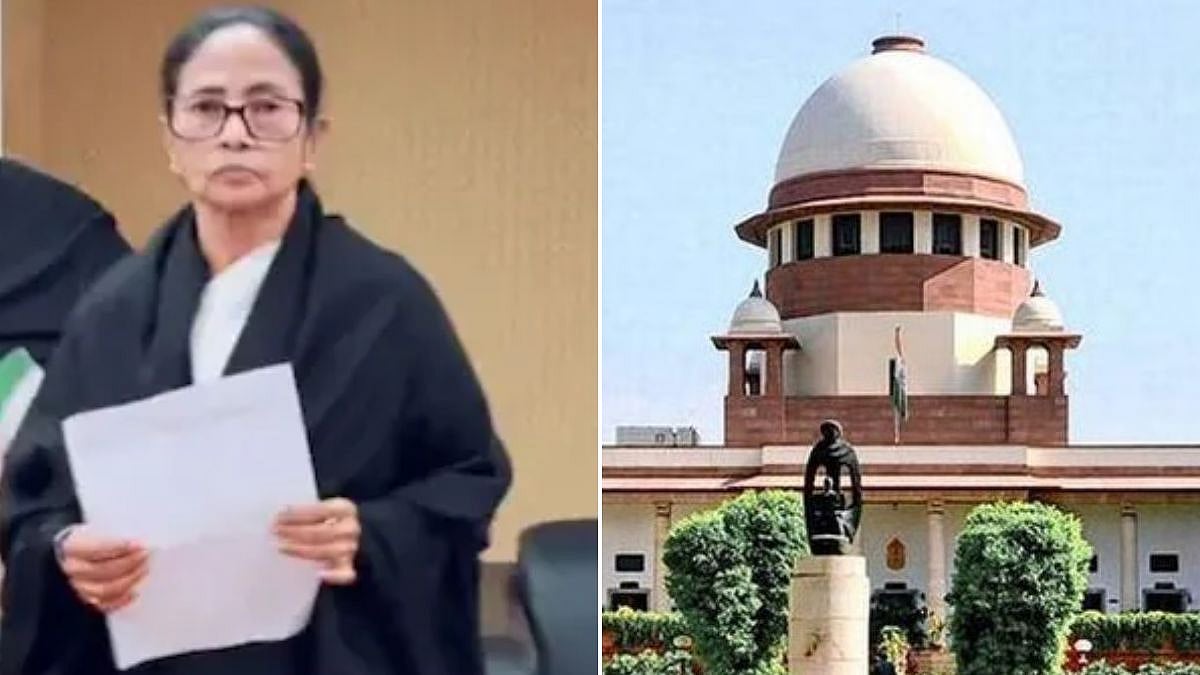
West Bengal Chief Minister Mamata Banerjee arrives at the Supreme Court to personally challenge the Election Commission’s electoral roll revision exercise | File Photo
West Bengal Chief Minister Mamata Banerjee created a rare moment in India’s constitutional history when she chose to personally argue her case before the Supreme Court against the Election Commission’s Special Intensive Revision (SIR) of electoral rolls in the state.
While Indian law allows any litigant to appear in person, courts ordinarily expect trained lawyers to handle complex constitutional matters. Banerjee, though a law graduate long removed from active legal practice, clearly believed that the gravity of the issue demanded her own voice.
Fears of voter disenfranchisement
Her argument was less about legal technicalities and more about the democratic consequences of the SIR exercise. Banerjee alleged that the revision, hurriedly sought to be completed in three months instead of the usual two years, carried a sinister political purpose: large-scale deletion of names from the voters’ list. In effect, she warned, the exercise could disenfranchise lakhs of legitimate voters ahead of the next Assembly election, potentially altering its outcome. Who is better, she seemed to ask, to articulate this fear than the elected Chief Minister herself?
Court acknowledges concerns
Despite Banerjee having to wait for over two-and-a-half hours on the back bench, her intervention had a visible impact. The bench headed by Chief Justice Surya Kant described her concerns as “genuine” and issued notice to the Election Commission, seeking its response. That, by itself, underlined the seriousness of the issues raised.
Questioning ‘logical discrepancies’
Central to Banerjee’s challenge was the concept of “logical discrepancy”, under which names are being flagged or deleted due to mismatches in spelling, surnames, age gaps, or changes after marriage. The court itself acknowledged the peculiarities of Bengal, where transliteration from Bengali to English often produces multiple spellings—Datta and Dutta, or variations of Bandhopadhyay—and that such minor inconsistencies cannot justify deletion. Banerjee’s examples, including married daughters and migrant workers losing their voting rights, exposed how bureaucratic rigidity can trample lived social realities.
Allegations against the process
She also questioned the deployment of thousands of micro-observers, branding them partisan, and alleged “secret mass deletions” through bulk Form-7 notices, often sent via WhatsApp. Her emotive references to overworked booth-level officers, with reports of deaths and hospitalisations, added a human dimension to what might otherwise appear a technical exercise.
Wider implications for democracy
Opposition-ruled states such as Kerala and Tamil Nadu have echoed similar apprehensions, suggesting that West Bengal is not an isolated case. Elections are the sacred core of a democracy, and it is the bounden duty of elected governments and constitutional bodies alike to protect their integrity. If voter revision becomes a tool for exclusion rather than inclusion, it risks inflicting severe damage on the democratic process itself.
The apex court has now stepped in as the constitutional arbiter. Its forthcoming scrutiny of the SIR will test not just the Election Commission’s procedures but the larger promise that every eligible citizen’s vote counts — and is protected.
RECENT STORIES
-
-
-
-
-