Maharashtra Bans Junk Food For Kids In And Around Schools
Maharashtra and Karnataka have restricted the sale of junk food in school canteens and near schools to improve child nutrition and curb rising obesity. The opinion piece says the move is timely, urging stricter enforcement and wider adoption of similar measures across India to protect children's health.

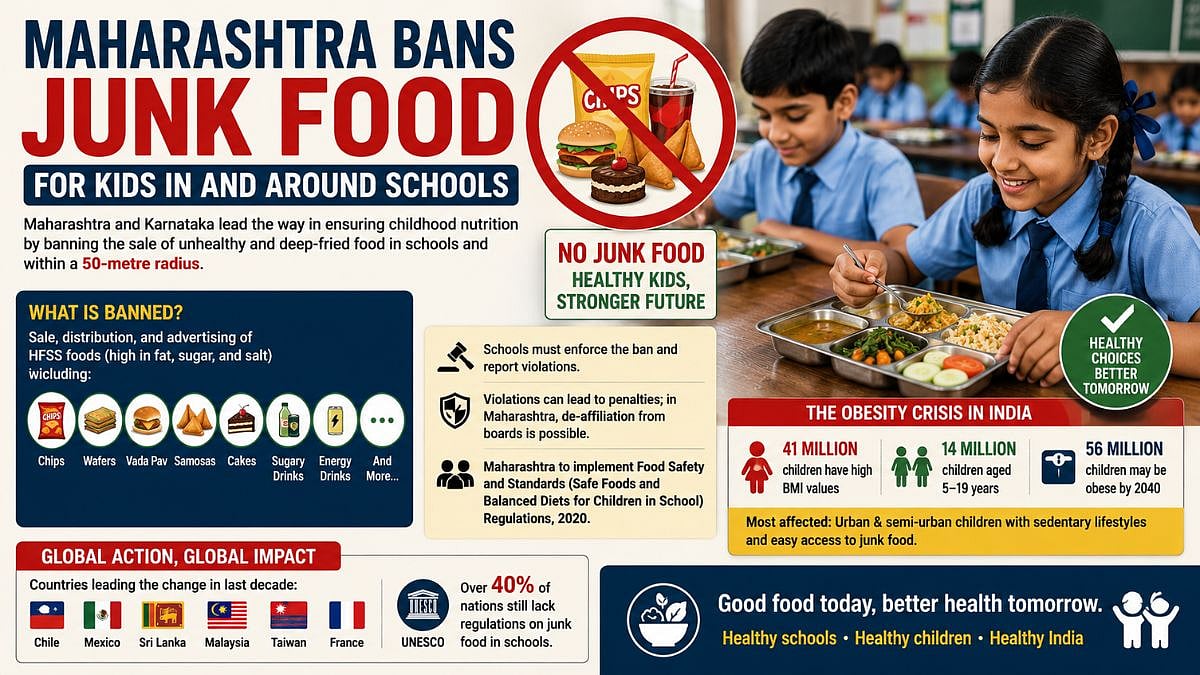
Maharashtra's decision to restrict junk food near schools aims to promote healthier eating habits among children | AI Generated Representational Image
The Maharashtra and Karnataka governments, in that order, took the first crucial step last week to ensure childhood nutrition by issuing orders to ban deep-fried and unhealthy foods in school canteens and within a 50-metre radius of all schools in their states.
Accordingly, there can be no sale, distribution or even advertising of what has come to be called HFSS foods (food items high in fat or trans fat, sugar and salt), which includes chips, wafers, vadas, vada pavs, samosas, cakes, some varieties of biscuits, sugary drinks, energy drinks and so on, that are loosely called ‘junk foods’.
The Food and Drug Administration in these states indicated that school managements would be held liable for enforcement and would be penalised for violations; Maharashtra will invoke the Food Safety and Standards (Safe Foods and Balanced Diets for Children in School) Regulations, 2020.
A Timely Public Health Measure
While the targeted children under 18 may protest this crackdown in ways they can, and harried households, mostly mothers, overworked to provide snacks and lunches high in nutrition, may find it challenging, the step has come not a day too soon.
In Maharashtra, this will ensure that more than two crore children in schools will eat healthier at least once a day and be less tempted to splurge their pocket money on junk food outside schools.
Schools are liable to report tuck shops selling such items to the FDA; Maharashtra’s FDA Commissioner, Tukaram Mundhe, went to the extent of stating that schools that violate the regulations within their premises and fail to report shops within their 50-metre radius may face de-affiliation from their respective boards.
Need For Wider Adoption
On the face of it, this may seem an overreach, but considering that India now stares at childhood obesity as a major public health crisis, with a staggering 41 million children with high BMI values, of whom 14 million are between five and 19 years of age, this was necessary.
Most obese children are in urban or semi-urban areas that have little space for physical activities and promote sedentary lifestyles; junk foods add to the problem.
In fact, other states should follow the lead of Maharashtra and Karnataka. The projection of 56 million children in India battling obesity by 2040 should spur serious thought and action.
Countries across the world too have had to grapple with the easy availability of HFSS foods in or near schools. In the last decade, countries such as Chile, Mexico, Sri Lanka, Malaysia, Taiwan and France introduced strict policies to restrict or ban high-calorie, ultra-processed junk foods and soft drinks in school canteens and near schools.
A worldwide report by UNESCO's Global Education Monitoring (GEM) team last year sounded the alarm about the issue, flagging that over 40 per cent of nations do not have regulations; most of them are low- or middle-income countries. Maharashtra and Karnataka are on the right track.
RECENT STORIES
-
-
-
-
-