Let’s Not Blame Celebrities For Surrogate Advertising
Celebrity endorsements of surrogate tobacco products raise questions over accountability, as Maharashtra FDA action against endorsers highlights the wider policy dilemma involving tobacco, alcohol and junk food, public health concerns, government revenue, livelihoods and consumer choice.

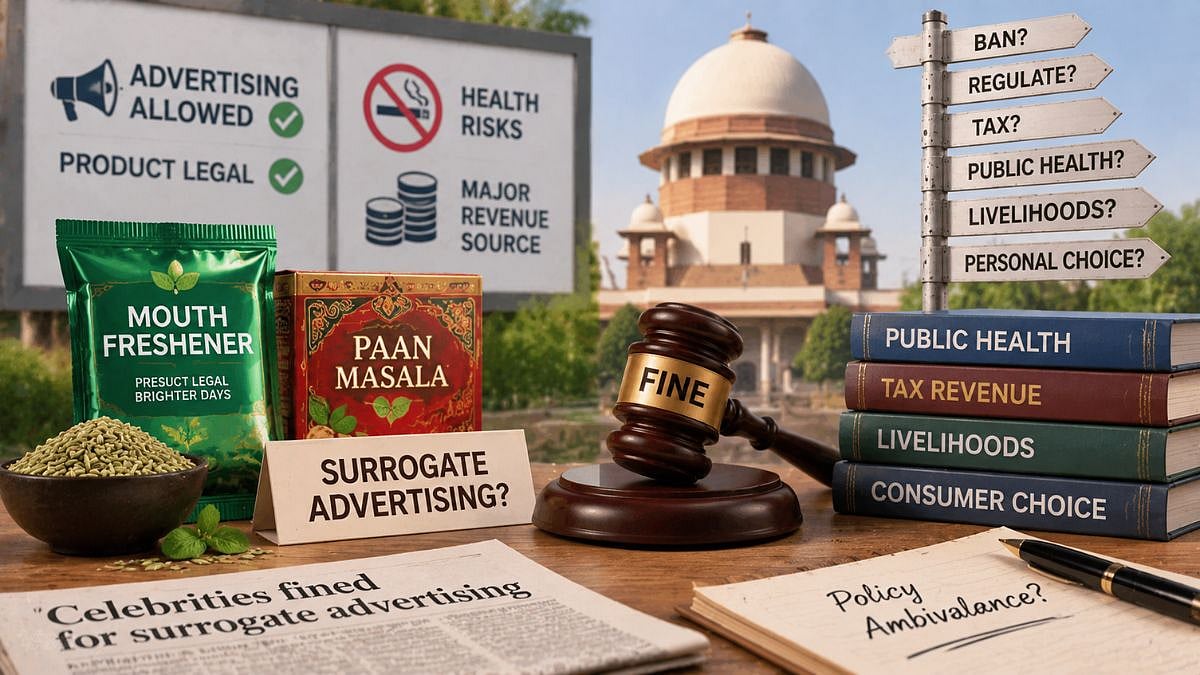
The debate over surrogate advertising has renewed questions about celebrity endorsements, public health regulations and government policy | AI Generated Representational Image
The recent controversy regarding the imposition of a fine on celebrities for endorsing a surrogate tobacco product opens the door for a debate on policy ambivalence. The present case refers to celebrities coming for an advertisement of mouth freshener, which is actually a surrogate for paan masala.
The surrogate product has been permitted to be marketed. The same holds for paan masala, which, along with related products, has a weight of 1.2% in the consumer price index. The company is clean, as it is not dealing with a banned product.
The advertisement was passed as being fit for being on TV and other channels. The advertising firm, hence, is also clean, as no one is blaming it. But, curiously, the celebrity, who appears for the product, pays the fine.
Question Of Advertising Rules
The logical thing is that if the product is deleterious for health, it should be banned. Alternatively, if the product is tolerated, advertising of the same should be banned.
Everyone is aware of surrogate products for liquor and tobacco, but the advertisements run freely. Hence, there is dualism here because it is the presence of a celebrity which leads to a dual standard being practised, which smells of hypocrisy.
Today, taking drugs is banned in most countries, and, hence, it becomes illegal to sell or consume them. There is no question about advertising the product or its surrogate. When it comes to tobacco and alcohol, the products are not banned, but the model advertising for the same faces the flak.
Revenue From Sin Products
The issue really is that alcohol and tobacco are major revenue earners for the government. Tobacco products come under GST, and the earnings could be in the region of Rs 80,000-100,000 cr, which is shared equally by the Centre and states.
In the case of liquor, where there are state excise and VAT levied, the revenue could be in the range of 10-15% of the states’ own tax revenue, which would be around Rs 2.5-3 lakh crore. This is good money, and states like Uttar Pradesh, Karnataka, Maharashtra, Andhra, and Telangana are some of the bigger beneficiaries.
The curious aspect of the GST rates is that while it would be upwards of 40% for cigarettes, it was lowered to 18% for bidis, which are considered by some to be more carcinogenic than the former. Hence, one is not sure about our ideology on the treatment of sin products.
The problem is that tobacco cannot be banned, as there are 6 million farmers involved in cultivation and a similar number employed as labour on such farms.
In the case of liquor, there are around 2.5 million people directly employed, while in the value chain, which carries on to farmers, restaurants, packaging, etc., there could be another 5-5.5 million. Interestingly, some of our FTAs signed allow for the import of high-end whisky at progressively lower tariff rates.
Governments Face Policy Dilemma
This is a policy dilemma for all governments when dealing with sin products. There is a tendency to raise taxes to dissuade consumption, which has limited impact, as those who are addicted will not really reduce the intake. Nor does it matter for the affluent.
The government is better off as revenues increase, and, hence, it is a Pareto optimal state where no one is worse off but some better off! There are several campaigns run to warn citizens of the perils of the consumption of tobacco and liquor. The net result is yet to be judged, as, with the proliferation of income and pub culture, Gen Z is hooked on to different forms of spirits.
Debate Over Junk Food
The issue has been stretched further of late, with talk of controlling the consumption of junk food, which includes aerated drinks, fried foods, including wafers, and other sugar-intensive food products. Different states have rules on how to protect school children from not just tobacco (shops cannot be located within a certain perimeter) but also junk food.
There is talk of ensuring that all junk food is labelled with sugar, salt, and oil content so as to warn children and parents that these foods are bad for health. The question is, how much should a government interfere in the choices of the people once the basket is allowed, or else they could become a ‘nanny state’?
Health Concerns And Choice
This is a problem all countries are facing, as health has become a major challenge with the younger population falling prey to diseases like hypertension, diabetes, and obesity, among others. While, in India, it is possible to ensure that branded products carry warnings of the dangers of consumption, there is a larger-sized unorganised sector where there can be no control.
Even today, most branded products have all the ingredients printed with other health-related parameters like fats, carbohydrates, cholesterol, etc. A lurking fear for celebrities would be that if they can be made to pay for endorsing a surrogate tobacco product, a similar treatment can be given for being brand ambassadors of chocolates, wafers, biscuits, and aerated beverages, among others, as, technically, all these products are not good.
Balancing Revenue And Health
Sin products have been a very useful source of revenue for the government and, hence, cannot be dispensed with, as that can impact livelihoods. At the same time, it is necessary to control the consumption growth, as it has an impact on the health of the people as well as increases the healthcare outlay of society.
Increasing taxes may not really help to lower consumption, as these are habits which are hard to disgorge. But spreading this basket to include the junk food basket may not be appropriate, as it comes in the way of the principle of choice. As a solution does not seem to be there, we will continue to live with such ambivalence.
The author is Chief Economist, Bank of Baroda and author of ‘Corporate Quirks: The Darker Side of the Sun’. Views are personal.
RECENT STORIES
-
-
-
-
-