It Is Too Early To Celebrate US-Iran Agreement
The reported US-Iran framework agreement offers hope for easing tensions in West Asia through a proposed 60-day ceasefire and peace talks. However, key issues including sanctions relief, the Israel-Hezbollah conflict, access to frozen Iranian funds and Iran's nuclear programme remain unresolved, making it premature to view the deal as a lasting breakthrough.

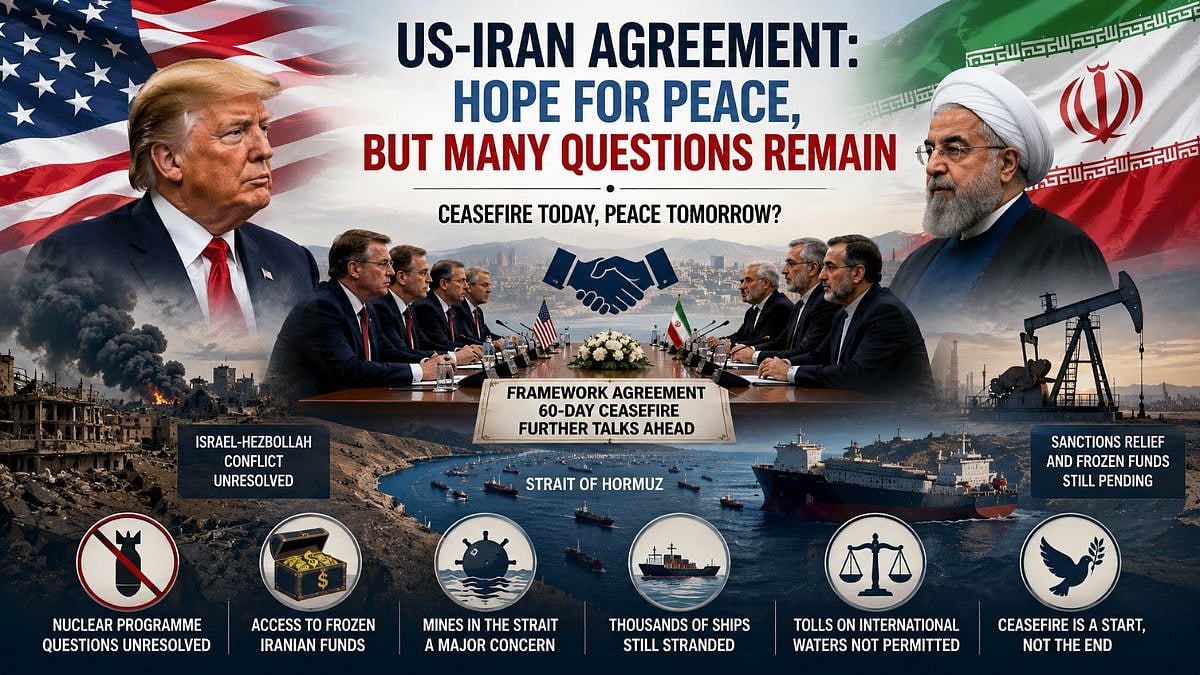
Key disputes over sanctions, regional conflicts and Iran's nuclear programme continue to cloud the prospects of a lasting US-Iran peace deal | AI Generated Representational Image
The framework agreement reportedly reached between the United States and Iran remains, for now, more an exercise in hope than a fully articulated diplomatic breakthrough. The broad contours alone are known: an immediate 60-day ceasefire and a commitment to negotiate a more durable peace during that period. Beyond these skeletal details lies a vast expanse of uncertainty. Yet, in a region battered by conflict and brinkmanship, even the silencing of guns deserves acknowledgement. President Donald Trump has already celebrated the reported reopening of the Strait of Hormuz and the resumption of oil flows from West Asia as a personal triumph. But Trump has often displayed a tendency to claim victory before the facts warrant it. Prudence demands that the world reserve judgement until the agreement, expected to be signed in Geneva on Friday, is made public and its provisions subjected to scrutiny.
Key Questions Remain Unanswered
The unanswered questions are numerous and consequential. Israeli Prime Minister Benjamin Netanyahu has made it clear that Israel is not a party to the agreement and does not regard itself as bound by its terms in the conduct of its operations in Lebanon. Trump’s description of Netanyahu as “crazy” may reflect frustration, but it hardly addresses Iran’s central concern: an immediate end to the Israel-Hezbollah conflict. Whether Washington possesses either the leverage or the will to persuade Tel Aviv to withdraw from areas under its control in Lebanon remains uncertain. Iran, meanwhile, insists that Western sanctions imposed over the years must be lifted. Many of these had been eased following the 2015 nuclear agreement, only to be reimposed after the United States withdrew from that deal under Trump’s presidency. Tehran also seeks access to funds frozen abroad, with reports suggesting that the United Arab Emirates may release $10 billion without delay. These issues are not peripheral; they lie at the heart of any meaningful reconciliation.
Challenges Extend Beyond The Ceasefire
Even the practical aspects of peace present formidable challenges. Although the United States has reportedly lifted its blockade around Iranian ports, the Strait of Hormuz cannot become fully navigable until mines are cleared. Western powers possess the capability to undertake de-mining operations, but such efforts require time. Thousands of vessels remain stranded, awaiting safe passage. Iran’s suggestion that it may levy fees on ships using the Strait raises further concerns, since international law does not permit tolls on transit through international waters. Above all looms the unresolved question of Iran’s nuclear programme. The United States wants assurances that Iran will never develop nuclear weapons. Iran maintains that it has no such ambition. What, then, becomes of its stockpile of enriched uranium? Until these questions receive credible answers, the world can welcome the ceasefire only with cautious optimism rather than genuine satisfaction that the war is truly over.
RECENT STORIES
-
-
-
-
-