Israel-Iran war: A Local War That Has Caused Worldwide Disruption
Three weeks into the Iran conflict, global repercussions are severe. Iran’s asymmetric attacks on civilian & energy infrastructure, including threats to the Strait of Hormuz, disrupt oil, gas, & supply chains worldwide. Israel’s strikes on gas fields & Iran’s retaliation escalate risks, highlighting the urgent need for international intervention to prevent long-term economic & humanitarian crises.

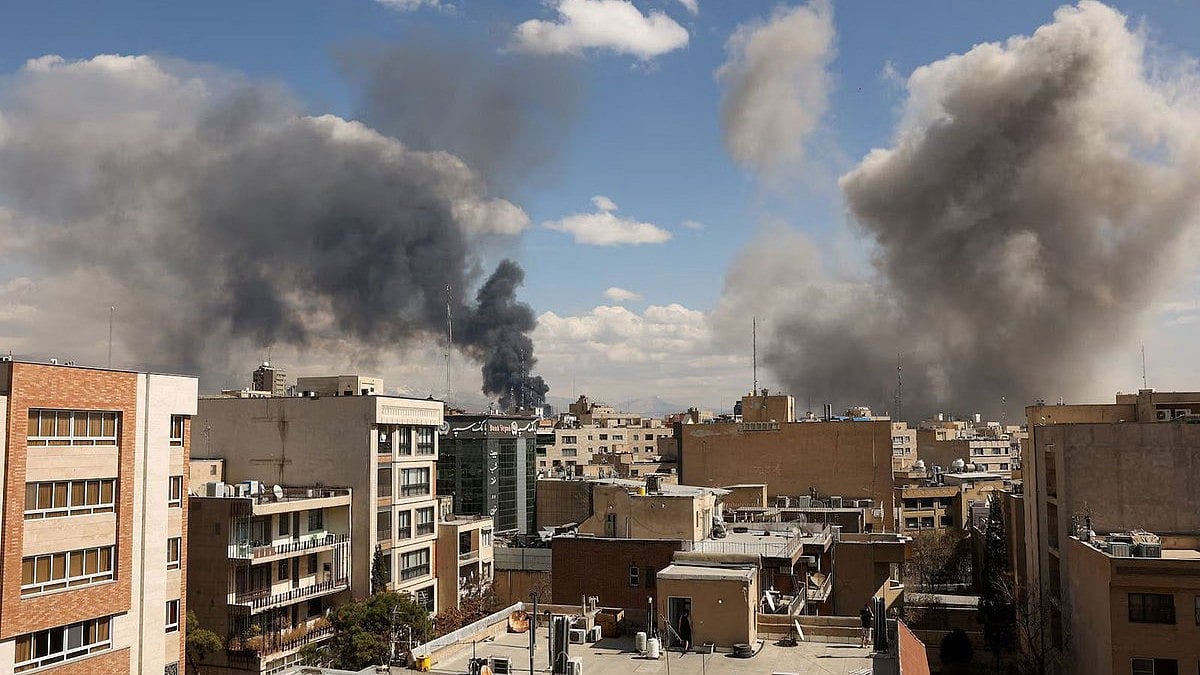
Israel-Iran war: A Local War That Has Caused Worldwide Disruption | ANI/ Representative image
Three weeks into the conflict, the reverberations of the Iran war are now felt all over the globe. What started as a war of choice and opportunity by President Trump and Prime Minister Netanyahu has morphed into a war of attrition and existence, thanks to Iran’s resilience and resort to asymmetric tactics. Iran is able to inflict considerable damage to civilian property, military infrastructure, and, critically, oil and gas supply chains in all the Gulf countries. Even more consequentially, from the global point of view, the threat of attacks on ships shut down the vital Strait of Hormuz for all merchandise navigation.
While the Islamic Republic is probably deeply unpopular, it has a mosaic defence strategy, and the Islamic Revolutionary Guard Corps is highly decentralised and capable of operating without a centralised command structure. Iran has been preparing for the current war for decades. Given its formidable science and technology manpower, Iran invested a great deal of resources and energy in nuclear weapons development, ballistic missiles, and low-cost drones. And, clearly, Iran was prepared to fully leverage its geographic location to inflict enormous pain on all the Gulf countries and the whole world by attacking the energy infrastructure and shutting down the vital Strait of Hormuz for navigation.
President Trump’s failure is not moral or legal. His failure as the leader of the world’s preeminent power is one of rank irresponsibility. A superpower that does not anticipate the potential hazards of its unthinking intervention does immense damage to its own credibility and authority. Far more important, in the present context, the global community is paying a humongous price for America’s failure of leadership. Already, oil and gas prices the world over have risen considerably.
Iran’s indiscriminate retaliatory attacks on the Gulf countries and threats to shipping in the Strait of Hormuz have already disrupted supply chains severely. On top of it, Israel's reckless attack on the Iranian portion of South Para, the world's largest natural gas field shared between Qatar and Iran, and Iran’s retaliatory missile attack on Qatar’s Ras Laffan industrial city, severely damaging the world's largest liquified natural gas facility, mark a dangerous escalation affecting the whole world. If energy infrastructure is seriously damaged, they may have to be shut down for years, causing long-term shortages of supply. Already, Qatar has announced that one-sixth of its total LNG supplies will be shut down for five years and invoked force majeure on long-term LNG contracts with Italy, Belgium, Korea, and China.
Global catastrophe does not require a third world war and nuclear Armageddon. Severe disruption of vital supply chains has devastating global consequences with lasting impact on the lives of billions of people. In 1958, Leonard Read published an essay—"I, Pencil"—illustrating the complexity of supply chain networks in producing a relatively low-tech, ordinary pencil we use every day. Manufacturing and supply of pencils involve logging and transport of cedar wood from California and Oregon to a mill in San Leandro, CA, where complex machines undertake cutting wood into slats, kiln-drying, tinting, and waxing—all using power from the hydroplant of Pacific Gas Electric Company.
Graphite mined in Ceylon is mixed with clay from Mississippi; wetting agents like sulfonated tallow are added, and leads are extruded and then treated with a hot mixture including candelilla wax from Mexico, paraffin wax, and hydrogenated natural fats. Many other intricate steps are involved—cedar receiving coats of lacquer from castor oil and other ingredients; labelling with carbon black mixed with resins; attaching the brass metal—the ferrule; the eraser rubber made from rapeseed oil from Indonesia; sulphur chloride and numerous vulcanising and accelerating agents; pumice from Italy; and cadmium sulphide pigment.
Four decades ago, well before economic reform reached Indian shores, as a young official, I was forced to learn this lesson on supply chains and the devastation caused by their disruption. The handloom weavers in the Chirala area of Prakasam District in coastal Andhra were in distress because of political instability and economic crisis in Nigeria and the consequent halt to imports of the unique cloth produced by the weavers called Real Madras Handkerchief! Instability in distant Africa led to distress and starvation on the east coast of India even during a period of state control and restricted trade. Imagine the devastation today when it is impossible to know what part of which product we use or consume is produced where.
This war needs to end soon if the Gulf countries and global community are to have a realistic chance of returning to a semblance of normalcy without long-term pain and suffering. If the war continues for several months through repeated cycles of recklessness and escalation, the damage done to Iran and the Gulf countries, and to the economies and wellbeing of the people all over the world, will be irreversible.
Transport, cooking, energy systems, fertilisers (urea and phosphate), computing chips, AI and the space industry (helium), and food production—all are in jeopardy. Even if the war ends now, enormous efforts and investments are needed for reconstruction, alternative sources of supply, viable supply routes, permanent patrolling of vital sea routes like the Straits of Hormuz, Bab al-Mandab, and Malacca, to name the most important, larger volumes of strategic reserves and storage, redundancies to meet future contingencies, and higher insurance provisions. All these will significantly increase costs for consumers.
The price humanity will have to pay if the war is prolonged and energy and mineral sources are permanently destroyed will be unimaginable. Europe, the UK, the GCC countries, China, India, Japan, and other middle powers need to act in concert to prevent a catastrophe and persuade the warring parties to end hostilities immediately and work for durable peace.
The author is the founder of Lok Satta movement and Foundation for Democratic Reforms. Email: drjploksatta@gmail.com / Twitter@jp_loksatta
RECENT STORIES
-
-
-
-
-