India’s Lone-Teacher Schools Need Urgent Reforms
More than one lakh single-teacher schools across India are educating 3.37 million students, raising concerns over the quality of foundational education. The latest data has renewed calls for teacher recruitment, stronger infrastructure and reforms to improve learning outcomes under the National Education Policy.

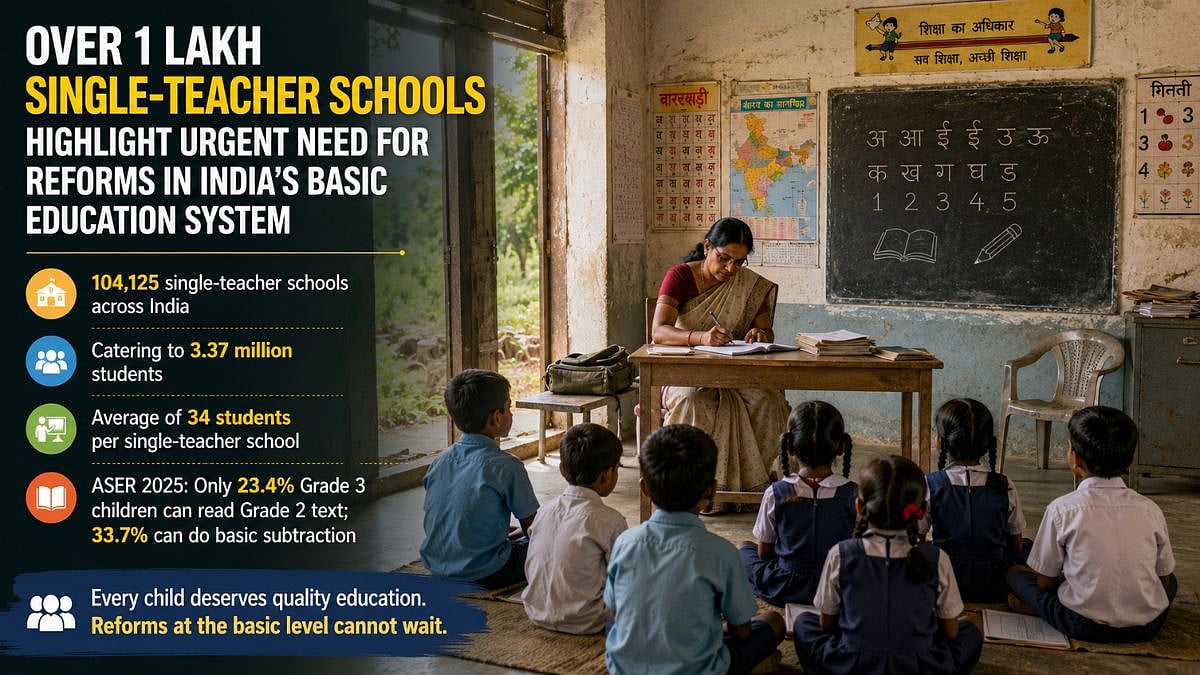
Fresh data has highlighted the urgent need to strengthen India's basic education system by addressing the shortage of teachers | AI Generated Representational Image
How badly reforms are needed at the basic school level, not merely at the higher secondary and competitive examination levels, was brought home in a stark manner this week when the Union Ministry of Education disclosed in Parliament that over one lakh schools across India are single-teacher schools.
These, according to the data, cater to a staggering 3.37 million students, with an average of 34 students in each single-teacher school. Andhra Pradesh has the maximum number of them, followed by Maharashtra, Jharkhand and Karnataka. In terms of the number of students enrolled in such schools, Uttar Pradesh leads the list, with Jharkhand and West Bengal following.
Questions Beyond Enrolment
These children are India’s demographic dividend of tomorrow, an attribute usually discussed in glowing terms as giving the country a competitive edge over other economies. To the discussions of the demographic dividend, the data disclosed now adds critical questions such as how well educated and skilled young Indians of tomorrow would be to leverage the dividend; what their worldview and exposure would be; and how the goals and outcomes of the National Education Policy (NEP)—debatable or controversial as they may be—could be achieved. There are no easy answers here, but the underlying call is clear: India’s governments at the Centre and in the states must pay more attention to basic school education.
This issue takes the debate beyond the school enrolment ratio, which has seen an uptick in recent years and is only half the battle won because, when children are in schools, they are not receiving the full-fledged instruction they are supposed to.
As the Annual Status of Education Report (ASER) 2025 showed, only 23.4 per cent of Grade 3 children could read a Grade 2-level text, and barely 33.7 per cent could do basic subtraction. While the 104,125 single-teacher schools form only seven per cent of the nearly 15 lakh schools across India, it would be a cardinal mistake to dismiss this.
Even if one child receives deficient or insufficient education due to the inadequacies and manageable shortfalls in the system, it deserves attention and repair.
Need For Urgent Action
The single-teacher schools data show that the struggle for adequate resources at the basic education level persists and goes beyond budgetary outlays. Even if these were to be augmented, the on-ground gaps would still have to be filled, which calls for political will.
It is also indicative of the immense pressure on the lone teachers in these schools to fulfil the NEP-mandated outcomes, satisfy the learning needs of children of varying ages, and ensure that all the administrative boxes are checked in good time.
It is too tall a task even for gifted teachers. Besides, teachers are now drafted to undertake other data collection and census work. The issue deserves all the attention it can get, and more.
RECENT STORIES
-
-
-
-
-