India’s Challenge Is To Work With Rival Power Centres Without Becoming Part Of Any Competing Bloc
How New Delhi navigated competing interests among Washington, Moscow and Beijing while keeping India’s strategic autonomy intact.

The Delhi BRICS summit has produced an unusual diplomatic outcome: a grouping marked by deep geopolitical contradictions has nevertheless spoken with one voice. The unanimous adoption of the New Delhi Declaration is therefore more significant than the document’s length or diplomatic language. It demonstrates that countries divided over Ukraine, West Asia, Iran, Russia and their relationship with the United States can still discover enough common ground to act collectively.
For India, the most important achievement is the declaration’s unequivocal commitment to zero tolerance towards terrorism in all its forms and manifestations and its condemnation of the April 2025 Pahalgam terrorist attack, in which 26 civilians were killed. At the same time, its criticism of unilateral tariffs and sanctions carries a message for Donald Trump, while the summit has revealed emerging possibilities in India’s equations with China and Russia.
India’s Distinctive Gains
The Pahalgam reference gives the declaration a clear Indian imprint. By specifically mentioning the attack and calling for action against terror financing, recruitment and safe havens, New Delhi has strengthened its long-standing argument that terrorism must be confronted without political selectivity.
This is particularly significant because BRICS brings together countries with sharply different security interests. Securing consensus on terrorism was consequently not merely a drafting achievement but a demonstration of India's diplomatic ability to build agreement among difficult partners.
The second gain is that India prevented BRICS from becoming an explicitly anti-Western platform. The declaration criticises unilateral tariffs, non-tariff barriers and sanctions, but stops short of turning the grouping into an ideological counter-alliance against the United States.
The third is India's continuing leadership of the Global South. Calls for reform of the United Nations Security Council and international financial institutions reinforce New Delhi's demand for greater representation of developing countries in global decision-making.
A Message Trump Cannot Ignore Donald Trump is unlikely to be comfortable with the direction of the Delhi declaration. Its criticism of unilateral tariffs directly challenges the philosophy behind his use of trade barriers as an instrument of economic pressure. The BRICS emphasis on local-currency settlements and greater resilience against external financial pressure will also attract Washington's attention:
But it would be wrong to interpret this as a collective declaration of war against American influence. India has carefully avoided that trap. Its relationship with Washington remains strategically important, and its objective is not to replace one dependency with another.
The message from New Delhi is more measured: a multipolar world cannot be constructed according to the preferences of one power. This may complicate India's trade negotiations with Washington, particularly if Trump adopts a more confrontational approach, but it need not derail an India-US trade agreement. India's ability to engage simultaneously with America, China and Russia could instead provide greater negotiating space.
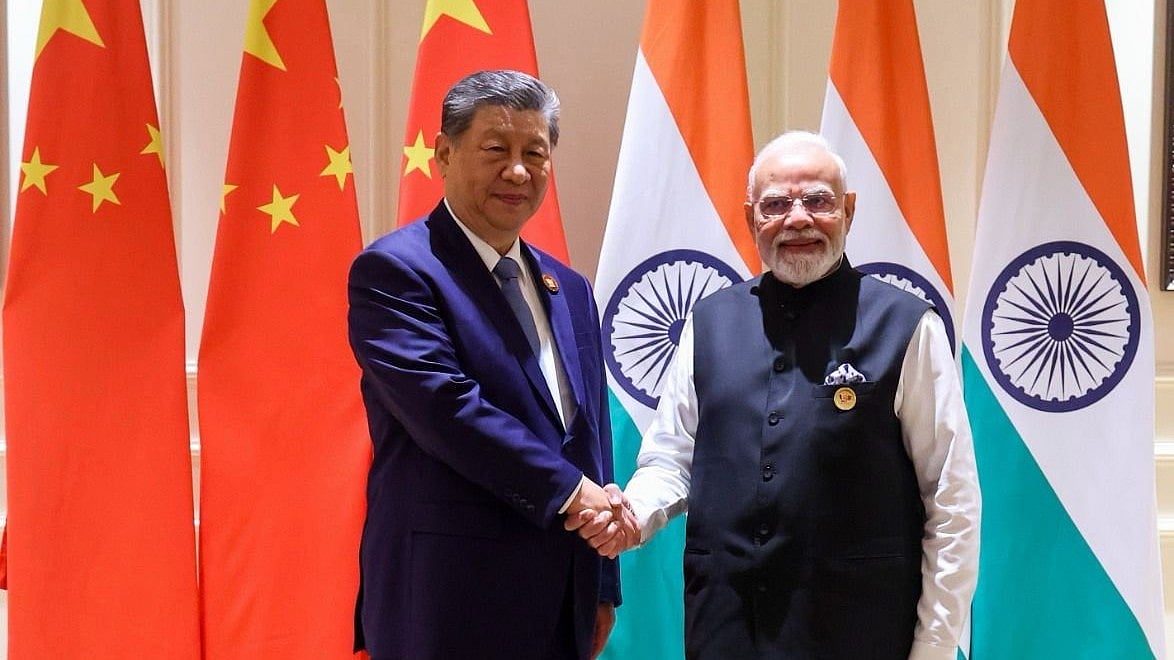
Modi-Xi Opens Another Door The Modi-Xi meeting has added a major bilateral dimension to the summit. After the Galwan clash and years of military confrontation and political distrust, the two leaders have begun rebuilding a channel of engagement.
Xi's assertion that India and China are partners rather than rivals, and Modi's insistence that differences should not become disputes, indicate a conscious attempt to prevent the border issue from paralysing the entire relationship.
Their commitment to a fair, reasonable and mutually acceptable settlement of the boundary question is important. Yet it should not be exaggerated into a border breakthrough. The real test lies ahead: whether military restraint can become permanent, whether confidence-building mechanisms can be strengthened and whether economic ties can be insulated from recurring political tensions.
For India, the appropriate policy is engagement without complacency. China can be an economic partner, a strategic competitor and a security challenge at the same time.
Putin and the Wider Strategic Picture Vladimir Putin's meeting with Modi reinforces another pillar of India's strategic balancing. Russia remains important to India's defence, energy and broader strategic interests, even as Moscow's relationship with Beijing becomes increasingly close.
India therefore has to manage the India-China-Russia triangle without becoming subordinate to any one relationship. Improved India-China ties could reduce one source of strategic pressure while allowing New Delhi to preserve its longstanding Russian partnership and simultaneously deepen cooperation with the United States.
Iran is another country whose importance will grow. Its membership of BRICS, energy resources and geographical importance to India's connectivity with Central Asia give Tehran a continuing place in New Delhi's Eurasian calculations. India will need to maintain this relationship while avoiding entanglement in West Asia's increasingly dangerous rivalries.
China’s Turn in 2027 China's assumption of the BRICS chair in 2027 will be closely watched in New Delhi. Beijing inherits a grouping that has acquired greater economic weight but also greater internal complexity.
China could use its chairmanship to strengthen BRICS as a broad and inclusive platform for the Global South. But any attempt to transform it into an overt counterweight to the West could expose the contradictions that India successfully managed during its own chairmanship.
The challenge for India will be to ensure that BRICS remains inclusive, consensus-driven and development-oriented rather than becoming an instrument of great-power rivalry.
From Declaration to Delivery
The Delhi summit has also exposed BRICS' fundamental weakness. Its members want a stronger collective voice but do not share a common geopolitical outlook. They disagree over conflicts, trade, energy and relations with the West. Expansion has increased the group's influence while simultaneously making consensus more difficult.
Its economic ambitions face equally formidable obstacles. Greater use of local currencies, alternative payment mechanisms, stronger intra-BRICS trade and resilient supply chains require practical systems, not merely political declarations.
The fundamental question is therefore whether BRICS can become an effective instrument of cooperation rather than simply a forum for dissatisfaction with the existing order.
India has demonstrated that contradictory forces can be managed through patient diplomacy and carefully calibrated language. That may ultimately prove to be the most important achievement of the Delhi summit.
The declaration is only the beginning. The credibility of BRICS will now depend on whether its members can transform consensus into action. For India, the larger diplomatic task is to keep every door open—towards Washington, Moscow, Beijing and the Global South—without allowing any of them to dictate its strategic choices.
(Writer is a strategic affairs columnist and senior political analyst based in Shimla. He is also Contributing Editor with The South Asian times from New York)
RECENT STORIES
-
-
-
-
-