India’s 2036 Olympics Bid Gains Momentum As Ahmedabad Leads Race Amid Strong Global Competition
India’s bid to host the 2036 Olympics, with Ahmedabad as the proposed venue, is gaining traction amid strong global competition from countries like Qatar and Germany. The race is shaped by geopolitical factors, historical sensitivities, and India’s ambition to emerge as a major global sporting destination.

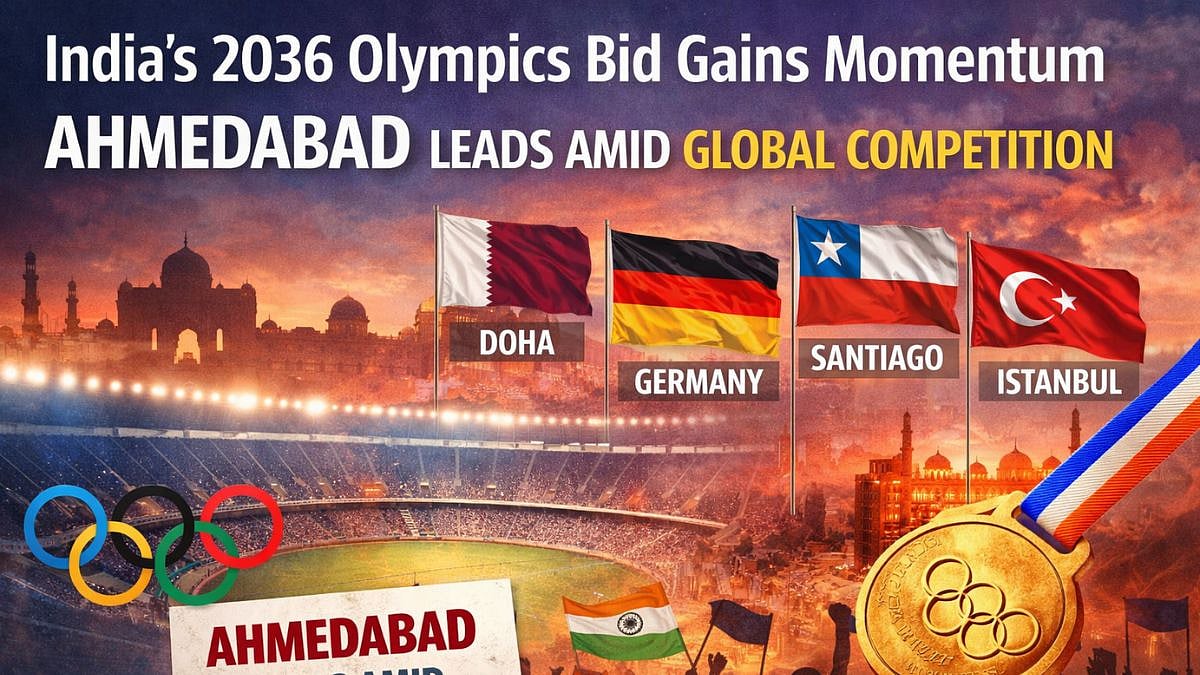
Ahmedabad emerges as India’s frontrunner city as the country intensifies its bid for the 2036 Olympic Games | AI Generated Representational Image
India has officially bid to host the 2036 Olympic Games in Ahmedabad. Its main competitor at this stage appears to be Doha, Qatar, with Santiago, Chile; Istanbul, Turkey; and South Africa (without announcing a city) also making bids. Lurking in the background is Germany, which is mulling a bid with Berlin, Cologne, Hamburg, and Munich as the four possible host cities, with the final decision to be made in September. However, both Berlin and Munich evoke negative memories, and if the 2036 bid falls through, Germany will try for 2040 or 2044.
Germany’s historical baggage
Germany has hosted the Olympics twice—once in Berlin in 1936, as a united nation as it is today, and then in Munich in West Germany in 1972. The bid for 1936 was decided in 1931, and just a year later Adolf Hitler came to power. He eventually turned the Games into a propaganda exercise to push his racist theory of the superiority of the Aryan so-called master race. It has forever gone down in infamy as the “Nazi Olympics.”
The trauma of Munich, thirty-six years later, was the storming of the Israeli quarters in the Olympic Village and the kidnapping and subsequent murder of 11 Israeli sportsmen at the hands of the PLO.
Germans are acutely sensitive to their Nazi past, and President Frank-Walter Steinmeier has expressed concern that Berlin being chosen as the host in 2036 would reopen old wounds, since it would mark the centenary of the notorious “Nazi Olympics.” The Berlin Olympics were the last until 1948 (London), with the Second World War being triggered by Hitler’s invasion of Poland.
Historic feats and global narratives
That racist theory of Hitler’s was blown to bits in Berlin by the amazing feat of Afro-American legend Jesse Owens, who achieved the unique distinction of winning gold in the 100m, 200m, 4x100m relay, and long jump—something the Führer found hard to stomach, since his propaganda machine dismissed Afro-Americans in the US contingent as “Black auxiliaries.” Fellow Afro-American Carl Lewis repeated the feat at the 1984 Los Angeles Games.
In fact, the USA came close to boycotting Berlin due to the Nazi Party’s anti-Jewish campaign, which would culminate in the Holocaust. However, they were arm-twisted into participating by US Olympic Committee head Avery Brundage, who allegedly had Nazi sympathies. Hitler spared no expense in turning Berlin into a vehicle for his hateful philosophy, spending $30 million on it—an astronomical sum at the time.
India at the 1936 Olympics
From the Indian standpoint, this was the last Olympics in which the contingent marched under the Union Jack, even though it had the Star of India at the centre. The contingent consisted of the hockey team led by the immortal Dhyan Chand, four runners, and a weightlifter from Burma (now Myanmar), then part of British India.
There are many myths about India at the 1936 Berlin Olympics, making it hard to distinguish fact from fiction—particularly in the age of social media, where myths, half-truths, and outright falsehoods take on a life of their own and are accepted by many as gospel truth.
Myths and realities from Berlin 1936
The first myth centres around the very start of the Olympics—the traditional march-past. Much has been made of the Indian contingent being the only one, apart from the USA, to refuse to give the stiff, right-armed Nazi salute to Hitler in his VIP box. This has been portrayed as an act of bravery and defiance, but it is far from the truth.
In fact, the only one of the 49 contingents that gave the Nazi salute was the host nation Germany. According to Volker Kluge, the doyen of German Olympic historians and an expert on Berlin 1936, the confusion arose because of the similarity between the Nazi salute and the Olympic salute, which was performed by eleven teams. It was due to this confusion that the IOC scrapped the Olympic salute in 1946. The peerless Indian hockey team had won gold in 1928 and 1932 and were going for a hat-trick. They met Germany in the final and routed them 8–1. The match was scheduled for August 14 but was postponed to the next day—which would later become a very special day in India’s history—due to heavy rain, and was played at 11 am.
The story about Hitler attending the final and being dazzled by the stick-work of Dhyan Chand and his team has also been disproved by Kluge, who has the full schedule of Hitler in Berlin. On that day, Hitler attended only the men’s 200m breaststroke swimming final and, in the evening, hosted a function for the German team.
There is also a myth surrounding Charles Sebastian Arul Swami, who ran the marathon. Here, there is a personal connection, as Swami was my first sports editor when I joined the profession in Madras (now Chennai) in 1982. For years, he was mocked by some in the sports journalism fraternity, who claimed Swami “kept Hitler waiting for his tea,” implying he came dead last and thus delayed the closing ceremony.
In fact, Swami finished the race bravely, placing 37th out of 42 runners who completed the course, with 14 failing to do so. His effort was particularly commendable because he had fallen ill with paratyphoid on the long sea voyage and spent three weeks in hospital. Unlike in later years, the marathon, held on August 9, was not the final event. That honour went to the equestrian events a week later, followed by the closing ceremony.
Swami, who died in Coimbatore in 1997 at the age of 83, was one of the pioneers of sports journalism in India and worked closely with the doyen AFS Talyarkhan. He was also a competitive shooter, as well as a football coach and referee. It is believed that he was the only active sports journalist to have competed in the Olympics.
The writer is a veteran independent journalist and author based in New Delhi. He has written extensively on India at the Olympics.
RECENT STORIES
-
-
-
-
-