India, The Dancing Elephant, Has Slowed To A Waddle
India’s ambitions of becoming a global power face challenges from economic, institutional and governance shortcomings. The Modi government’s policies on democracy, federalism and foreign affairs are criticised, while concerns over inequality and institutional independence add to the country’s difficulties. The piece argues that India needs a new strategic and political imagination.

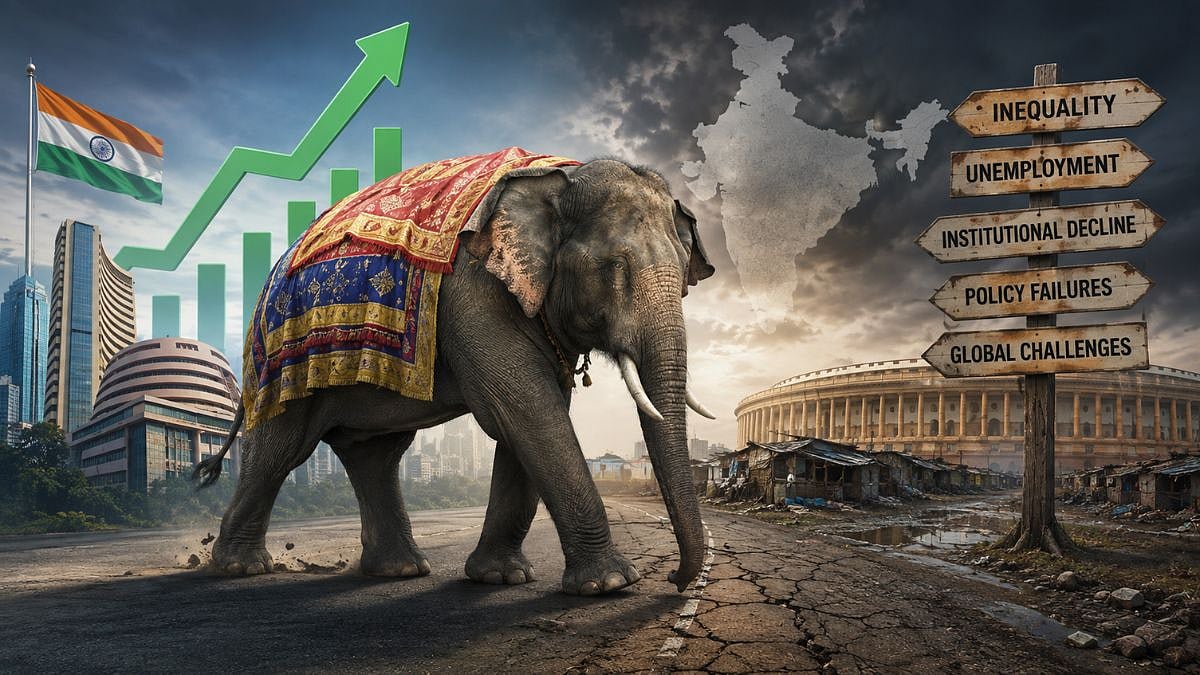
India’s economic performance, democratic institutions and foreign policy against its ambitions of becoming a global power | AI Generated Representational Image
Not many would agree with Prime Minister Modi that the world sees India as a “bright spot of growth and hope”. For a long time, the country has been projected as a bright spot and a potential great power. Way back in 2008, British journalist Edward Luce published a book, In Spite of the Gods, The Rise of Modern India. The volume argued that in spite of being a land of many contradictions, India had huge opportunities to become a great power.
India is increasingly seen as a potential world power. But as C Raja Mohan recently wrote, India is “forever rising, never arriving”. Bharat Karnad explains in Why India is not a Great Power Yet.
In History in the Making, JH Elliot makes a distinction between a chosen nation and a victim nation. A chosen nation thinks it has spiritual, biological, and racial characteristics to make it dominant in global affairs. A victim nation, on the other hand, tends to attribute its misfortunes to others and to ignore failings closer home.
Chosen Nation And Victim Nation
The Hindutva forces claim the status of a chosen nation but act like a victim nation. They refuse to accept the fact that discrimination against the so-called lower castes and women was not the fault of the White colonisers but a product of traditional Indian practices. Tagore advised Indians to seek glory in the illumination of lamps lit everywhere in the world. Unlike RSS/BJP ideologues, the nationalism of Gandhi and Tagore was not based on the sense of persecution or cultural/racial superiority.
History is not just about the past; it also has its present agendas. As EH Carr says, all history is contemporary history. Elizabeth A Clark also considers history as “an enterprise that takes place in the present”.
George K Tanham of the Rand Corporation wrote in his 1992 book, Indian Strategic Thought: An Interpretative Essay, that India had “no grand plan, no strategic vision for its foreign policy in a post-cold war period”. The same can be said about Modi’s foreign policy.
From Lion To Waddling Elephant
One of the first decisions of the Modi government was to adopt a leonine trademark containing four lions of Emperor Ashoka, symbolising strength, courage, pride, and confidence. The impression was sought to be created that India, the elephant, now wanted to become a lion and was ready to pounce.
But in the past 12 years, the lion hasn’t roared. Has the elephant also stopped dancing?
In India, politics booms and economy bombs. India’s growth and economic potential create illusions to join the high table. Modi’s India began to delude itself as a new brown member in a white man’s club. In reality, as veteran journalist Sunanda K Datta-Ray argues, India may have been on the brink of superpower status only “in the condescending rhetoric of American diplomats playing up to our political windbags”.
What went wrong? The Modi government took the US National Intelligence Council report, Global Trends 2030: Alternative Worlds, which said India will surge ahead after 2020, too seriously. The Modi government follows a policy where the state advances as the people retreat.
Hype Over Institutions And People
Magical thinking can never supplant reality. India has come to a point where leaders have become big. It is the people and institutions that have become small. We are in the midst of breathless hype. India is fast becoming what one of the characters in German dramatist Bertolt Brecht’s play, Life of Galileo, says: “unhappy land that is in need of heroes”.
Today, patriotism involves anthems and flags. Ideally, it should have been constitutional patriotism. The isolated, unskilled youth are now part of another NEET, that is, ‘Not in Education, Employment, and Training’.
India’s experience shows that democracy can die in daylight too. Some analysts argue that demonic nihilism has infected the nation. As David A Bell argues, authoritarianisms don’t simply prevail through violence; they seduce, they appeal, and they exert charisma. India has become what Guillermo O’Donnell calls “delegative democracy”. Its playbook contains co-option, use of tax raids, harassment, persecution, and extracting cooperative behaviour from the media, civil society, and opposition.
Federalism And Foreign Policy
Governance is marked by institutional amnesia, weaponisation of investigative agencies, and lunatic servility to oligarchic interests. It is like breaking the thermometer to bring down the fever. The Foreign Policy Journal has been very harsh when it says, “Modi fiddles while India burns”.
As chief minister of Gujarat, Modi moved a resolution at the BJP national executive meeting in Lucknow titled “UPA—A great threat to our federalism”. It accused the Manmohan Singh government of “misusing investigative agencies and exploiting statutory and constitutional bodies to undercut states”. However, his own government follows a “champagne-and-pizza” brand of federalism.
Here is a country which witnesses the largest number of internet shutdowns. But Prime Minister Modi told the G7 Summit in 2021 that India is a “natural ally of open society”. Ironically, the Open Society Foundation is not even allowed to function in India.
India can’t be a clone of China. China is now in a different league. The Pew Research Centre says that for the first time, China and President Xi Jinping are “seen more favourably than the US and its president”. India is on a diminishing curve. Referring to the growing rich-poor income gap today, Thomas Picketty argues that the income distribution in British India was more equitable than it is today.
India’s near-complete silence on Israeli atrocities and crimes against the Palestinians is a new low in Indian diplomacy. Interestingly, in his first term, the Prime Minister received the highest honours from Palestine. India punches below its potential. Its failure in foreign policy is thanks to its efforts to sell platinum when all it had was steel.
A Republic In Need Of Imagination
Prime Minister Modi may not have become an Icarus, one of the tragic figures in Greek mythology. But the smoke and mirror games don’t make you a world power. The grandstanding has an expiry date. India needs new imagination to halt its slide towards a bamboo republic.
The author comments on global affairs.
RECENT STORIES
-
-
-
-
-