India Can Lead The Next Global Commodity Boom In The Coming Years
India’s expanding demand for food, textiles, housing, energy and mobility could make it a major driver of global commodity markets over the next two decades. Rising incomes, demographic pressures and infrastructure needs are expected to boost consumption, although the current commodity price surge may prove temporary rather than a new super-cycle.

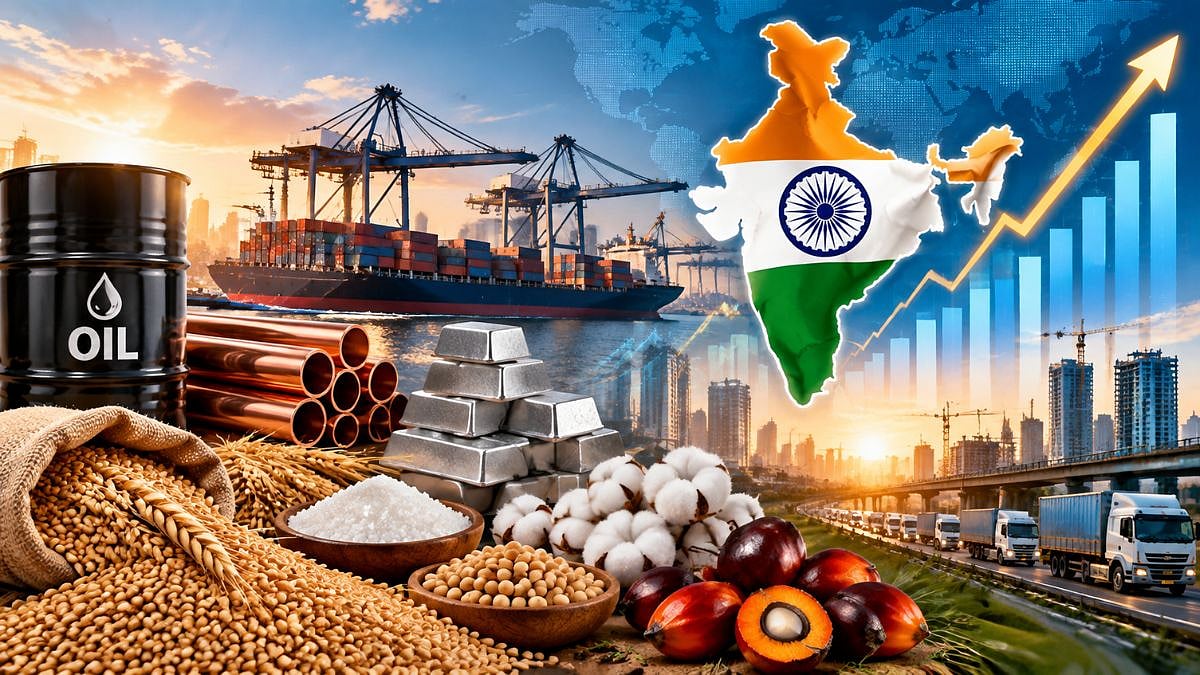
India’s rising demand for energy, metals, food and other commodities could reshape global markets over the coming decades | AI Generated Representational Image
Since the beginning of this year, there has been a broad-based spike in the prices of several commodities, including energy products (crude oil, natural gas), industrial metals (copper, aluminium), and agricultural goods (palm oil, cotton, sugar). For example, Brent crude has moved from below $70 a barrel to over $100 a barrel. Copper has escalated from $13,200 a tonne to $14,300/t. Aluminium is up from $2,700/t to the current $3,500/t. Crude palm oil has spiked from $1,000/t to $1,300/t. Sugar and cotton are no exception.
Temporary Rally Or Super-Cycle?
Many ask if this is the start of another commodity super-cycle. In reality, the current price rise is nothing but a temporary rally caused mainly by geopolitical events centred around the Persian Gulf region that has caused supply chain disruptions of critical energy commodities like crude oil and natural gas. The US-led trade tariffs and El Nino weather phenomenon have exacerbated the situation.
Current high prices contain a risk premium of 10%-15%. Speculative funds have created huge trading positions in the derivatives market. When the threat of military action decisively ends and cargo movement normalises, funds will quickly exit their long positions and risk premium will reduce substantially. There will be a price correction.
A genuine commodity super-cycle has certain distinct features—it would be a multi-decadal phenomenon; it would involve a broad-based rally across a wide spectrum of physical commodities; and it would generally be driven by structural long-term shifts in global demand, while persistent supply constraints may fail to immediately match the demand growth.
Lessons From The Last Super-Cycle
Commodity super-cycles typically last 15-20 years; business cycles last two to five years, driven by short-term inventory changes or monetary policy changes. The current commodity price spike may be a ‘false start’. The spike is essentially temporary, triggered by the ongoing geopolitical and geo-economic upheavals, supply disruptions, and speculative rallies.
The last real commodity super-cycle the world witnessed was in the early 2000s, driven by one country—China. To fuel robust growth, the Asian major had a voracious appetite for commodity consumption—oil, steel, cement, copper, aluminium, soybean, palm oil, cotton, and many more.
That cycle, in a sense, ended some 10 years ago (around 2015) when the Chinese policymakers decided to move gradually from investment-led growth to consumption-led growth.
India’s Commodity Potential
India can trigger the next global commodity boom. India has all it takes to be the next China to drive the global commodity markets and lead at least a mini super-cycle. Large population, economic growth, a ravenous appetite for consumption, and huge growth potential in agriculture, textiles, energy, and construction sectors—all commodity-intensive growth sectors—combine to provide a perfect recipe.
The Indian economy is in an expansionary phase and will continue its robust growth into the foreseeable future. There are eight major growth sectors for India—Agriculture and Food; Textiles and Clothing; Housing and Infrastructure; Energy; Mobility; Healthcare; Education; and Leisure and Entertainment.
While the last three—healthcare, education and leisure/entertainment—are services, the first five are growth sectors of the ‘real economy’ with strong commodity implications. The commodities include food crops, fibres (natural and synthetic), energy products, and industrial metals.
Rising Demand, Emerging Constraints
The strong positive correlation between economic growth and commodity consumption is well recognised. India is already a large producer, processor, consumer, exporter, and importer of a range of commodities.
Going forward, Indian demand for food, textiles, housing, energy, and mobility will continue to expand because of rising incomes, demographic pressure, and current low per capita availability.
Yet, there will be constraints. Limited land availability, water shortages, and climate change would impact growth in agriculture. The way forward is the adoption of multiple technologies to overcome the challenges. India may not exactly be food insecure today, but food security cannot be taken for granted. Demand growth will remain relentless.
Infrastructure And Energy Demand
The infrastructure and housing sector is highly commodity-intensive. Steel, cement, copper, aluminium, wood, rubber, etc., account for over two-thirds of the project cost. At any given point of time, India faces a shortage of about five million dwelling houses. We spend close to $100 billion annually on infrastructure development, covering roadways, railways, airways, seaways, and bridges, as well as urban and rural infrastructure.
Energy fuels economic growth. India is not self-reliant in energy but import dependent (over 85% in crude oil, for instance). Demand for energy products (oil, gas, coal, biofuel, renewables) will continue to expand.
India’s Role In Global Markets
So, in the years ahead, inevitably, commodities will propel India’s growth in a big way for at least two decades. In a sense, India can be the ‘mover and shaker’ of global commodity markets as a large producer, processor, consumer, and exporter or importer.
Our trade and tariff policies can potentially impact global markets. We can attract foreign direct investment in the real economy that has commodity intensity. We can leverage the strength and clout offered by our size and scale. Are we ready?
G. Chandrashekhar is an economist, senior journalist and policy commentator specialising in global commodity markets. Views are personal.
RECENT STORIES
-
-
-
-
-