India-Bangladesh Relations: Towards A Reset Or A Deeper Crisis?
India-Bangladesh ties face pressure from political tensions, energy shortages, trade restrictions and the approaching deadline for renewing the Ganges Water Sharing Treaty. With both sides facing practical reasons to improve cooperation, discussions could focus on energy, essential supplies, trade and water issues rather than an immediate comprehensive reset.

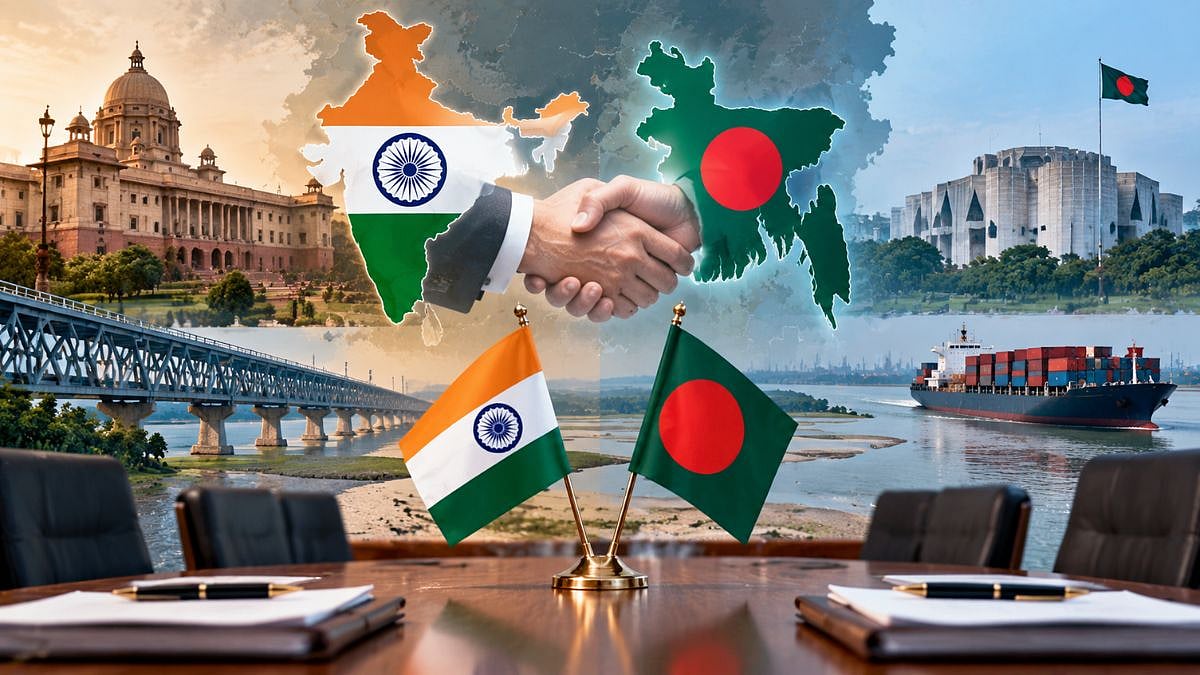
India and Bangladesh face a series of diplomatic, energy, trade and water-sharing challenges as both sides consider rebuilding ties | AI Generated Representational Image
As India-Bangladesh relations try and move towards a reset, rumours are emanating from Dhaka of yet another possible attempt at regime change by Islamists. Islamist groups, which have been witnessing a resurgence, are believed to be in a hurry to lay claim to the throne through yet another mass movement ahead of December, when Sheikh Hasina has announced she will return to her land of birth and face whatever be the consequences. If Hasina returns to Bangladesh, Awami Leaguers and many others calculate that there will be an outburst of nostalgia for the “fallen queen”, who has been dubbed a fascist by her rivals but retains command over large portions of the populace.
However, it must be said here as a disclaimer that such scenarios of chaotic change remain speculative. Nevertheless, the underlying political vulnerability of Dhaka’s governing structure is real enough. Bangladesh’s Prime Minister Tarique Rahman leads a government attempting to consolidate authority after a dramatic election eight months ago in an atmosphere of worsening law and order, rising prices of essentials, prolonged electricity and gas shortages, public insecurity, and an increasingly adversarial political environment.
Amidst all these problems and rumours, the need for Bangladesh to press a reset button and renew relations with its largest neighbour India has perhaps grown even more.
Diplomatic Reset Takes Shape
For months, Bangladesh’s proposed new envoy to New Delhi was a diplomatic appointment waiting to happen. Now, with India having granted its formal approval, Foreign Secretary Asad Alam Siam is set to move to the Bangladesh High Commission in the Indian capital, replacing Riaz Hamidullah, who is heading to Geneva as Dhaka’s permanent representative to the UN Office.
This comes even as Bangladesh is trying to discuss dates for Prime Minister Tarique Rahman to visit New Delhi in the second half of November, after an earlier visit planned for August was cancelled. Siam’s posting, therefore, could be the first piece of a larger effort by Dhaka and New Delhi to reconstruct a relationship badly damaged since the fall of Sheikh Hasina in August 2024.
However, the room to manoeuvre is extremely limited. The deadline for renewing the 1996 Ganges Water Sharing Treaty, signed for 30 years, expires on December 12, and Bangladesh will either have to scramble or else seek a temporary extension till it is better placed to talk ‘fish’ before signing another treaty.
Incidentally, Dhaka is now asking for a new treaty rather than simply extending the old one, including guarantees concerning dry-season flows, something which would be extremely difficult for India to agree to, given the seriousness of climate change in the upper Himalayan tracts.
Ganges Treaty Poses Challenge
A comprehensive new water agreement cannot realistically be negotiated in the space between a prime ministerial visit and the treaty deadline. Even if Rahman were to come in January, it is unlikely that the quibbling over data and guarantees would have ended.
However, for both Bangladesh and states like Bihar and West Bengal, the Ganges dispute is not simply another item on a bilateral agenda; it is one of the few issues capable of connecting high diplomacy with both the country’s domestic politics, agriculture, and environmental anxieties. The treaty itself was negotiated on the basis of hydrological conditions and data from an earlier era, which is far removed from the new realities.
It will have to be seen whether sending the former foreign secretary to New Delhi will quicken the pace of negotiations, given the fact that he is believed to have Rahman’s ears as he had Prof Mohammad Yunus’s. Siam joined the Bangladesh Foreign Service in 1995 and has also served as Dhaka’s envoy in Washington, which would mean he has good links in the US State Department too.
Ties Strained Since Hasina’s Ouster
His predecessor Riaz Hamidullah’s tenure coincided with perhaps the most difficult period in India-Bangladesh ties in decades. Yet in New Delhi Hamidullah acquired an unusually wide network across the diplomatic, bureaucratic, journalistic, strategic, and cultural worlds. The network mattered because the formal relationship had become increasingly difficult.
After Hasina’s ouster and the installation of the Muhammad Yunus-led interim administration, Indian concerns over the treatment of minorities, the Awami League, and the broader direction of Bangladesh’s political transition collided with Dhaka’s objections to Hasina’s continued presence in India. Anti-India rhetoric in Bangladesh became an increasingly visible feature of domestic politics, while disagreements over the future of bilateral agreements and security cooperation deepened.
The return of the Bangladesh Nationalist Party under Tarique Rahman in February did not automatically reverse that trajectory. Dhaka continued to review agreements with India, while questions surrounding Hasina remained politically charged with a section of its political elite and their followers.
Energy Crisis Adds Pressure
The irony is that the political leadership now has strong practical reasons to repair the broken relationship with India. Bangladesh needs stable access to energy, trade, and transit arrangements. India needs a stable eastern neighbour and has a direct interest in the security of its northeastern states, border management, and connectivity with the Bay of Bengal.
However, Bangladesh has another headache—how to keep a lid on domestic politicking and scoring of points against India by politicians and repair its all-important relationship with India.
The country has recently experienced significant gas and electricity shortages. Imported LNG has become particularly expensive amid the wider Middle East conflict, while Bangladesh relies on those very imports for more than 40 per cent of its electricity generation. The resultant energy shock has caused factory disruptions and added pressure on government finances.
The government has acknowledged the seriousness of the problem, with Rahman promising measures to restore industrial gas supplies and expand domestic exploration, while his government has announced plans for new LNG terminals and extensive drilling. But these are long-term measures, and his continuation at Bangladesh’s Ganabhaban may well depend on what he succeeds in doing now.
Practical Bargains Over Grand Reconciliation
Rahman himself has accused political parties and individuals of exploiting the energy crisis to create unrest. Jamaat-e-Islami, meanwhile, has been pressing demands concerning shortages of electricity, fuel and gas, prices, corruption, and law and order as part of a wider political mobilisation.
All these issues make it imperative to seek India’s assistance. However, the problem is that Rahman cannot arrive in New Delhi appearing to have achieved little on the issues that matter most to Bangladeshi voters. At the same time, India cannot be expected to resolve in a few weeks disputes that have accumulated over years.
The answer may, therefore, be less a grand reconciliation than a series of practical bargains on energy, cheaper essential supplies, and reversing a series of tit-for-tat trade embargoes and chokepoints if Rahman were to come to New Delhi.
But then the big question will remain—will Siam be able to pull off a prime ministerial visit, and what will Bangladesh ultimately seek and be content with, and for how long?
The writer is Editor, United News of India.
RECENT STORIES
-
-
-
-
-