How Shere Hite Started A Revolution And Why She Should Get Her Due
Australian historian Rosa Campbell's biography of Shere Hite, published in April 2026, revisits the researcher whose 1976 book challenged views of female sexuality. Columnist Deepa Gahlot writes that The Hite Report sold five crore copies in 13 languages worldwide. Hite gathered anonymous responses from over 3,000 women, although her research methods drew criticism from experts.

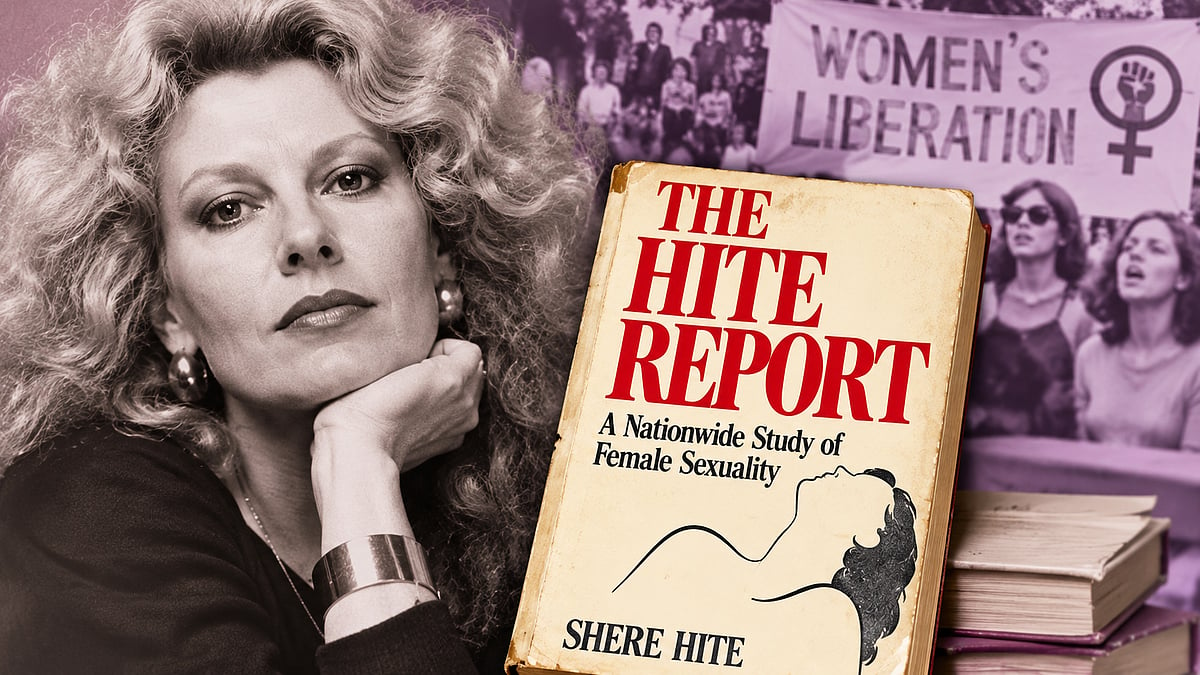
How Shere Hite Started A Revolution And Why She Should Get Her Due | AI
Today, there is a great degree of openness about sexual matters and a lot of medical and sociological research on the subject of sexuality. But 50 years ago, things were very different. And it was then that Shere Hite had dropped a bombshell on a still conservative American society with her book, The Hite Report: A Nationwide Study of Female Sexuality.
Despite the shock and debunking of her method and conclusions by other experts—mostly male—what Shere Hite did was bring the discussion out into the open and take some of the shame and embarrassment that inevitably accompanied talk of sex. There were others, sexologists of course, Alfred Kinsey, Masters and Johnson, Alex Comfort and Dr Ruth. Even so, The Hite Report was back then one of the best-selling nonfiction books, selling 50 million copies in 13 languages all over the world.
Before Hite published her book, studies about female sexuality were the domain of male researchers and traditional Freudian psychoanalysis. In the 1970s, when the feminist movement was breaking myths and urging women to reclaim control over their bodies, Shere Hite understood that existing models of sexuality that revolved around male gratification needed to be questioned and reassessed.
Her method of gathering data may have been unorthodox, but she also challenged centuries of patriarchal standards that surrounded women’s sexual health and bodily autonomy. By letting women speak honestly, she achieved what sexologists before her had failed to do: get women to define their own desires in their own words. And without anyone controlling what they wanted to say, women freely complained, shared opinions, expressed sexual frustration, and admitted to faking orgasms because men’s pleasure was considered more important.
Rather than relying on a conventional research methodology, Hite distributed open-ended, highly detailed questionnaires containing up to 60 probing questions. These were distributed through feminist networks, church groups, motorcycle clubs, and national magazines. Her survey got candid responses from over 3,000 women out of approximately 100,000 distributed questionnaires to women aged 14 to 78. Anonymity was promised, so women could share intimate details without fear of social judgement. Rather than reducing the responses to numbers, she quoted extensively from the completed forms so that the reader could understand what women of varying backgrounds were thinking.
The original Hite Report was compiled from the responses to anonymous survey questions printed in “rainbow ink on pastel-coloured scrap paper and offcuts of old bingo cards and adorned with love hearts, cupid bows and arrows, and starbursts,” according to a piece by Alexandra Jacobs in The New York Times.
Published first by Macmillan, The Hite Report was perhaps the most controversial in the wave of literature exploring women’s libido that included Nancy Friday’s My Secret Garden (1973) and The Sensuous Woman (1989) by Terry Garrity, which could hardly compete with what Shere Hite had achieved.
Later, Hite went on to write The Hite Report On Male Sexuality (1981), compiling the results of about 7,200 questionnaires completed by men. In 1987, she published an update of her first study, The Hite Report On Women And Love: A Cultural Revolution In Progress, the content again collected from questionnaires. That book’s revelation that 98 per cent of American women found their sex lives lacking stirred controversy once again and brought Hite renewed notoriety. In The Hite Report On The Family (1994), she argued that the traditional patriarchal family is repressive and that single-parent families can be more beneficial to children (Source: Britannica.com).
So why, wonders Jacobs, has Shere Hite not been given her due? Was the conservative backlash the cause for whiting her out? Australian historian Dr Rosa Campbell wrote a cultural biography and analysis of the second-wave feminist titled The Book That Taught the World to Orgasm and Then Disappeared: Shere Hite and The Hite Report, published in April 2026. The title is self-explanatory.
A Kirkus.com review states, “Although Hite received grateful letters from women, mostly suburban wives, and even from some men, who admitted that it taught them about sex with women, Hite was attacked by others. She was accused of assuming that a ‘normal’ woman was white and middle-class; some readers outside the US said she was culturally insensitive. Hite was also criticised for promoting an essentialist view of women as nurturers and men as emotionally closed off. In the 1980s, Hite’s trilogy—The Hite Report, The Hite Report on Male Sexuality, and Women and Love—became caught in the crosshairs of a feminist backlash from the right wing and evangelicals, and Hite’s stature plummeted. Campbell aims to revive her contributions: with the rise of the manosphere, trad wives, “resurgent misogyny, homophobia, transphobia, and racism”, Hite, Campbell argues, is worth remembering. A portrait of a complex woman in fraught times.”
A Publishers Weekly piece says, “Campbell shows how Hite’s early life influenced her later interest in sexual dynamics, from her Christian fundamentalist upbringing to her work in porn, but the book captivates most when documenting Hite’s relentless pursuit of her research, including her finagling the National Organisation for Women into sending out the anonymous questionnaires covered “with love hearts [and] cupid bows.” Tracing the extraordinary public response to the book’s publication, Campbell unearths a trove of effusive letters to Hite from women expressing that “a cloud of guilt... was completely lifted” and men questioning whether they had been “complete... sexual partner[s].” Campbell also tackles Hite’s blind spots and personal flaws, including a propensity to “fly off the handle”, which played a role in the 1980s backlash against Hite after an incident in which she struck a limo driver. Campbell, however, notes the excessive misogyny in the press’s treatment of Hite (“How many Shere Hites does it take to change a light bulb?” asked the Chicago Tribune). Readers will find this an essential account of an oft-overlooked feminist pioneer.” Incidentally, one of the many answers to the light bulb question was, "Just one—though she will first send out 100,000 questionnaires to ask how everyone else feels about the dark, and 95% of respondents will report that the bulb doesn't actually need to be screwed in to be satisfying."
Jacobs concludes, “What lingers of the Hite-geist is not the statistics nor the 20th-century idea of ‘normalcy’, but the stories she gathered—a genre living on in New York Magazine’s popular ‘Sex Diaries’, or the confessions of Reddit. Consider it all the manicured middle finger she extended to shame.”
Deepa Gahlot is a Mumbai-based columnist, critic and author.
RECENT STORIES
-
-
-
-
-