Gender Parity Is Still A Distant Dream For India
India retained 131st position among 145 countries in the Global Gender Gap Index 2026, with a parity score of 0.64. The assessment highlights continuing gaps in women’s economic participation and political empowerment, despite relatively stronger progress in education, underscoring persistent challenges to achieving gender equality.

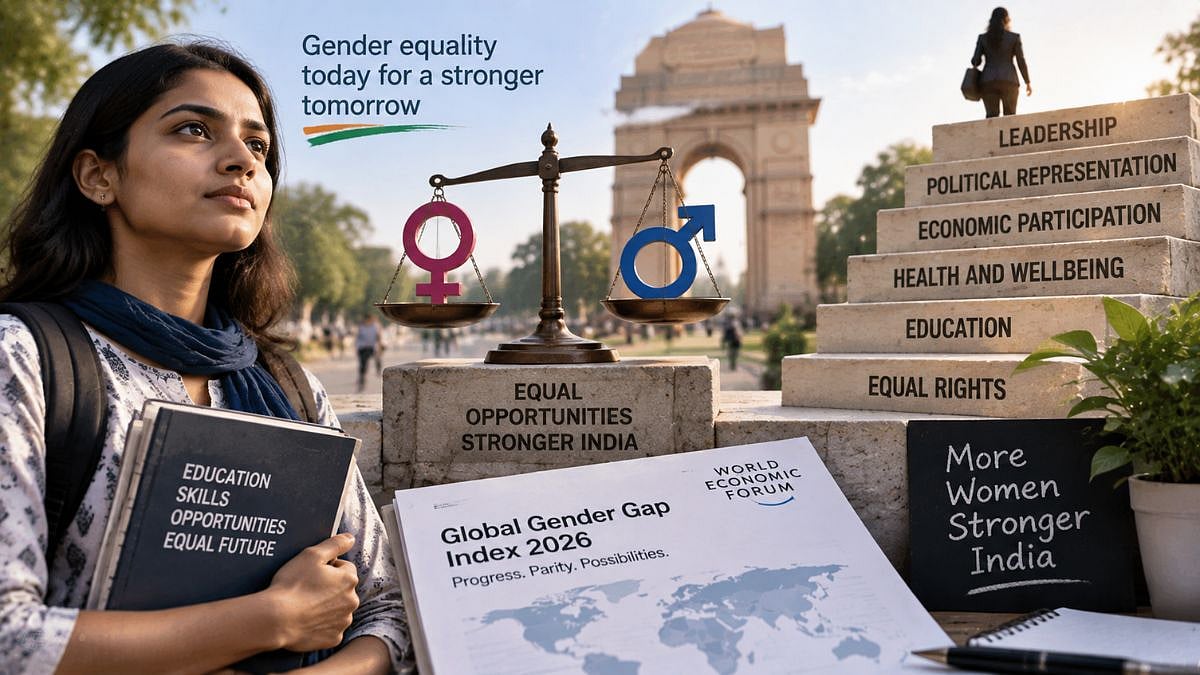
India’s unchanged position in the latest global assessment highlights persistent gaps in women’s economic and political participation | AI Generated Representational Image
The good news in the annual Global Gender Gap Index 2026, released on Wednesday by the World Economic Forum, is that India managed to hold on to its rank of 131, out of 145 countries, that it obtained last year. Only 14 countries, such as Kuwait, Oman, Qatar, Saudi Arabia, Egypt, Morocco, Mali, and Papua New Guinea, are behind India—hardly anything to crow about.
The non-slippage in the rank is not a consolation for the Government of India despite rolling out specific programmes for women’s upliftment and welfare in the past decade. On a scale that measures gender parity from zero (lowest) to 1 (highest), India got a score of 0.64; it was the same in 2014, too, when the BJP-led government assumed power.
Index Tracks Four Key Areas
Given the general attitude of the government, such rankings need not be taken seriously because they follow Western models; it will be surprising if there is a cogent response.
Yet, it would be foolish to dismiss an in-depth exercise that marks its 20th year with this report and has evolved as a globally accepted benchmark of progress on gender issues.
It tracks progress year-on-year on a framework of four sub-indices: Economic Participation and Opportunity Subindex, Educational Attainment Subindex, Health and Survival Subindex, and Political Empowerment.
That India made little progress across these in over a decade should ring alarm bells in the corridors of power, including at the highest level. Even one decimal point improvement calls for committed on-the-ground work rather than vacuous slogans and tokenistic gestures.
India Lags Global Progress
Irrespective of and apart from the official response, India’s place in the Global Gender Gap Index will matter greatly to scores of people working to uplift the lives and status of women in India at educational, economic, social, and political levels.
It is sobering that, of the 143 economies measured, more than two-thirds have improved their gender parity scores, and the five that reported the highest year-on-year improvement do not include India but are Maldives, Niger, Angola, Guatemala and Namibia.
The dichotomy in India between gender parity in education, which is not embarrassing, and gender parity in employment, which is poor, has dogged policymakers for years now.
Education Yet Employment Gap
Women are getting an education but are not contributing on par with men to the economy; a private report earlier this year put the comparative figure at 18 per cent compared to 78-79 per cent of young men in paid employment.
This is a systemic issue where the socio-economic or socio-political structures have not made space for women. This can come neither from making laws nor election-time handouts to women, but from visionary policies and consistent work on the ground. That political empowerment has seen the least improvement tells the story; till this improves, there is little hope for parity.
RECENT STORIES
-
-
-
-
-