El Nino May Lower Kharif Harvest; But Not Compromise Food Security
El Nino and a delayed monsoon could reduce India's Kharif crop output by 10-12% in 2026-27. However, food security is unlikely to be affected due to ample public stocks of rice and wheat. While production shortfalls may lead to supply tightness and higher prices, policymakers have fiscal, monetary and trade measures available to manage inflation and protect consumers.

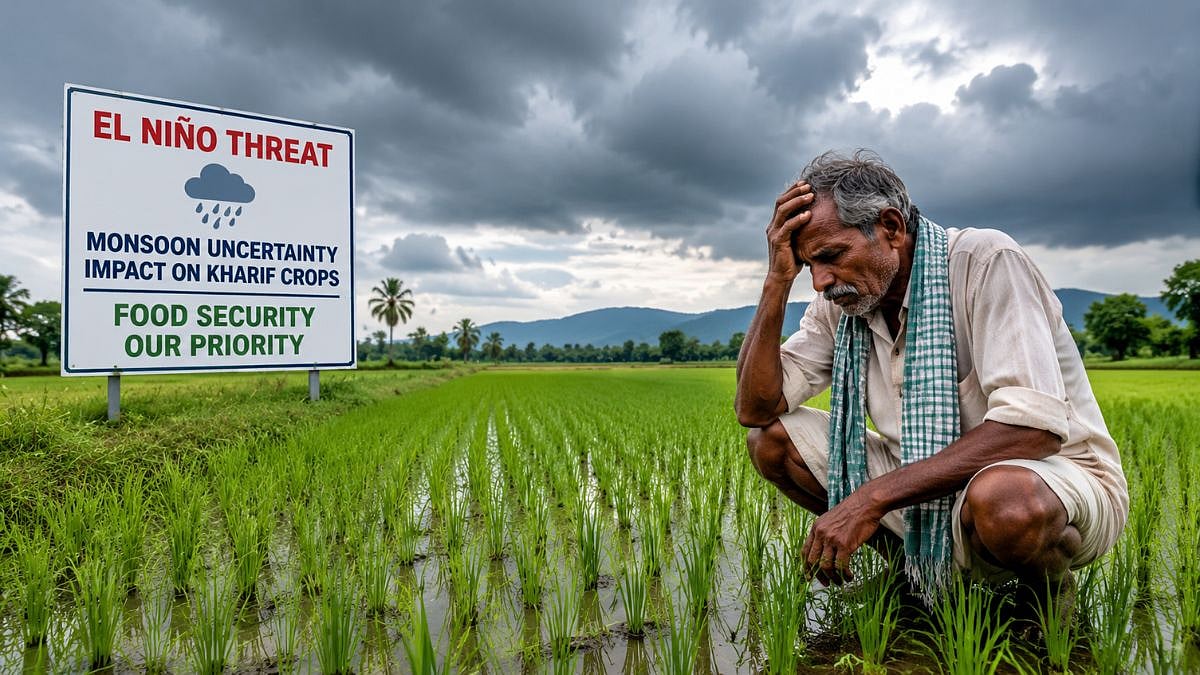
Delayed monsoon progress and the looming El Nino threat could impact Kharif crop production, though India's food grain stocks remain adequate to safeguard food security | AI Generated Representational Image
Even as the country has entered the southwest monsoon season—June to September—concerns over the tardy progress of the monsoon, El Niño threat and tightness in synthetic fertiliser availability occupy the discourse on agriculture.
While the monsoon broke over the Kerala coast on June 4, its northward progress in the following 10 days has stalled. The India Meteorological Department has downgraded its forecast of rainfall from the earlier 92% to 90% of the long-period average of 870 mm, with a model error of +/- 4%. Ninety per cent of 870 mm translates to about 780 mm.
Terms like ‘Super El Niño’, severe drought and threat to food security are doing the rounds. So, how grave is the situation? The looming threat of El Niño is very real, but we do not yet know how severe it will turn out to be. However, we have to be ready to face the worst.
Rainfall Distribution More Critical
First, it is important to recognise that the temporal (over four months) and spatial (geographic) distribution of rainfall is more critical than the total quantum of rains recorded at the end of the season. So, even a lower quantum of rainfall, say 800 mm, well distributed temporally and spatially, can help reduce potential harvest losses.
We are at nature’s mercy. Water storage at major reservoirs across the country is barely satisfactory. Moreover, heatwave conditions of the past six to eight weeks, especially in northern and central parts of the country, have resulted in loss of soil moisture.
A good risk management principle is to build plausible scenarios and design strategies to mitigate adverse outcomes. A district-wise contingency plan could well be the starting point for this.
As a weather phenomenon, El Niño is usually associated with lower rainfall, dry conditions and aberrant behaviour of monsoons. It may result in early or late onset of monsoon, early or delayed withdrawal of rains, long intermittent periods of no precipitation or a large number of cloudy days with no rain.
Such weather patterns confuse the crop and affect the growth cycle. For example, a prolonged period of rainless cloud cover often results in pest proliferation and makes the crops susceptible to pest attack.
Need For Farmer Support
This is where education and active handholding of growers become important.
Engaging with farmers by using the domain expertise of agricultural universities and Krishi Vigyan Kendras would surely help mitigate risks to an extent.
Food Security Not Under Threat
From a food security perspective, our country is not in the danger zone. We have adequate public stocks of rice and wheat. State agencies, like the Food Corporation of India, procured well over 300 lakh tonnes of wheat in the just-concluded Rabi harvest, while rice stocks are at a decade-high level of close to 400 lakh tonnes.
The export of sugar is suspended, while the import of pulses is liberalised till March 2027. Edible oil availability in the global market is comfortable even though prices are high.
It is in this context that New Delhi must review its biofuel policy. We cannot afford to divert essential food crops for fuel purposes, surely not in this year of challenged production prospects. We do not have a genuine food surplus, unlike the US or Brazil, for instance, which produces an enormous surplus of maize (corn), soybeans, wheat and other crops.
Managing The El Niño Impact
In sum, even if the Kharif 2026-27 output of major crops falls 10-12% from the previous year’s level, it would not compromise our food security. Surely, there would be supply tightness and a resultant price rise. Overall, rural incomes may not rise and inflation will burn the pockets of the poor.
As inflation hits the poor the hardest, policymakers will have to deploy fiscal, monetary, trade, tariff and administrative measures in an appropriate manner to mitigate the negative fallout of El Niño.
A four-decade-old statement that ‘Indian agriculture is a gamble on the monsoon’ rings true even today. We have miles to go before we can claim genuine food self-sufficiency to meet the food needs of people.
G. Chandrashekhar is a commodity sector specialist. Views are personal.
RECENT STORIES
-
-
-
-
-