Civic Sense May Be Trending In 2026, But India’s Water Crisis Still Fails To Make Headlines
While civic sense became a viral topic in 2026, India’s worsening water crisis remains under-addressed. Rising pollution, groundwater depletion, and weak governance highlight the urgent need for community participation and long-term water management reforms.

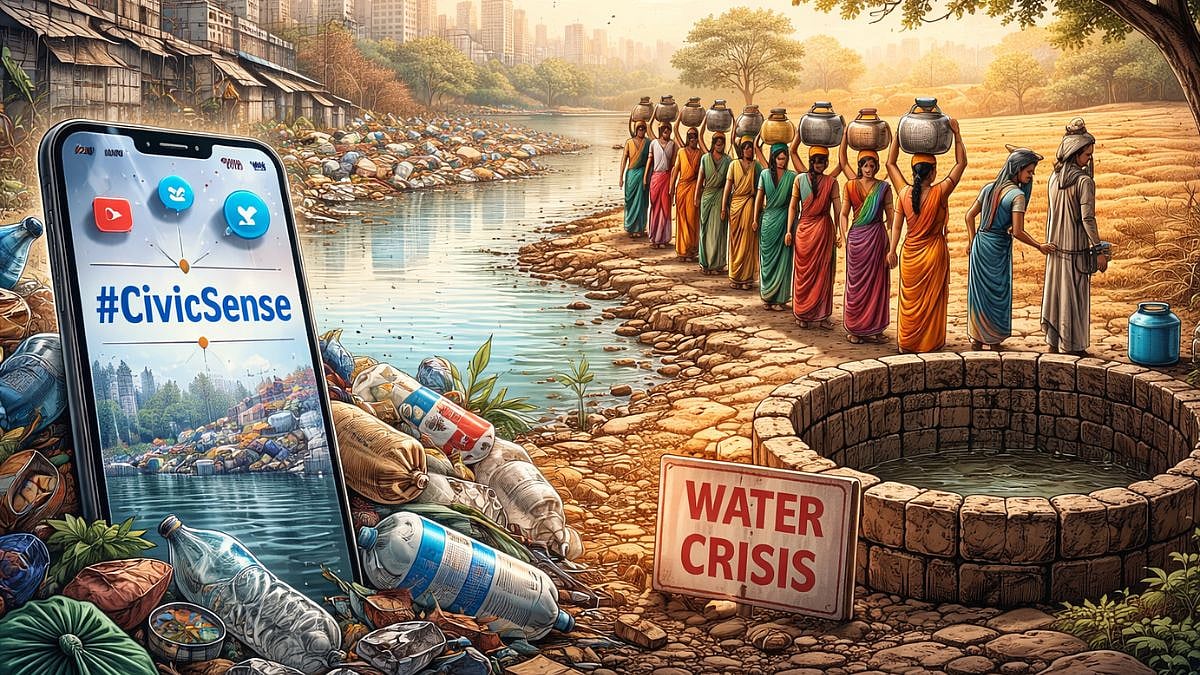
Debate on civic behaviour intensifies as India faces worsening water scarcity and neglected water resources | AI Generated Representational Image
The year 2026 began with a trend around “civic sense”. Social media was flooded with videos calling out people for littering, spitting, or even polluting public spaces, behaviours widely condemned as signs of “zero civic sense”.
While the outcry is much needed, it also raises an uncomfortable question: why did it take a viral trend to bring back our attention to something so fundamental? And more importantly, will this concern fade once the trend cycles out?
From polluted lakes to disappearing wells
Consider a lake in the middle of a city, once known for its beautiful sunset views, now choked with plastic waste and domestic garbage. What was once a shared public space has quietly turned into a dumping ground.
Or think about village wells, historically common resources for drinking and daily use, now vanishing, leading to a proliferation of borewells, often going hundreds of metres deep in water-scarce regions. Or, picture young girls standing in long queues, forced to skip school just to collect water in 2026.
These are not isolated images; they are reflections of a deeper, systemic crisis that rarely sparks the same level of public outrage.
Rising water stress across India
India, once abundant in water resources, with over two million natural and man-made water bodies, is now facing a troubling reality. Nearly 16% of these are no longer in use due to pollution, siltation or drying. Around 65% of India’s states fall under high or extremely high water stress, and the situation is expected to worsen.
As India advances towards manufacturing growth and water-intensive cropping, groundwater is being extracted faster than it can be replenished. Even states like Manipur, Meghalaya and Sikkim, traditionally rich in rainfall, are projected to face higher water stress due to climate variability and increasing human pressures such as deforestation and rapid urbanisation.
Gaps in implementation and long-term accountability
In response, the government has allocated significant funding for water, sanitation and river conservation. However, the outcomes do not always reflect the scale of these investments.
In many cases, initiatives show encouraging early progress and receive attention for their successes, but sustained follow-through and long-term planning are often needed to ensure that these efforts remain effective over time.
India’s real challenge today lies in what happens after water management projects are completed. Many water structures fall back into neglect because the responsibility of their management is either unclear or weakly enforced, and this gap needs a conjunction between government and community responsibility.
Community-driven solutions and role of women
Schemes like VG-RAM G, a rural-focused programme aimed at guaranteeing employment through development-linked projects, and Women Water Champions, empowering women from local communities to manage and safeguard water resources at the grassroots level, can help fill this gap by creating a balance between incentivisation and community participation.
By linking these programmes to post-implementation responsibilities such as periodic water quality audits, community-led monitoring and sustainable usage practices, it can move beyond short-term employment generation to create a long-term system of accountability and care.
Furthermore, women, who are often the primary managers of household water, can be placed at the centre by engaging in planning to manage the resource, thereby formally acknowledging and strengthening the role they already play informally.
The balance between paid structure and voluntary responsibility is crucial. Financial incentives can initiate participation and ensure consistency, but long-term sustainability depends on building a sense of ownership and a relationship with natural resources.
Beyond viral trends to sustained action
Ultimately, the conversation around civic sense cannot remain a fleeting passing trend. Nor can it end with public outcry alone. Sustainable management must integrate science-backed efforts, community participation and continuous accountability. Only then can conservation efforts move beyond short-term metrics to build long-term resilience.
Water, after all, should not need a viral video to remind us of our responsibility towards it.
About the authors
Ashlesha Gaikwad is a researcher at the WOTR Centre for Resilience Studies, focusing on water policy and governance.
Faraz Rupani is an economist at the WOTR Centre for Resilience Studies, focusing on sustainable development, climate finance, rural resilience and climate change.
RECENT STORIES
-
-
-
-
-