Beyond The Pale Blue Dot: Voyager 1’s Onward Journey To The Final Frontier
NASA's Voyager 1 has reportedly reached a distance of one light-day from Earth, around 49 years after its launch in 1977, writes astrophysicist Rudraa Abirami Sudarshan. One light-day represents approximately 2,590 crore km, the distance light travels in 24 hours. Originally launched to study Jupiter and Saturn, the spacecraft crossed the heliopause in 2012 and entered interstellar space.

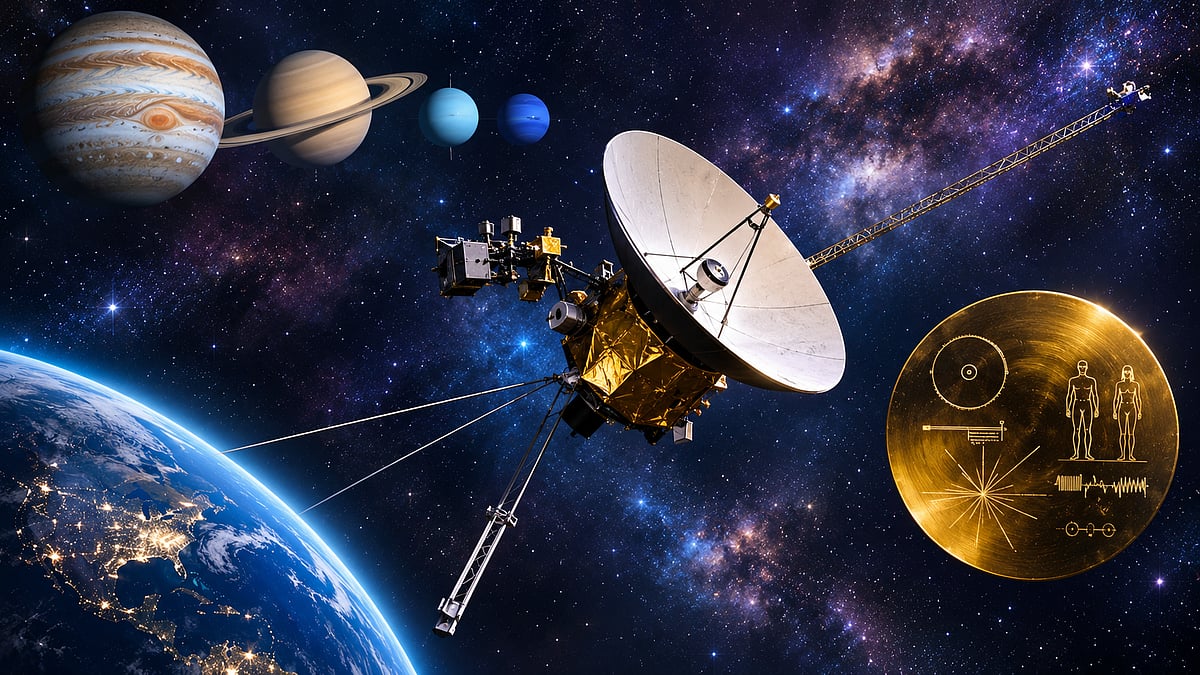
Beyond The Pale Blue Dot: Voyager 1’s Onward Journey To The Final Frontier | AI
A lonely little spacecraft is travelling way above our sky, through interstellar space—that area between stars, a region filled with cosmic dust, gas, debris, and what remains of dead stars. It’s been up there for 49 years since 1977. Last week, it made quite a buzz, having travelled the farthest a man-made object has from planet Earth, completing one light day—it is Voyager 1.
A light day is how far light travels in 24 hours, which is roughly around 25.9 billion km (16 billion miles). Contrary to what you might imagine, it is a measure of distance, not time, and we use this as a standard unit of measurement, as nothing travels faster than light. If you want to travel one light day on Earth, then you would need to travel around the planet over 646,000 times, and with enough mileage you could even travel to the moon and back 67,400 times.
It took Voyager 1 49 years to cover the distance light travels in a day. And if you had a space car of your own to commandeer and hope to catch up with Voyager 1, then it would take you 28,250 years driving at an average speed of 104.61 km/h. An aeroplane travelling at the speed of 885.14 km/h would get you to it faster, but it would still take you over three millennia, 3340 years. While Voyager 1 isn’t travelling at light speed, it is still very fast at 1467721.73 km/h.
Voyager 1 has a twin, Voyager 2. And though it might seem strange, the latter is actually the older one. Voyager 2 set off on its journey on August 20, and Voyager 1 shortly thereafter, on September 5, both from Cape Canaveral, Florida.
In the late 1970s and 1980s, a unique phenomenon occurred. The outer planets (Jupiter, Saturn, Uranus and Neptune), had arranged themselves in a way that a single spacecraft could visit them while using a minimum amount of fuel and in a minimum amount of time, thanks to gravitational assists from the planets. This rare window of opportunity occurs once every 175 years, enabling the spacecraft to continuously propel itself to its destination.
Aside from the flybys, the Voyager twins draw power from three radioisotope thermoelectric generators (RTGs). These devices are used in deep space missions when the spacecraft are too far from the Sun to use solar panels. The RTG works by converting the heat which is produced from the radioactive decay of the plutonium kept inside into electricity, which is what keeps the spacecraft and its onboard instruments (the computers, the radio and the transmitter) going. These were not an infinite power source, however, and were initially meant to last only five years. Even now, NASA routinely shuts down instruments to preserve power. Voyager 1, as of now, has four functioning instruments—the cosmic ray telescope, the low-energy charged particles experiment, the magnetometer, and the plasma waves experiment.
Launched as part of the Voyager Mission in 1977, these two were sent out into space to specifically study the gas giants, Jupiter and Saturn, as it was too expensive to craft a spacecraft loaded with instruments for all four planets. They were to get up close and personal to study them, their moons, and Saturn’s rings. They have an onboard transmitter through which they send back data collected down to Earth in the form of weak radio waves transmitted via NASA’s Deep Space Network.
When scientists realised that the Voyager twins were showing no signs of shutting down, the Voyager Mission became the Voyager Interstellar Mission (VIM), where they studied not only the outer planets but also interstellar space.
The Voyager also carries a 12-inch gold-plated disc known as the Golden Record. In the event of any extraterrestrials who might be travelling through space coming across the Voyager twins, they would find a little disc with images etched on it. The Golden Record contains details about our home planet, the music, people, wildlife, weather, culture, and even greetings in 55 different languages in the form of a phonograph. There’s also a map that explains how old our planet is and where we are in the solar system in case the aliens want to pay us a visit!
The Voyager Mission and the VIM have made pathbreaking discoveries in science that help us understand our universe a lot better. They have also become space-based UV labs, looking at celestial objects that emit UV radiation.
Voyager 1 found that Jupiter has a thin ring around it made up of cosmic dust. It observed lightning on Jupiter, making the large planet the only other place in our solar system to have this particular weather phenomenon. The Great Red Spot in Jupiter turned out to be a storm. It found the cause of volcanic activity on Jupiter’s moon Io. It even discovered Saturn’s bright G-ring.
In 2012, Voyager 1 crossed the heliopause, the boundary region where the Sun’s solar wind is stopped by the interstellar medium. Currently, the Voyager is heading off into deep space beyond the jurisdiction of our Sun, in the direction of a star more than 17 light-years away from Earth called 445, which is in the constellation of Ursa Minor, aka ‘The Little Bear’. However, the ETA is in the very distant future, more than 40,000 years away. We don’t know whether the Voyager 1 will make it, but it has proved us wrong before. Either way, this little spacecraft is trucking along steadily to what we think is its final destination. So, the next time you look up at the sky, think of Voyager 1, which echoes the Star Trek monologue: “Space: the final frontier. These are the voyages of the starship Enterprise. Its five-year mission: to explore strange new worlds; to seek out new life and new civilisations; to boldly go where no man has gone before!”
Rudraa Abirami Sudarshan is an astrophysicist from University College London and a science communicator.
RECENT STORIES
-
-
-
-
-