Avoidable Litigation Clogging The Court's Docket
The Madras High Court criticised a District Vigilance Committee’s approach of using physical traits and language skills to question an SC certificate claim, The Hindu reported. The court held that caste status must be determined through legally relevant evidence and remanded the matter for fresh review.

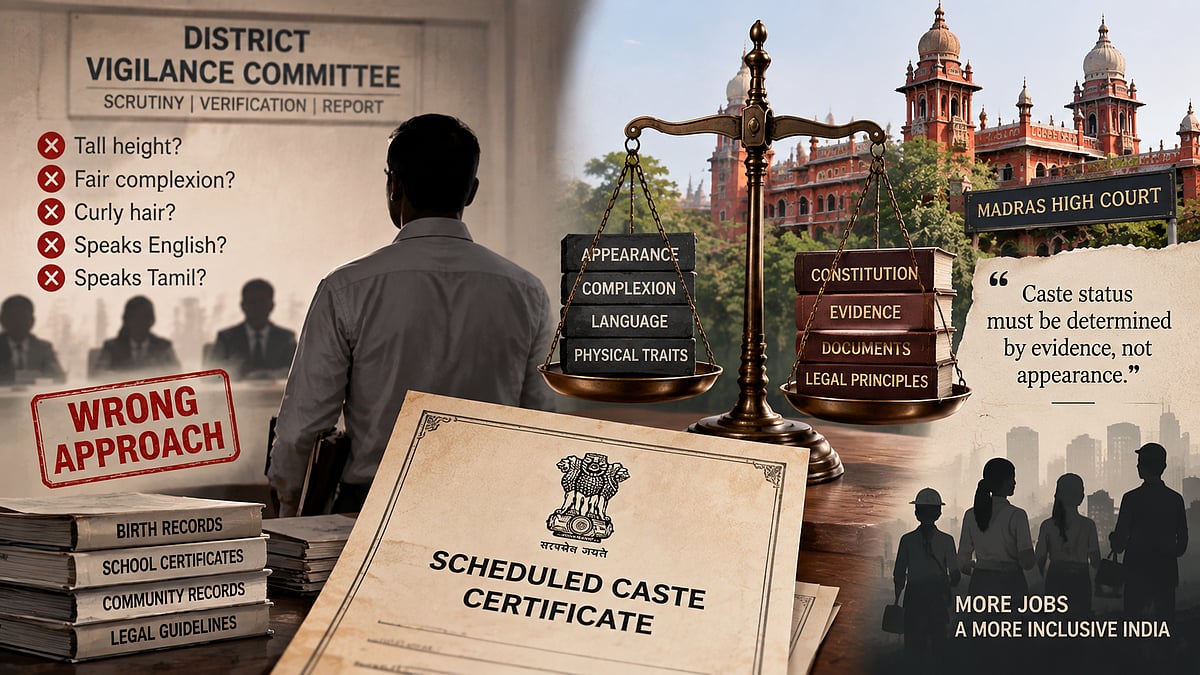
Avoidable Litigation Clogging The Court's Docket | AI
A District Vigilance Committee’s reliance on the physical appearance of a person to determine his Scheduled Caste status, and the Madras High Court’s rejection of this obviously untenable approach, is a classic instance of avoidable litigation clogging the dockets of courts. The case involves a government official, who, at the time of retirement, found his SC certificate under scrutiny by a District Vigilance Committee (DVC), which concluded that the man’s tall height, fair complexion, curly hair, and proficiency in English and Tamil made his caste claim improbable. The adverse decision by the panel led to a legal challenge, and the High Court faulted it for relying on non-evidentiary aspects to make a determination. There is little reason for the DVC to have acted the way it did, since there is abundant constitutional clarity and judicial direction to determine the SC status of an individual. Even where there has been conversion to another faith, such as Christianity, and reconversion to Hinduism, which is a crucial aspect since only Hindus, Sikhs, and Buddhists are eligible for SC status, the test is clear—proof of membership of the earlier community, the acceptance by the former SC community, and total renunciation of the faith to which the member converted. Acquisition of the SC status by marriage is also not possible. Given the legal position, a DVC has little reason to be misled and rely on facile factors that have no empirical value and lack anthropological evaluation to determine caste status.
With due diligence and basic legal acumen, the DVC could have avoided needless litigation. Moreover, the court found some aspects of the committee’s findings relevant but lacking in evidence, and the matter has now been remitted back to it for fresh consideration based on new evidence, such as pictures from his past, that the litigant could present. Determining caste is an administrative function carried out by specific committees and solely rooted in birth, as per the Constitution. It should be the endeavour of such verification panels to act diligently, scrutinising the relevant documentation of birth, schooling, and community events, sparing the higher courts new cases that can be determined conclusively using statute and precedent. Yet, on the other hand, pressure is also mounting on the system because of regression in government employment today and the shrinking of formal employment opportunities; in the instant case, the candidate superannuated in May this year. Beyond the procedural follies over caste determination, there is the question of striving for a labour melting pot where people from different backgrounds meld. In the most populous country, the quest should be for expansion of formal jobs, which would reduce disparities based on caste and community. Unfortunately, it is the precariat that is expanding, putting pressure on the relatively few formal positions available where the reservation system still matters.
RECENT STORIES
-
-
-
-
-