As Forest Fires Escalate, Hills Of North India Struggle To Survive
Forest fires across Uttarakhand, Himachal Pradesh and Jammu & Kashmir are worsening environmental and water crises in the Himalayan region. Experts warn that declining rainfall, hydrological drought and inadequate preparedness are damaging forests, agriculture and water sources, while smoke pollution and shrinking natural springs are affecting public health and livelihoods.

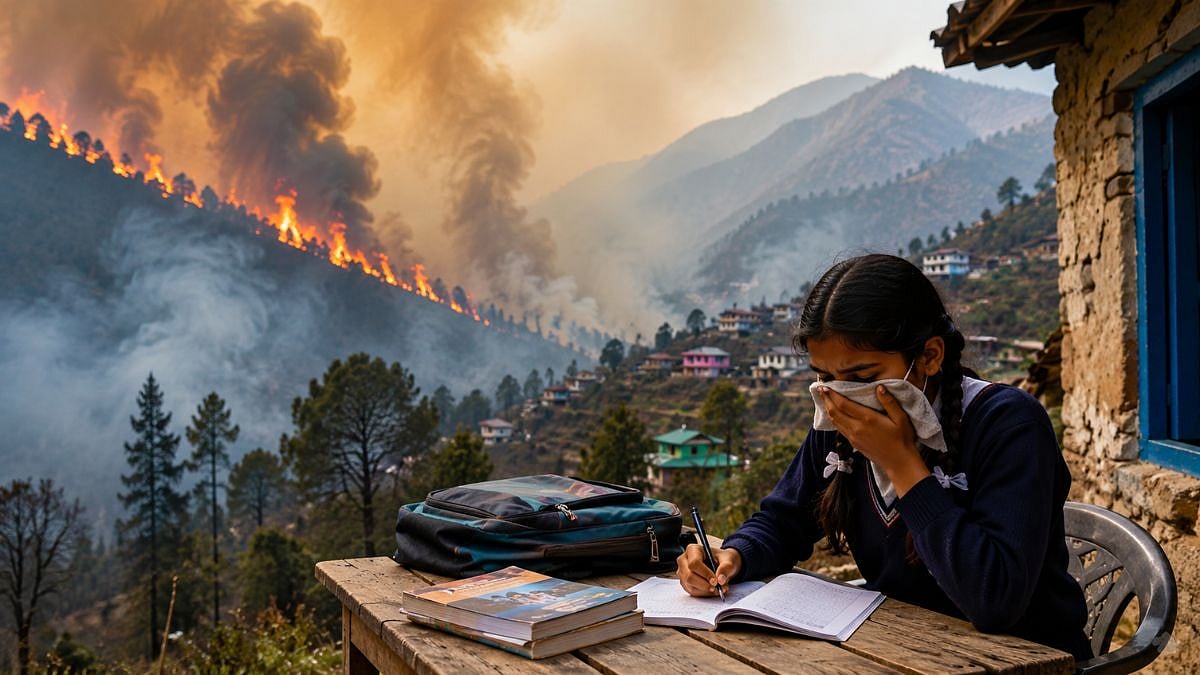
Thick wildfire smoke blankets Himalayan hills as forest fires threaten ecosystems, water sources and livelihoods across North India | AI Generated Representational Image
The hills of North India are grappling with escalating forest fires, severely affecting communities, agriculture, and natural resources. A photograph of a young girl studying in the Uttarakhand hills has drawn nationwide attention, highlighting how hundreds of schoolchildren are forced to cover their eyes with damp cloths to combat the stinging effects of wildfire smoke. Tourists visiting the region have reported hazardous haze, drastically reduced visibility, and respiratory discomfort.
Forest fires across the region
Forest fires have spread across several districts, including Almora, Chamoli, Rudraprayag, Uttarkashi, Pauri, Nainital, and Mussoorie. The flames have engulfed both pine and oak forests above 1,800 metres. Strong winds have complicated firefighting efforts, and tourists are sharing images of smoke rising from scorched slopes.
Satellite images confirm multiple forest fires in Uttarakhand and neighbouring states Himachal Pradesh and Jammu and Kashmir. Between February 15 and May 29, 2026, Uttarakhand recorded 476 forest fire incidents affecting 402.38 hectares. Himachal Pradesh reported 295 incidents, while Jammu and Kashmir logged 926 fires. These fires cumulatively destroy several thousand acres annually.
Weak preparedness and policy gaps
The state’s capacity to combat fires is weak. The National Disaster Management Authority does not recognise forest fires as natural hazards, leaving Uttarakhand without a detailed preparedness blueprint. Last winter, fires starting in January threatened the Valley of Flowers, requiring intervention from the Indian Air Force.
Impact on children and health
Schoolchildren exposed to wildfire smoke—containing carbon dioxide, carbon monoxide, nitrogen oxides, and volatile organic compounds such as formaldehyde and benzene—are experiencing wheezing, chest tightness and other health concerns. Many are being taken to local hospitals for treatment.
Agricultural and economic consequences
Forest fires are devastating agriculture, with 70 per cent of the kafal crop, a key source of income, destroyed. Wheat and apple production have also suffered due to lack of winter snow and weakened flowering. The ongoing hydrological drought, declining winter rains, and increased glacial melt further threaten rain-fed kharif and rabi crops. Fires damage undergrowth, soil health, and increase the risk of landslides.
“Moisture has evaporated from the soil, and seeds are unable to germinate,” said BD Sharma, retired agriculture protection officer. This is driving families to migrate to the plains due to diminished agricultural viability.
Water crisis intensifies
Nearly 12,000 natural springs in Uttarakhand have dried up; Almora district alone lost 83 per cent of its springs. With 90 per cent of drinking water sourced from these springs, residents in Pithoragarh, Champawat, and Almora have been protesting water shortages. In Champawat, the district hospital often lacks 67,500 litres of water daily, delaying surgeries and complicating childbirth.
Tourism and resource imbalance
The last decade has seen a surge in tourists to Uttarakhand, straining water resources. Tourists consume 40–70 litres daily; in Mussoorie, peak-season demand doubles available supply. Authorities in Nainital are extracting extra water from lakes, risking ecological damage. Villages remain parched while hotels and resorts have uninterrupted access. Environmentalists call for limits on tourist inflows to reduce stress on local resources.
Solutions and community involvement
Experts advocate allowing rainwater to percolate to recharge aquifers, combined with nature-based earthworks and afforestation to stabilise soil. Native tree roots act as natural sponges to slow subsurface water flow. Community mobilisation is crucial, with village-level participation, van panchayats, and Mahila and Yuva Mangal Dals forming the backbone of sustainable fire management. In May 2025, Chief Minister Pushkar Singh Dhami praised these groups and announced a loan assistance policy to promote self-reliance.
Conclusion
The Uttarakhand hills face a multi-dimensional crisis—ecological, hydrological, and socio-economic—exacerbated by climate change and inadequate preparedness. Community engagement, ecological restoration, and sustainable tourism management are essential to protect both the environment and livelihoods.
Rashme Sehgal is an author and an independent journalist.
RECENT STORIES
-
-
-
-
-