Artemis II Signals A New Space Era, But Can NASA Move Beyond Rivalry With China?
NASA’s Artemis II mission marks a historic step in lunar exploration, setting the stage for future Moon and Mars missions. However, experts warn that long-term success depends on moving beyond US-China rivalry and building a sustainable vision for space exploration.

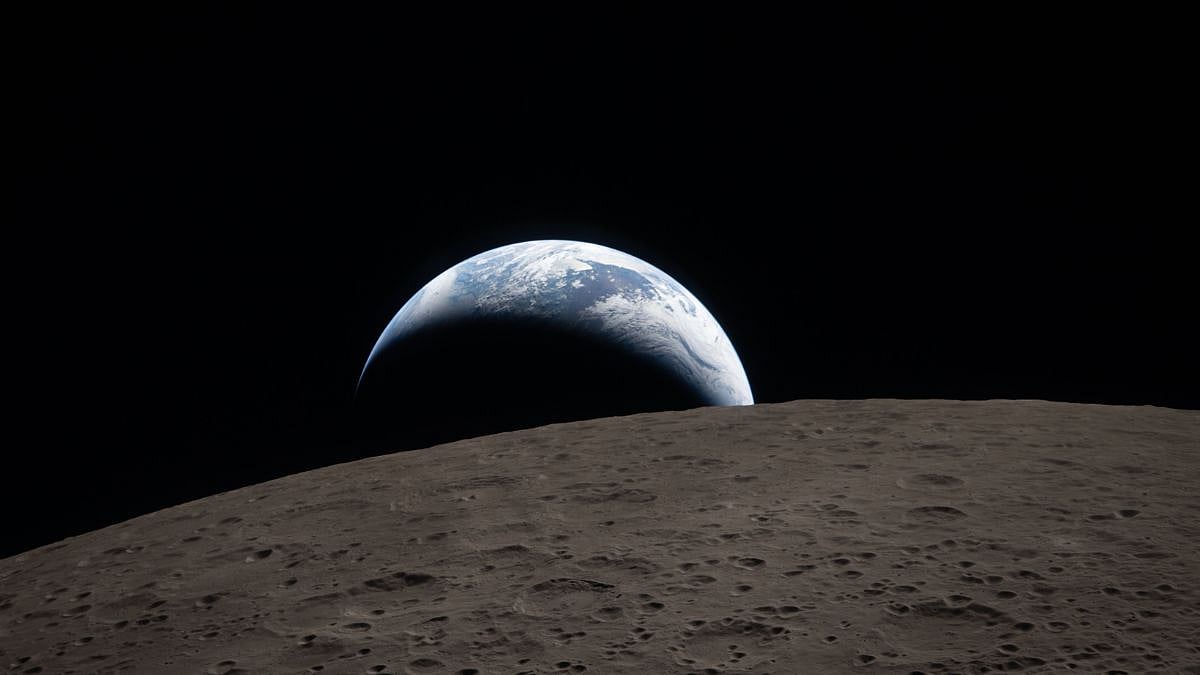
Artemis II astronauts orbit the Moon as mission reignites global ambitions for deep space exploration | X - @NASA
As NASA’s Artemis II mission approaches its expected conclusion on April 10, there is every reason for celebration. The four astronauts—among them a Canadian—have travelled farther from Earth than any human before them, witnessing a solar eclipse from a vantage point few could have imagined.
Swept into the Moon’s gravitational embrace, they looped around its far side, marking a historic moment that echoes humanity’s earliest lunar ambitions. In many ways, Artemis II represents the golden jubilee of America’s engagement with the Moon. It is both a tribute to the past and a bridge to the future.
As mission pilot Victor Glover observed, expectations are immense—not just for what this mission achieves, but for what it makes possible. Artemis II is not an end in itself; it is a precursor to Artemis III, which aims to test critical technologies, including docking with a lunar lander, by 2027. Beyond that lies the larger dream: using the Moon as a staging ground for human exploration of Mars.
Science, ambition and geopolitical undertones
These missions, therefore, are not mere spectacles. They are foundational steps in humanity’s enduring quest to understand the solar system. Yet, beneath the scientific promise lies a familiar geopolitical undertone. Many view Artemis as part of a broader effort to counter China’s growing ambitions in space.
This perception is not unfounded. In Washington, competition with China has acted as a powerful political accelerant—unlocking funding, sharpening focus, and restoring a sense of urgency reminiscent of the Cold War-era space race between the U.S. and the Soviet Union. History, however, offers a cautionary tale.
The Apollo programme, one of humanity’s greatest achievements, succeeded spectacularly—only to be abandoned once its competitive objective was met.
The U.S. landed on the Moon six times and then walked away, forfeiting decades of potential exploration because the race had been “won.” The lesson is clear: programmes driven solely by rivalry are inherently fragile.
Need for a long-term vision
The current momentum behind Artemis risks a similar fate if competition remains its only sustaining force. While rivalry with China may endure, it does not guarantee consistent political or public attention. Strategic priorities shift, and what seems urgent today can quickly fade tomorrow.
A programme as ambitious and long-term as Artemis requires a more durable foundation—one rooted not just in beating a competitor, but in advancing enduring scientific, economic, and human interests.
Looking beyond competition
All said and done, Artemis II is a remarkable milestone, one that rekindles humanity’s sense of wonder and possibility. But its true success will depend on what follows.
If it is to avoid becoming another brilliant but fleeting chapter, the mission must transcend the logic of competition and embrace a broader vision—one that ensures humanity’s return to the Moon is not just a race, but a lasting presence.
Published on: Wednesday, April 08, 2026, 07:10 PM ISTRECENT STORIES
-
-
-
-
-