An Altruistic Gift To Humanity: The World Wide Web And Our Collective Responsibility
The World Wide Web transformed how humanity creates and shares knowledge after CERN released it freely in 1993. As social media and AI reshape the digital landscape, strengthening digital literacy, scientific temper and ethical responsibility is essential to counter misinformation, online fraud and declining civility while preserving the Web's original purpose.

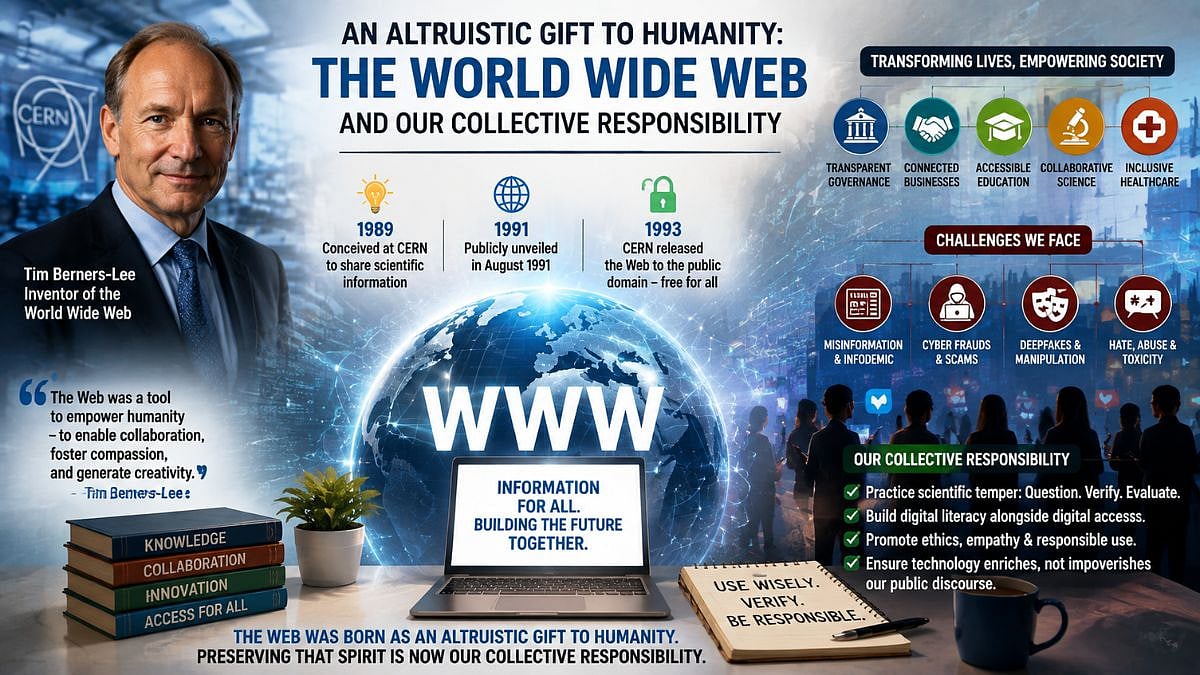
The World Wide Web transformed global access to knowledge, but preserving its original spirit now depends on responsible and ethical digital engagement | AI Generated Representational Image
On August 1 this year, I had the privilege of inaugurating the website of the Alpaiwalla Museum in Mumbai and delivering a lecture titled "From Zero to Web to AI: A Civilisational Journey Through Numbers, Networks and Knowledge". Incidentally, this day is celebrated as World Wide Web Day, a day which “commemorates the birth of the WWW” and its transformative impact on our lives.
My talk reflected not merely on the remarkable technological journey that has transformed our lives but also touched upon a more fundamental question: Have we remained faithful to the spirit in which the Web was gifted to humanity by its inventor, Tim Berners-Lee, and CERN, where the WWW was invented?
A Gift To Humanity
The World Wide Web is arguably one of the greatest acts of scientific altruism in modern history. Conceived by Sir Tim Berners-Lee at CERN in 1989 as a means of managing and sharing scientific information among the international scientific community, the Web was publicly unveiled in August 1991. More significantly, in April 1993, CERN took an extraordinary decision: it released the Web into the public domain, free of patents, royalties or licensing restrictions. CERN voluntarily chose the collective good over commercial gain, enabling anyone, anywhere in the world, to use the Web for free and to build upon it.
Few technological inventions have transformed civilisation as profoundly as the Web. It has helped governments become more transparent, businesses more connected, education more accessible, science more collaborative, and health more inclusive. Distance ceased to be a barrier to knowledge creation and sharing. The Web democratised information on a scale unprecedented in human history.
Yet, history has taught us that every transformative technology carries with it unintended consequences. The invention of the printing press spread literacy and propaganda; nuclear physics gave us clean energy as well as atomic weapons—Hiroshima and Nagasaki. Artificial intelligence promises extraordinary benefits while simultaneously raising serious ethical concerns. Therefore, the Web is no exception.
Challenges In The Digital Age
As the Web evolved into its Web 2.0 avatar, in today's social media-driven ecosystem, information is travelling not merely faster but often without responsibility and verification. The World Health Organisation introduced the term "infodemic" during the pandemic to describe the spread of misinformation during public crises. "WhatsApp University" has entered everyday vocabulary as a metaphor for unchecked forwarding of falsehoods and unverified claims. Deepfakes blur the distinction between reality and fabrication. Online financial frauds, digital arrest scams and identity theft have become distressingly common.
Perhaps even more worrying today is the erosion of civility. Outrage, abuse and sensationalism often travel faster than reasoned discussion on social media. Unfortunately, viral content is frequently rewarded not because it is true but because it attracts attention. Algorithms, designed to maximise engagement, often amplify emotionally charged content. The result is an online ecosystem where falsehood can travel farther than facts and hate often obscures thoughtful conversation.
Recent events in India have once again reminded us how quickly abusive language, misinformation and manipulated content can spread across digital platforms. While democratic societies must always protect freedom of expression, they must equally value responsibility. We must remind ourselves that technology must be used to enrich public discourse, not impoverish it.
Need For Verification
Ironically, even the celebration of "World Wide Web Day" itself offers an important lesson. Millions commemorate it on August 1, although there is no internationally recognised observance of this day by the United Nations or any similar body. Historical events point to other significant dates in the Web's history, including August 6, 1991, when Tim Berners-Lee announced the World Wide Web publicly, and April 30, 1993, when CERN extended it freely to the world. The very uncertainty surrounding the date reminds us that popularity is not necessarily proof. Before accepting information merely because it is widely shared, we must pause and verify its authenticity.
The answer, however, is not to fear technology. The Web has empowered billions, accelerated scientific discovery, enabled digital governance, and transformed education. India itself has demonstrated how digital public infrastructure (the JAM trinity) can improve the lives of millions through innovations in digital identity, payments and public services.
The real challenge is to cultivate digital literacy alongside digital access.
Scientific Temper And Responsibility
Scientific temper, enshrined in our Constitution, requires us to question, verify and evaluate evidence before accepting claims. Digital literacy must become as important as conventional literacy. Schools, universities, museums, libraries, civil society and governments all have a role in nurturing informed and responsible digital citizens. IT companies, too, must maintain transparency and accountability in the design of their platforms.
As I concluded my lecture at the Alpaiwalla Museum, I left the audience with one thought. Museums preserve humanity’s knowledge. The Web democratised that knowledge. AI is now transforming humanity’s relationship with knowledge. Yet, knowledge without wisdom can become misinformation, and information without ethics and responsibility can become a weapon.
From Zero to Web to AI, technological advances have expanded our ability to create, process and share knowledge. But unless we learn to distinguish truth from falsehood, technology alone will not make us wiser. Scientific temper and ethical responsibility remain indispensable companions of every technological revolution.
In his article titled “Marking the Web’s 35th Birthday: An Open Letter”, posted on Medium on March 12, 2024, Tim Berners-Lee wrote that the Web’s original purpose was to enable collaboration, foster compassion and generate creativity—what he called the three Cs of the Web’s utility. It was a tool to empower humanity. He, however, lamented that, over the past decade, the Web has too often eroded rather than strengthened those values.
The Web was born as an altruistic gift to humanity. Preserving that spirit is now our collective responsibility.
Senior Advisor to DG CSMVS Museum and former Director, Nehru Science Centre, Mumbai, and NGMA Mumbai.
RECENT STORIES
-
-
-
-
-