AISHE Report 2023-24: Profile Of Students And Teachers In Higher Education
India's higher education system recorded nearly 4.5 crore students and 17.32 lakh teachers in 2023-24, with a Gross Enrolment Ratio of 30%. Undergraduate courses accounted for 76.8% of enrolment, while unaided private colleges enrolled 50.8% of students in affiliated and constituent colleges. Students with benchmark disabilities remained severely underrepresented.

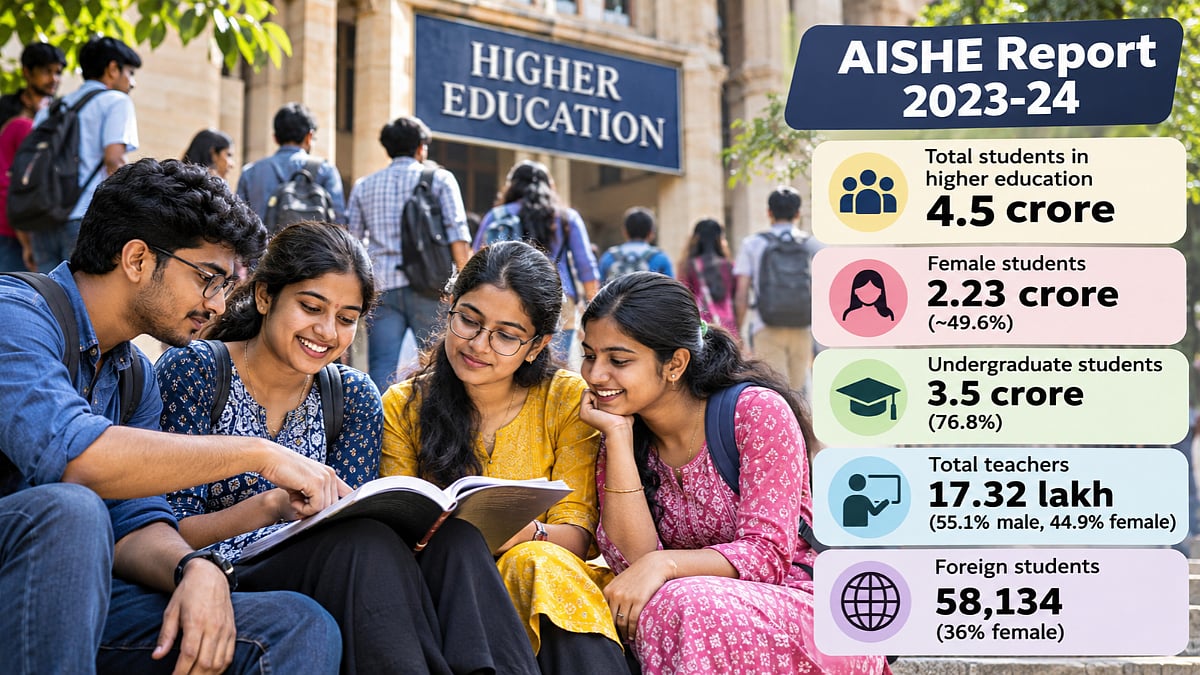
AISHE data highlights enrolment patterns, gender representation and disparities in access across India's higher education system | AI Representational Image
In the previous article (Learning Curve, October 16, 2026), I summed up the present institutional network of higher educational institutions in India. In this part, I will summarise the composition of students, the courses they choose, the number and composition of foreign students, and the teaching staff.
In the AISHE survey 2023-24, the total estimated number of students enrolled in higher education was nearly 4.5 crore, out of which 2.23 crore students were female. Of the total number of students, 15.5% were SCs, 6.4% were STs, and 40.1% were OBCs. Further, about 5% of students were from the Muslim community, and 2.4% of students were from other minority communities. Across communities, the proportion of female students was above 50%, except among OBCs, where the female proportion was almost 50%. There were only about 54,080 students with benchmark disabilities: 34,080 male and 20,000 female.
Student Enrolment Across Courses
About 3.5 crore (76.8%) students were enrolled in undergraduate courses, followed by 57.9 lakh (12.9%) enrolled at the postgraduate level, and about 3.5 lakh (0.8%) students enrolled for a PhD. About 7.4% were enrolled in diploma courses, primarily in technical/polytechnic, nursing, and teacher training courses, and 0.4% in PG diploma courses.
About 1.3 crore students—the highest among all courses—were enrolled in BA and BA (Hons) courses (53.9% female), followed by BSc and BSc (Hons), with 53.4 lakh (53.4% female) students, and BCom and BCom (Hons), with 40.8 lakh (48.0% female) students. Engineering and technology had 43.2 lakh students enrolled (31.1% female). In education, 17.8 lakh students (64.2% female) were enrolled, and in medical science, 21.3 lakh students (57.4% female) were enrolled.
At the postgraduate level, the largest number of students, 10.6 lakh, were enrolled for Master of Arts (18.6% of total enrolment), followed by 10.4 lakh students for management (18.2% of total), 8.6 lakh students for science, 9.6 lakh students for MBA, and around 4.5 lakh students each for commerce and Indian languages.
At the PhD level, total enrolment was 3.44 lakh. The maximum number of students were enrolled in science (23.4% of the total), followed by engineering and technology (20.5%). Other major disciplines for PhDs were social sciences, medical sciences, and management.
Enrolment In Different Types Of Institutions
Out of the total enrolment of students in affiliated and constituent colleges of central and state universities, government colleges accounted for 28.6% of the total enrolment. Private (aided) colleges accounted for 20.7%, and private (unaided) colleges accounted for 50.8% of total enrolment.
There are 11 different types of universities, with a total enrolment of 1.1 crore students. State public universities accounted for around 31.8% of total enrolment, and all open universities for another 29.5%. 62.8% of all students were enrolled in undergraduate courses, while 27.2% were enrolled in postgraduate courses. PhD admissions accounted for only 2.7% of total enrolment.
There were about 23 lakh students enrolled in stand-alone institutions, out of which 60.3% were male. Technical/polytechnic institutions accounted for 60.7% (22% female), nursing institutions for 20% (81% female), and teacher training institutions for 10.9% (60.8% female) of total enrolment.
Foreign Students And Distance Education
The total number of foreign students in 2023-24 was about 58,134 (36% female). These include NRIs, PIOs, and other foreign nationals. They came from 173 countries. Among the neighbouring countries, Nepal accounted for 24.1%, the UAE for 7.0%, the USA for 5.9%, and Bangladesh for 5.9% of the total foreign students. About 73.6% of foreign students were enrolled in undergraduate courses and 16.8% in postgraduate courses.
For students living in remote and distant places and employed students, universities offer distance, private, and online modes of education. Almost 44 lakh students were enrolled in distance mode, 6.5 lakh in private mode, and 2.8 lakh in online mode in higher education at different levels through universities. 63.7% of these students were enrolled in undergraduate courses and 31.3% in postgraduate courses. Distance education contributed around 40.3% of total university enrolment, while the private and online modes contributed another 8.6%.
Gross Enrolment Ratio
The Gross Enrolment Ratio (GER), representing the proportion of students in the 18–23 age group enrolled in higher education, was 30%. It was 27.8% for SC students and 22.8% for ST students. The GER for the male population was 28.9% at the all-India level, 26.4% for male SC students and 21.9% for male ST students. It was 31.2% for the female population at the all-India level, 29.3% for female SC students and 23.7% for female ST students.
Profile Of Teachers In Higher Education
For the year 2023-24, the total number of teachers in higher education institutions was 17.32 lakh, out of which 55.1% were male. At the all-India level, about 32% of all teachers were from OBC groups, 10% were from SC communities and 3% were from ST communities. About 5.7% of teachers were from the Muslim community, and 8.5% were from other minority communities. The rest, 40.8%, were from the general category.
In terms of gender distribution of teachers, at the all-India level, there were 82 female teachers per 100 male teachers. For the SC category, there were 66 female teachers per 100 male teachers, and for the ST and OBC categories, there were 87 and 79 female teachers per 100 male teachers, respectively. For the Muslim community, it was 65 female teachers per 100 male teachers, while for other minority communities, it was 166 female teachers per 100 male teachers. Among Persons with Benchmark Disabilities, there were 65 female teachers for every 100 male teachers. Among all teachers, 67.2% were lecturers/assistant professors, 9.8% were readers/associate professors, 9.7% were professors and equivalents, and 5.9% were temporary teachers.
To sum up, these data inform us that about 30% of all eligible young people now access higher education in some form or another. Almost 64% of all students enrolled for a general undergraduate degree, and about 51% of students—more than half—were enrolled in unaided private colleges. Our institutions of higher education hardly have any place for students with benchmark disabilities, and there is a negligible presence of foreign students. Simultaneously, the profile of our college teachers is now quite diversified.
Vrijendra taught in a Mumbai college for more than 30 years and has been associated with democratic rights groups in the city.
To get details on exclusive and budget-friendly property deals in Mumbai & surrounding regions, do visit: https://budgetproperties.in/
RECENT STORIES
-
-
-
-
-