After Ayodhya, BJP Turns To Mathura: Will Krishna Become The Next Political Plank?
The BJP’s renewed focus on Mathura and its pitch for a grand Krishna temple have raised questions about whether the Krishna Janmabhoomi issue could become a key political narrative ahead of the 2027 Uttar Pradesh elections. The strategy may help the party seek broader Hindu consolidation while challenging the Samajwadi Party’s PDA mobilisation.

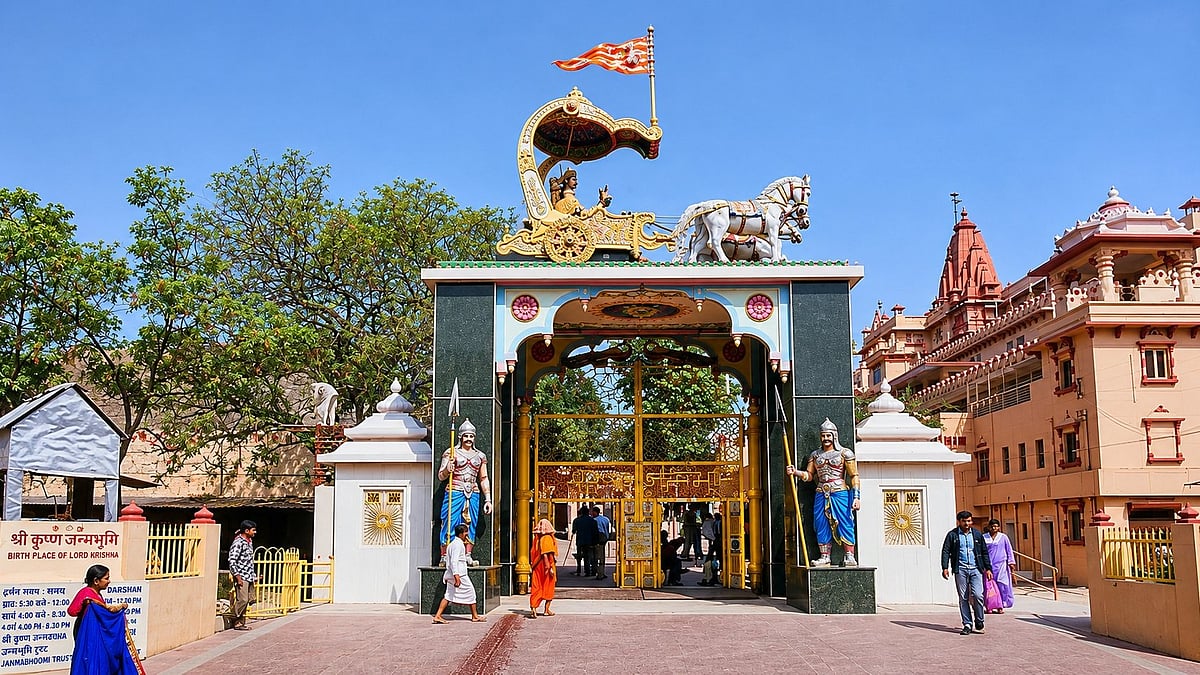
The BJP’s renewed focus on Mathura raises questions about the Krishna Janmabhoomi issue becoming a key political narrative ahead of the 2027 Uttar Pradesh elections | X - Outlookindia
The politics of temples in Uttar Pradesh has never been confined to matters of faith. It has been equally about political mobilisation, identity, and the ability to transform religious symbolism into an electoral narrative. Ayodhya demonstrated how a temple movement could reshape the state's political landscape and help establish the BJP as a dominant political force. Now, with the Ram Temple standing as a reality, the party appears to be looking towards Mathura to keep that political narrative alive.
The BJP's two-day strategy meeting in Braj ahead of the 2027 Assembly elections has brought this possibility into sharper focus. The renewed pitch for a grand Krishna temple, coupled with the slogan ‘Radhe-Radhe, Kamal Khila De’, suggests that the party is preparing to extend its religious-political narrative from Ram Janmabhoomi to Krishna Janmabhoomi. The choice of Mathura for an organisational exercise was hardly incidental. It was a political statement in itself.
BJP Seeks To Extend Temple Narrative
Deputy Chief Minister Keshav Prasad Maurya made the intent explicit when he declared, "Ayodhya hui hamari hai, ab Mathura ki baari hai". He went a step further by inviting Samajwadi Party president Akhilesh Yadav to join the proposed kar seva for a grand Krishna Temple. The challenge was carefully calibrated. Lord Krishna occupies a special place in the religious and cultural identity of the Yadav community, which forms an important pillar of the Samajwadi Party's support base. By bringing Akhilesh into the debate, the BJP is attempting to create a political dilemma for the SP.
The larger significance of the Mathura pitch lies in the timing. The consecration of the Ram Temple in January 2024 fulfilled a promise that had remained central to the BJP's ideological and electoral mobilisation for decades. Ayodhya provided the party with a powerful political narrative, cutting across caste divisions and helping consolidate a broader Hindu identity. With that chapter now reaching a different phase, Mathura offers a fresh rallying point.
However, the BJP may not necessarily be looking to recreate the Ayodhya movement in Mathura. The political circumstances are different, as is the legal context. The dispute over Shri Krishna Janmabhoomi and the adjoining Shahi Idgah mosque remains before the courts. Hindu petitioners have sought removal of the mosque, claiming that it stands on land associated with the birthplace of Lord Krishna, while the Muslim side has contested these claims. In 2024, the Allahabad High Court rejected a challenge to the maintainability of the suits, allowing the litigation to proceed. The court did not decide ownership of the disputed property or order the mosque's removal. The substantive dispute remains unresolved.
This distinction is important because the BJP's emerging strategy could be less about launching another mass movement and more about keeping the issue in public and political circulation. Court proceedings, religious gatherings, political speeches, and visits by prominent leaders can periodically revive the subject without necessarily requiring the kind of sustained street mobilisation witnessed during the Ram Temple movement.
In other words, temple politics could be entering a new phase in Uttar Pradesh—less agitation, more narrative.
Religious Slogan With Electoral Appeal
The slogan ‘Radhe-Radhe, Kamal Khila De’ is particularly significant. It blends the devotional language of Braj with the BJP's electoral symbol, turning a familiar religious greeting into a campaign message. The party is seeking to communicate that its political appeal is not restricted to Ayodhya or the Ram Temple but is rooted in a wider civilisational and cultural identity.
There is also a clear electoral calculation behind the strategy. The BJP suffered a significant setback in the 2024 Lok Sabha elections in Uttar Pradesh, winning 33 of the state's 80 seats against 62 in 2019. The Samajwadi Party, backed by the Congress in the INDIA bloc, emerged as the principal beneficiary of the BJP's reduced electoral footprint. Akhilesh Yadav's PDA mobilisation, centred on backward classes, Dalits, and minorities, challenged the BJP's social coalition and exposed the limits of relying solely on its traditional support base.
Mathura could provide the BJP with an opportunity to revive Hindu consolidation across caste lines. By invoking Krishna, the party can reach beyond the immediate political geography of Braj and appeal to a much wider audience. The BJP would like to position the Krishna Janmabhoomi issue as a question that transcends caste identity, potentially complicating the SP's attempt to consolidate its PDA constituency.
Political Dilemma For Akhilesh Yadav
For Akhilesh, the situation is politically delicate. A direct endorsement of the temple demand could undermine the carefully constructed social coalition that includes minorities. An outright rejection, on the other hand, could provide the BJP with an opportunity to portray the SP as uncomfortable with a religious issue that has resonance among Hindu voters, including sections of its support base. The SP will, therefore, have to balance its social justice narrative with the sensitivities of a politically charged religious debate.
More importantly, the 2027 election will not be fought exclusively on religious identity. Employment, inflation, farmers' concerns, education, law and order, welfare delivery, and development will remain central to the electorate's assessment of the government. The BJP will have to defend its governance record while rebuilding the broader social coalition that came under pressure in 2024. Its strategy meeting in Braj, with an emphasis on booth-level mobilisation, youth participation, and outreach to beneficiaries of government schemes, indicates that the party understands this challenge.
The more interesting political question, therefore, is not whether Mathura will replace Ayodhya; it is whether the BJP can keep the Krishna Janmabhoomi issue alive as a sustained electoral narrative while simultaneously campaigning on development and governance. Ayodhya gave the BJP a defining chapter in Uttar Pradesh's political history. Mathura could become the next chapter, but it is unlikely to follow the same script. The final verdict will depend on whether the politics of faith can once again outweigh the everyday concerns of voters. For now, the BJP has clearly signalled that after Ram, Krishna could become an important part of its political conversation.
The writer is a senior journalist. Views expressed are personal.
Level up your brain the fun way. Play daily games and quizzes on FPJ Smart!
To get details on exclusive and budget-friendly property deals in Mumbai & surrounding regions, do visit: https://budgetproperties.in/
RECENT STORIES
-
-
-
-
-