Acknowledge And Restore The Fundamentals Of The City Life
Maharashtra’s drought crisis exposes Mumbai’s deep dependence on rural regions, natural ecosystems and interconnected urban systems. From water sources in Palghar to mangroves, salt pans and public transport, city life relies on relationships often overlooked by rapid urbanisation. Recognising these links is essential for ecological, economic and social sustainability.

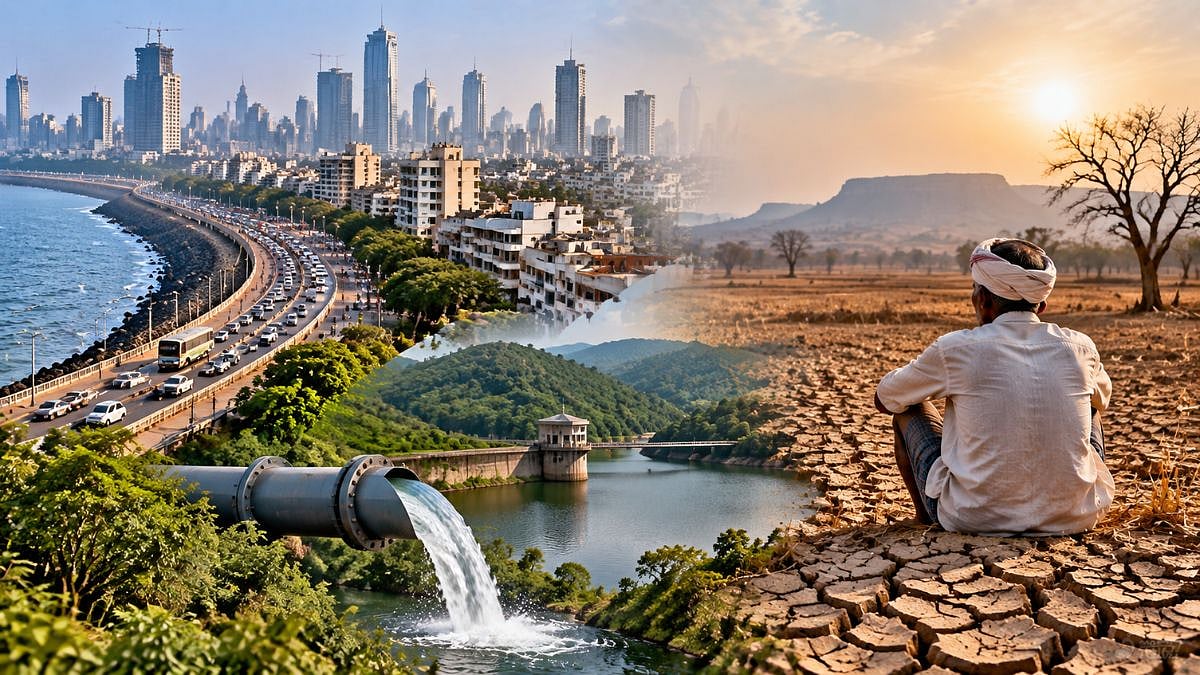
Drought conditions across Maharashtra underscore Mumbai’s dependence on rural regions, natural ecosystems and interconnected urban systems | AI Generated Representational Image
Living the daily rhythms of life in Mumbai, or for that matter in most of Navi Mumbai and Thane, it is possible to be unaware of the extreme and serious situation of drought in most of the districts of Maharashtra. Independent estimates suggest that 31 of the state’s 36 districts have deep drought or drought-like conditions—acute drinking water shortages and agricultural crises, to name a couple—that demand immediate relief measures.
Even the state government acknowledges that more than 20 districts show distress, and the agriculture minister recently termed the situation in Marathwada as “grave”. This could be true of Bengaluru and any of the 177 talukas of the state’s 239 that have been declared as drought-hit. Or of any large city and the rest of the state it sits in.
The Urban Disconnect
The disconnect is disconcerting, but it reflects a lot more of what’s not right with city life. Cities are predominantly seen and repeatedly referred to as “economic engines” or “engines of growth” by those with political and economic power; then, they are structured or buffered so that they do not ordinarily suffer from the vicissitudes of nature and climate that ravage millions of lives outside them. Cities are made, almost, as islands unto themselves. So, a drought-like condition in areas barely 100 kilometres from Mumbai does not even register for most Mumbaikars.
In the process of such urbanisation as is now rampant in hitherto rural or peri-urban areas outside large cities, the most proximate example for us being Mumbai 3.0 and Mumbai 4.0, something precious and fundamental to life is lost—interconnectedness, contextualisation, and co-dependency. The ICC, for short. These form the fundamental framework, the motherboard as it were, of all life. They are most visible in nature, if we care to see, and they silently keep the rhythms of urban life moving. Cities are not ‘self-made’, nor is anyone who lives in them, although it is increasingly in season to claim ‘self-madeness’.
Interconnected City Systems
The themes of interconnectedness, context, and co-dependency are at work within cities too. In Mumbai, for example, every system—from transport and retail of fresh produce to solid waste management and climate action—works on the basis of this fundamental framework. Their gradual fraying or erasure across geographies and groups of people shows up during extreme climate events—the mangroves of Versova are needed to keep parts of south Mumbai flood-free, and the salt pans in the far east of the city hold rainwater for all of the city—or during other crises such as an epidemic or communal riots.
Interconnectedness, contextualisation, and co-dependency are all around us, if we care to acknowledge. Lives in cities depend on the web of nature or natural cycles—roots of trees absorb rainwater, which prevents flooding and recharges the groundwater; evapotranspiration helps in rainfall and cleaning the air; green areas and urban forests reduce ambient heat; small ponds and lakes cool areas around them; and more. Yet, in the profound economic and engineering transformation of city-making, there is a break in interconnectedness, contextualisation, and co-dependency. The relationship with the natural world lies disrupted and fractured, as the interwoven ecosystems are broken down by design.
Urban life, for many, then becomes de-contextualised from their immediate surroundings, let alone being co-dependent on geographies far away in rural districts. The lack of interconnectedness shows in most of Mumbai receiving a regular supply of water even as nearby Palghar sees bone-dry reservoirs and residents yearning for water tankers despite the area receiving an average of 2,000 mm of rain every year.
Mumbai’s Water Dependence
Why should I worry about Palghar or even areas in Mumbai? This is the question often asked. The answer is simple: two of the water systems, the lower and middle Vaitarna, among Bhatsa, Tansa, Vihar, and Tulsi, are situated in Palghar. More examples can be cited, but the central point is that the disconnect makes many city-dwellers forget or remain blissfully unaware of the interconnectedness, the context of getting tap water in Mumbai homes, and the inevitable co-dependency of the city on areas outside its municipal limits.
This is also reflected in the spatial design of areas within the city and then in the relationships between different kinds or classes of people. Several posh or high-end pin codes have poor bus connectivity in the belief that residents use private cars. But what about the transport needs of thousands who service these wealthy families and can afford only public transport to get to their workplaces? Why does the uber-posh commercial and residential island of Bandra Kurla Complex not have adequate public bus routes and autorickshaws plying by the meter? In the SRA-redevelopment of Mumbai, the erstwhile slum dwellers and the upper middle to posh classes share a compound wall between their buildings but little else of their lived realities. Environmentally conscious Mumbaikars campaign for the proposed coastal forest but are rarely seen in the battles being fought to save the mangroves or the Sanjay Gandhi National Park.
Why Interconnectedness Matters
Why should the erasure or fraying of the interconnectedness, contextualisation, and co-dependency become a point of concern? Primarily because cities and their people cannot sustain themselves this way, either ecologically or economically or even socially. The economic machine, driven by political power, might design and even desire the fracture of this fundamental framework, but this hardly promises sustainability.
So, what can one do? Start by recognising interconnectedness. Show it to children and students. Speak about it and emphasise the contextualisation of city life with the natural world and the areas that lie outside the city. Donate and contribute in whatever ways possible to alleviate some of the extremely grim and challenging conditions across Maharashtra. None of this may be enough, but it is a start. And a much-needed recognition of the fundamental framework of life itself.
Smruti Koppikar, an award-winning senior journalist and urban chronicler, writes extensively on cities, development, gender, and the media. She is the Founder Editor of the award-winning online journal ‘Question of Cities’ and can be reached at smruti@questionofcities.org.
RECENT STORIES
-
-
-
-
-