A Stern Warning To India: Don’t Take Water For Granted
India's recurring water crisis reflects decades of inadequate water management, excessive dependence on water-intensive crops, delayed irrigation projects and growing climate risks. The piece calls for urgent policy reforms, including investment in irrigation, climate-resilient agriculture, water conservation, scientific research and coordinated national action to ensure long-term water security.

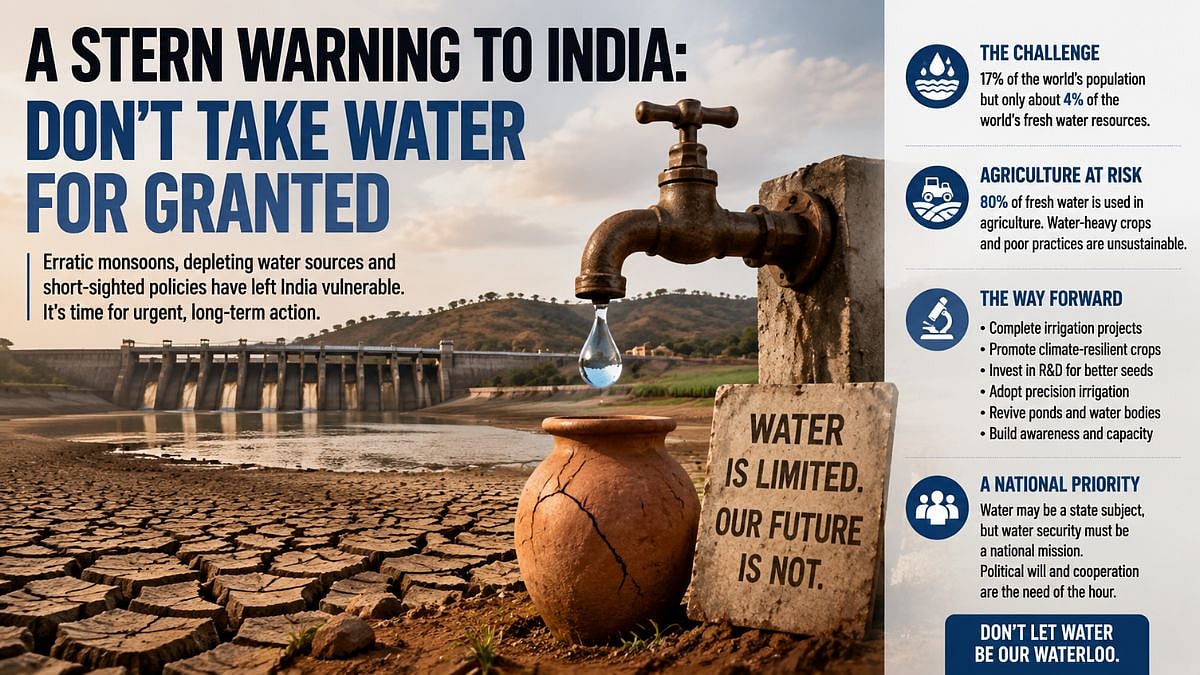
The commentary calls for urgent reforms to strengthen India's long-term water security amid growing climate and monsoon challenges | AI Generated Representational Image
By the end of June, in the four-month southwest monsoon cycle that ends in September, the country was facing a severe water crisis. This followed a heatwave in April and May that led to the loss of subsoil moisture, the delayed onset and tardy progress of the southwest monsoon, and depleted reservoir levels.
Everyone blames the El Nino weather phenomenon that reduces rainfall and brings dry conditions affecting the country's Kharif season planting of key crops like paddy, coarse cereals, pulses, oilseeds and cotton.
Climate Warning Ignored
El Nino may well be the proximate cause of water stress this year, but the country is actually paying a price for its past omissions and commissions. That, as a tropical nation, India was vulnerable to the adverse effects of global warming and climate change, and that these would only worsen, has been well recognised for at least two decades now.
Yet, we chose not to heed the warning signs. It is not that the country does not have adequate water resources or infrastructure to handle the crisis. Our natural endowment includes a long-period average rainfall of 870 mm from the southwest monsoon, hundreds of rivers that criss-cross the country, and a 7,500-km coastline. We have built scores of major and medium reservoirs over time.
Yet, today we are in a situation that simply mirrors what used to be said, perhaps pejoratively, four decades ago: “India is just one bad monsoon away from a farm disaster.” Simply put, we took water for granted.
India is home to 17% of the world's population but has only about 4% of the world's freshwater resources. This is a big mismatch. As the economy grows, so will the demand for water—for agriculture, industrial activity and household use. We have to find ways to augment water availability.
Need For Policy Shift
Our farm policies over the years focused merely on production enhancement without considering the risks associated with climate change. In our country, the farm sector, covering field agriculture and animal agriculture (livestock, poultry, etc.), consumes 80% of freshwater.
We incentivised water-intensive crops, like paddy and sugarcane, which has resulted in excessive use of water (flood irrigation of paddy, for example) and depletion of groundwater levels in many regions. By exporting rice, and occasionally sugar, we are actually exporting water indirectly. The argument that exports benefit growers is specious because the same growers will suffer when water becomes scarce.
It is a wake-up call for policymakers. Several simultaneous steps are required for long-term water security. Some key steps include:
Priority Areas For Reform
Irrigation: Accelerate completion of pending irrigation projects. Scores of irrigation projects face time overruns and cost overruns. Many languish for want of funds, especially for last-mile connectivity. Inter-state water disputes, delayed techno-economic approvals and poor supervision of project implementation are some key challenges.
Climate-resilient crops: Incentivise the planting of millets, pulses and oilseeds, especially in arid regions. Because of production shortfalls, we import massive quantities of pulses and oilseeds (in the form of vegetable oils).
R&D: Invest in developing short-duration, heat-tolerant and drought-resistant varieties of seeds. As seed research is a long-term play, results will be visible in five to seven years. Policymakers have to stay committed to long-term policy in order to attract private investment in R&D that can supplement public investment.
Precision agriculture: Accelerate water-conserving technologies like drip irrigation and sprinklers, especially for horticultural crops.
Ponds: The country has about 600,000 villages, and there was a time when each village had at least one pond. Even urban areas had ponds. These water sources are fast disappearing or falling into disuse. There is a dire need to revive, rejuvenate and desilt these water bodies.
Enlist the services of agricultural universities and Krishi Vigyan Kendras to create renewed awareness and train Farmer Producer Organisations and rural communities in water conservation and scientific water management.
National Resource Approach
Under the Indian Constitution, ‘water’ is a State subject, yet it should be treated as a national resource and every water crisis as a national emergency. It requires enormous political will and commitment to address this challenge. It devolves on the Central government to bring all State governments together to ensure the nation's water security. New Delhi has its task cut out. Don't let water be the nation's Waterloo.
G. Chandrashekhar is a Mumbai-based economist, senior journalist and policy commentator. Views are personal.
RECENT STORIES
-
-
-
-
-