A Memory, A Book And The Politics Over Its Publication
Sonia Gandhi’s upcoming memoir has sparked debate over its reported criticism of Narendra Modi and the RSS, its timing ahead of the Uttar Pradesh polls and the legal risks for publishers. Indian defamation law, freedom of speech and past cases involving politicians highlight the challenges of publishing politically contentious material.

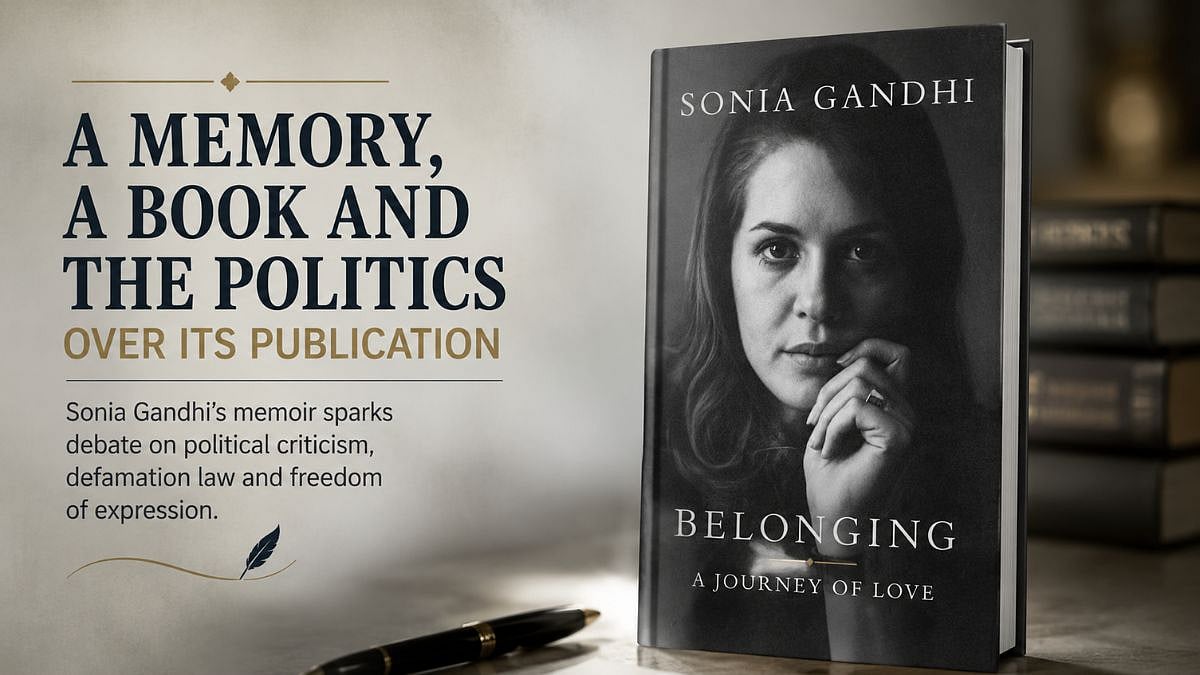
Sonia Gandhi’s upcoming memoir has triggered debate over political criticism, publishing risks and freedom of expression | AI Generated Image
“Publish and be damned” is the politician’s preferred response to being disparaged in a work authored by an opponent. Books and opinion pieces are often deployed to censure political rivals, but in India, they have limited impact on public opinion and voting behaviour. So, politicians tend to shrug off gratuitous criticism from other politicians. Then why the unwarranted fuss over Congress MP Sonia Gandhi’s upcoming memoir, which reportedly impugns Prime Minister Narendra Modi’s leadership and the RSS ideology?
Controversy And Political Timing
For one thing, controversy sells. Regardless of the content of a book, the notion that it contains secrets someone might want to suppress generates curiosity, speculative debate, and social media traction. The book promises to be an interesting read from two points of view: a 1960s fairy-tale romance segueing into tragedy and murky politics, and a behind-the-scenes look at the defining events over the past half-century. But it takes a digital buzz to turn intriguing non-fiction into a viral FOMO product.
The book seems strategically timed, as it will hit the shelves just before the assembly polls in Uttar Pradesh, a state closely associated with the Gandhi dynasty. It was also the site of Sonia Gandhi’s first foray into politics in 1995, where she emerged as a tragic hero figure. People may be keen to read about that episode, but the book itself is unlikely to help the Congress electorally. The many books critiquing ‘Modi’s India’ haven’t damaged the BJP, nor did former US president Barack Obama’s comment on Congress leader Rahul Gandhi’s “lack of aptitude and passion” (in his book The Promised Land) hurt the latter’s political career.
Given that Sonia Gandhi’s views on Modi and the RSS are no secret, it seems doubtful that the government would attempt to suppress her memoir. The PM is no stranger to negative portrayals of his leadership style, accusations of crony capitalism and even complicity in violence against minorities and has always taken it in his stride. Likewise, the RSS has been long accustomed to aspersions on its ideology and activities, for instance by Congress intellectuals Shashi Tharoor, Salman Khurshid, and Kapil Sibal (now an Independent MP) in their respective books. In any case, the only books proscribed by the Modi government have to do with Jammu and Kashmir, presumably owing to security concerns.
Defamation And Political Criticism
Politicians are usually thick-skinned, because they are used to being the target of political satire and vilifying remarks. They have no option but to take it on the chin, so defamation cases filed by politicians are the exception rather than the rule. While there have been egregious instances of people being arrested for posts or forwards about politicians (notably Mamata Banerjee and Karti Chidambaram) under Section 66A of the Information Technology Act, that provision was struck down by the Supreme Court back in 2015. The judiciary has made it clear that political humour and criticism of policies are not considered defamatory, although what constitutes humour is unclear.
Politicians resort to defamation suits only when they are accused of financial misdemeanours or specific violations of law that can dent their public image. Even so, most matters are settled peaceably with a public apology from the offending party. Finance minister Arun Jaitley was satisfied with a “sorry” from AAP supremo Arvind Kejriwal, who had publicly questioned his integrity. Kejriwal also apologised to Union minister Nitin Gadkari for putting his name on a list of corrupt politicians and to Akali Dal leader BS Majithia for linking him to narcotics trafficking. Smriti Irani’s case against Sanjay Nirupam was different in that she was challenging crass sexism in the political space and not just the smearing of her character.
Rahul Gandhi Defamation Case
An exception to the apologise-and-settle rule was Rahul Gandhi’s conviction for criminal defamation, which was stayed by the Supreme Court on the grounds that the trial court’s reasoning in handing down a two-year sentence was unclear. However, the Bench remarked that his comments were not in good taste, and public figures ought to exercise restraint when speaking. Journalist Ravi Nair and activist Medha Patkar are among those convicted of defamation, but their targets were not career politicians.
Publishers And Legal Checks
Coming to the publishers’ perspective, opinions, and subjective perceptions is one thing; allegations of malfeasance are another. Whether Gandhi’s book is covered under Article 19(1)(a) or crosses the Lakshman rekha of Section 356 of the Bharatiya Nyaya Sanhita is for the publisher to determine. In other words, does the book fall under the freedom of speech and expression provision, or can it potentially provoke accusations of slander/libel? As publishers are liable under BNS 356 (previously IPC 499) along with the author, every manuscript is subject to a legal check before publication. If a publishing house finds portions of a manuscript legally dubious, it is well within its rights to demand that they be edited.
Publishers are right to take legal checks seriously, given the litigious nature of Indian society. Controversy sells, but people who claim to be offended by the content of a book tend to rush to court. A rash of petitions leading to a stay on sale and distribution for the duration of the case is not in the publisher’s interest. Such petitions rarely succeed, as the burden of proof lies squarely on the complainants, but having to deal with the legal tangle is an unnecessary and expensive burden.
Memoir Unlikely To Be Suppressed
A grand conspiracy to quash Gandhi’s memoir seems far-fetched, particularly as it is slated for international release. Like Harry Windsor’s ‘Spare’, it may well end up being available as a WhatsApp forward. Times have changed since the government nixed Salman Rushdie’s ‘The Satanic Verses’. Controversial books can be censured but not censored, panned but not banned.
Bhavdeep Kang is a senior journalist with 35 years of experience in working with major newspapers and magazines. She is now an independent writer and author.
RECENT STORIES
-
-
-
-
-