'Why Not Enter Iran?' National Security Chief Mohsen Rezaei Challenges US Over Ground Troops Amid Ongoing War
Iran’s Supreme National Security Council Secretary Mohsen Rezaei has challenged the US to deploy ground troops in Iran if Washington is confident in its military campaign. He questioned its reliance on air strikes, warned of stronger Iranian retaliation against US interests and said Tehran remains open to negotiations if its demands are met.

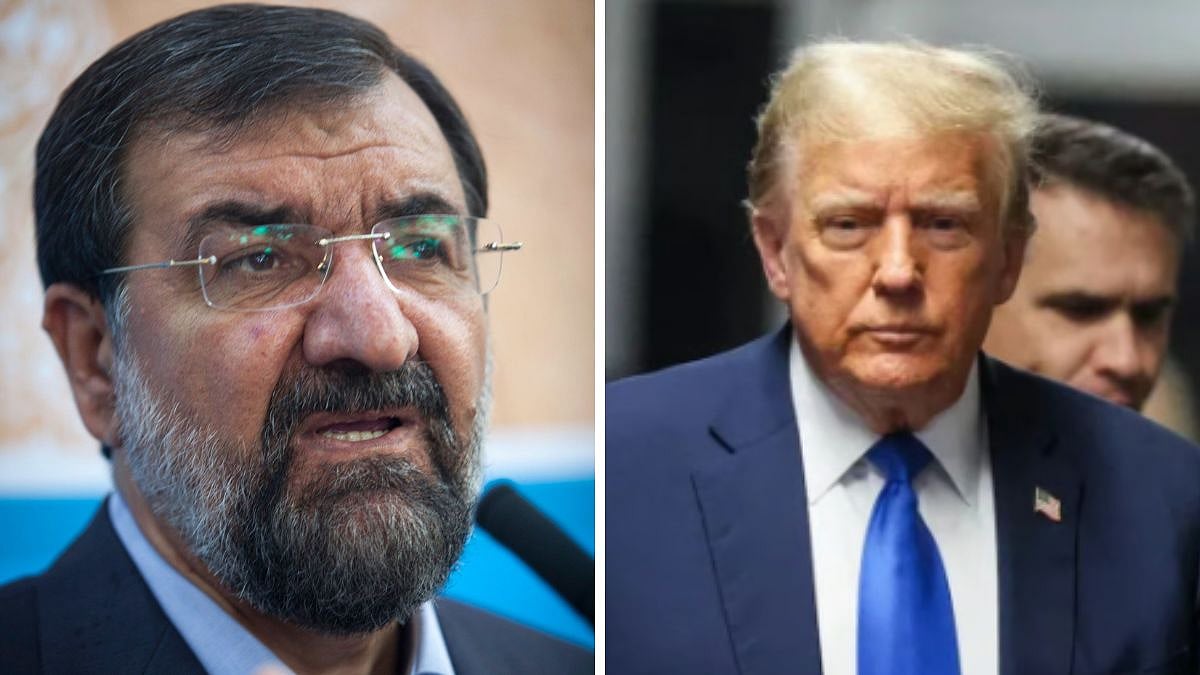
Iran’s Supreme National Security Council Secretary Mohsen Rezaei (L) & US President Donald Trump (R) | X @MarioNawfal & File Pic
Iran’s Supreme National Security Council Secretary Mohsen Rezaei has questioned Washington’s reluctance to deploy ground forces in Iran, saying the United States should send troops into the country if it is confident about its ongoing military campaign.
“If the Americans are serious, let their soldiers come and enter Iran. Why do they not come in?" Rezaei said, arguing that ground forces ultimately have the final say in wars.
He further questioned why Washington has restricted its operations largely to air strikes instead of deploying troops on the ground.
“Why do the airborne divisions not come? Why do the US ground forces not enter Iran? Why do they only bomb from the sky and then leave?" he asked.
US-Iran conflict continues amid military threats
Rezaei's comments come as tensions between Washington and Tehran remain high, with both sides continuing to exchange threats even as diplomatic channels are being explored to bring the conflict to an end.
Reuters reported that Rezaei, a close associate of Supreme Leader Mojtaba Khamenei, became his military adviser in March before being appointed secretary of Iran's Supreme National Security Council in August.
His remarks highlight the contrasting approaches adopted by the two countries. Washington has largely relied on air power and other long-range military capabilities to strike Iranian targets, while Tehran has focused on retaliatory attacks against US military facilities and American interests across the region.
Iran claims it has adapted to US air strikes
Rezaei also said Iran had altered its military approach towards the United States and was now better equipped to deal with American aerial attacks.
He warned that any fresh US strike would trigger a stronger Iranian response against American bases and interests in the region, signalling that Tehran intends to escalate its retaliation if Washington resumes attacks.
Why a US ground offensive would be difficult
The challenge issued by Rezaei comes against the backdrop of a conflict in which the US has so far avoided a large-scale ground campaign or an attempt to seize Iranian territory.
A ground invasion would mark a significant escalation and create a vastly different military challenge for Washington. Iranian territory includes extensive mountainous regions and is home to a large population, making any attempt to deploy and sustain a major ground force particularly complex.
ALSO READ
Previous assessments of a potential US ground operation have similarly highlighted Iran's geography as a major obstacle. Experts cited by Al Jazeera have said a full-scale invasion would be difficult, although they noted that smaller, limited ground operations could theoretically be undertaken.
Rezaei's comments appear to challenge the effectiveness and limits of Washington's existing strategy, particularly over whether continued aerial bombardment can achieve the decisive outcome that Tehran argues would ultimately require troops on Iranian soil.
Diplomatic efforts remain underway
Rezaei's comments also come as diplomatic activity between Iran and the US has continued. On September 19, he told Al Jazeera that Tehran had communicated its conditions for ending the conflict to Washington through Qatar and was awaiting US President Donald Trump's response.
ALSO READ
Iran's demands reportedly include a complete halt to the war across all fronts, the unfreezing of Iranian funds and an end to the US naval blockade.
Tehran has also said that Qatar and Pakistan are maintaining diplomatic contacts aimed at bringing Iran and the US back to negotiations. While Rezaei has warned that Iran is ready for a “decisive war" if its demands are rejected, Tehran has continued to leave the door open for a negotiated settlement.
RECENT STORIES
-
-
-
-
-