Nearly 4 Million Colonial-Era Enslavement Records Digitised And Made Searchable For First Time
Nearly four million records documenting enslaved people across 20 former British colonies have been digitised and made searchable online. The 300,000-page collection, covering 1813-1840, includes names, ages, family links, births, deaths and ownership transfers, helping descendants trace ancestry across the African diaspora.

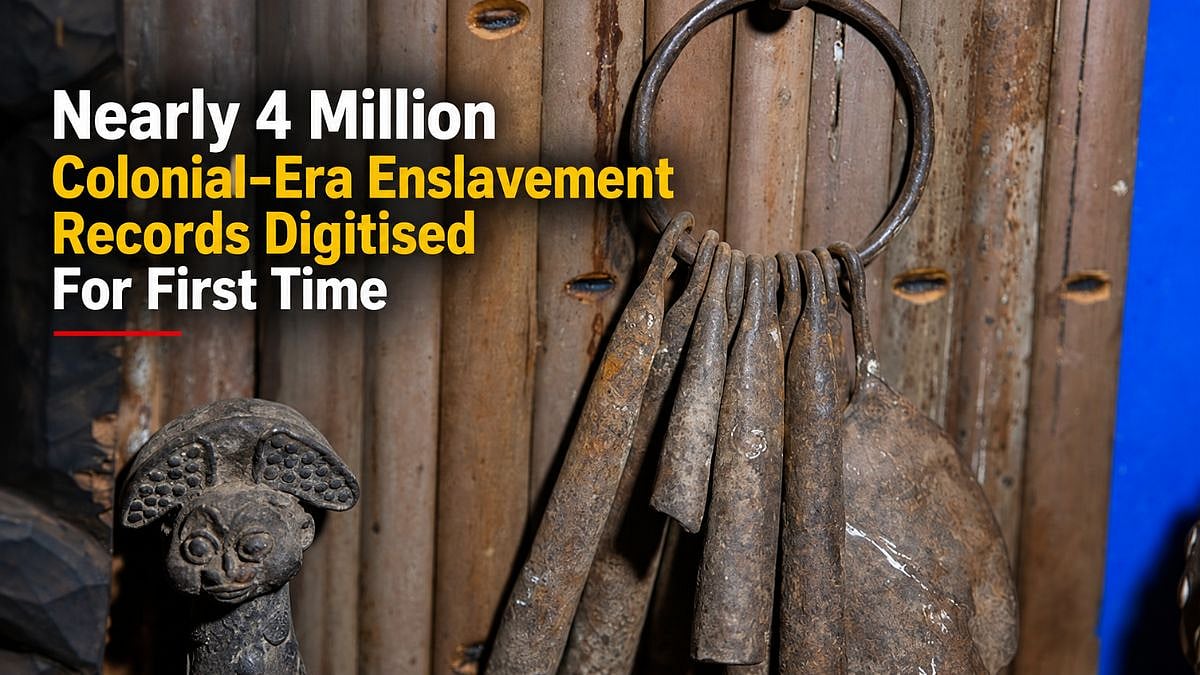
A newly digitised archive is giving descendants access to millions of records documenting enslaved people and their families | AI Generated Image
London, September 22, 2026: Nearly four million records documenting the lives of enslaved people across 20 former British colonies have been made searchable online for the first time, opening up a vast archive that could help millions of descendants trace their family histories.
Genealogy company Ancestry has digitised and indexed the records in partnership with the Centre for the Study of the Legacies of British Slavery at University College London (UCL).
Known as the Former British Colonies Enslavement Registers, the collection contains about 300,000 pages covering the period from 1813 to 1840. It includes records from former British colonial dependencies such as the Bahamas, Barbados, the Cape of Good Hope in South Africa, Jamaica, Mauritius and Trinidad, The Guardian reports.
The collection gives descendants across the African-Caribbean and wider African diasporas access to one of the most extensive surviving archives documenting British enslavement.
Records Detail Families, Births And Transfers
The British government created the registers after the abolition of the transatlantic slave trade in 1807 to prevent the illegal trading of enslaved people and monitor the enslaved population.
The records contain names, ages, physical descriptions and family relationships, along with details of births, deaths and transfers of ownership. Some entries also indicate whether a person was born in Africa or the Caribbean.
Nicka Sewell-Smith, a professional genealogist and senior story producer at Ancestry, said records originally created to count enslaved people as property could now help their descendants reconstruct their family histories.
“When I use these records to unearth my enslaved ancestors, I’m using them for a purpose that was different than what it was initially intended for. Our product is restoring the humanity of a person.”
Some records contain exceptionally detailed information. “You can pinpoint an exact birthday for an enslaved baby,” Sewell-Smith said.
Digitisation also removes a significant practical hurdle for descendants researching their ancestry. Instead of navigating physical registers held at the National Archives in London, they can search the online collection by entering a name.
“There are potentially millions of people who descended from the enslaved people in the archive,” Sewell-Smith said. “Oftentimes, one of the ways that people detach from enslavement is to make an insinuation that there’s nobody living connected to these people. That’s foundationally not true.”
Archive Could Shift Focus To Lives Of Enslaved People
Professor Matthew J Smith, director of the UCL centre, described the registers as “the most systematic set of archival documents we have on enslavement in the British Caribbean and British colonial world”.
The collection’s release follows the publication of the Register of British Slave Traders, a three-year research project that identified as many as 10,500 people who invested in the trafficking of enslaved Africans over nearly 250 years.
Historians have increasingly called for research to focus more closely on the lives and experiences of enslaved people rather than primarily on those who owned, trafficked or administered enslaved populations.
“The biggest piece of the story of British slavery, and it’s also the most misunderstood piece, is the experience of the enslaved,” Smith said.
The collection is also known as T71, after the National Archives series in which the records are held. Smith said the detail contained in the registers could transform researchers’ understanding of enslavement.
“When you start to see the names of those individuals, and their ages, and their children, and get these very fine glimpses into their lives, it transforms how you understand the system.”
Researchers Trace Jamaican Families Across Six Generations
Smith said the records could help researchers recover “family stories, community stories, stories of survival, stories of resistance, stories of the search for freedom”.
Researchers testing the data in Jamaica have been able to trace some families across six generations.
“It is painstaking work, but the rewards are tremendous,” Smith said. “It opens up a whole new way for descendants of enslaved people in the Caribbean, across the African diaspora, to understand how their heritage came to the Caribbean and survived slavery.”
The archive’s potential extends beyond Britain and the Caribbean. Migration and the forced movement of enslaved people mean their descendants can be found throughout the African diaspora, including in the US and Latin America.
“One of the things I’m very excited about is how much more interconnected it’s going to make those of us in the diaspora,” Sewell-Smith said. “It almost makes the world smaller. It tightens us up in a way that I don’t think we even possibly considered.”
Also Watch:
ALSO READ
Millions Of Descendants Could Explore Their Ancestry
Sewell-Smith said the collection’s full potential was likely to emerge as descendants and researchers began linking its records with other archives.
“We’re in a new space, in a new place,” Smith said. “As hard as it is to look at this, it also makes me very excited for the descendants of all these people. They have a better chance to be able to get this information, to use it, and to connect with them.”
The collection is free to search and can be accessed by anyone who creates an Ancestry account.
To get details on exclusive and budget-friendly property deals in Mumbai & surrounding regions, do visit: https://budgetproperties.in/
RECENT STORIES
-
-
-
-
-