Can Coffee Waste Grow A Forest? Costa Rica Experiment Shows Striking Results In 2 Years
A Costa Rica experiment found that spreading 360 cubic metres of coffee pulp over degraded pasture accelerated natural forest regeneration. After two years, canopy cover above two metres reached about 83%, while woody-stem density was more than 20 times higher than in an untreated plot, though researchers cautioned that wider testing is needed.

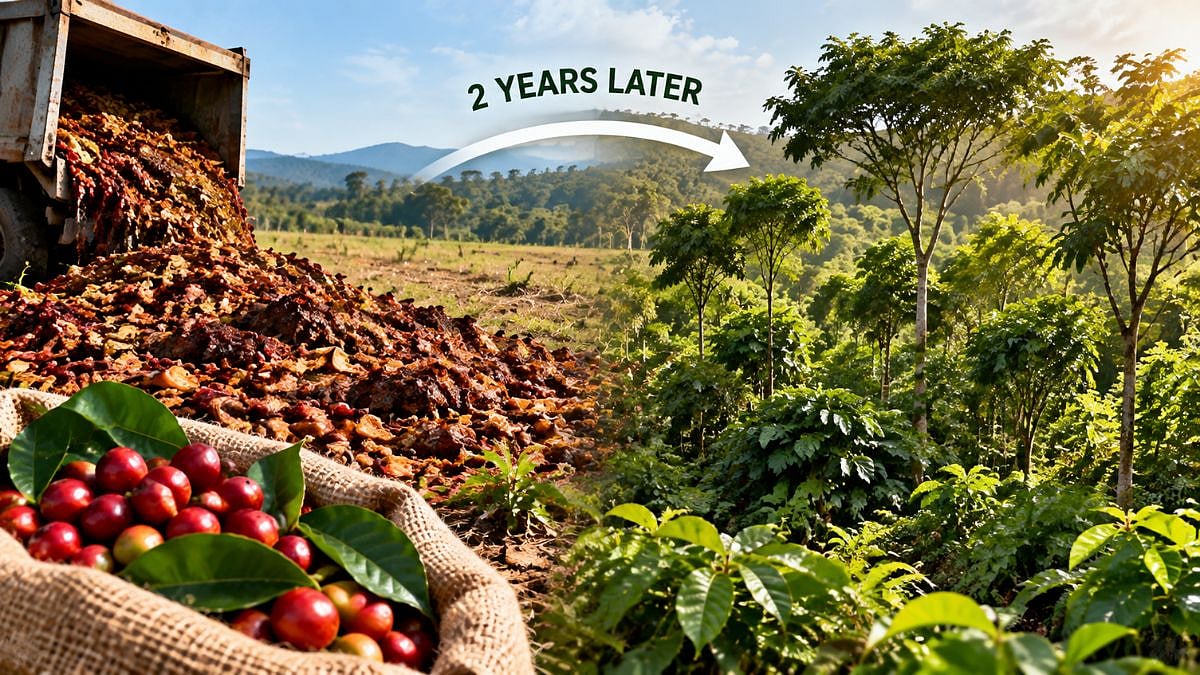
A layer of decomposing coffee pulp helped suppress pasture grass and create conditions for naturally dispersed trees to establish in Costa Rica | AI Generated Representational Image
Mumbai, September 29, 2026: In March 2018, scientists spread about 30 dump truck loads of coffee pulp over an abandoned pasture in southern Costa Rica. Two years later, more than 80% of the treated plot had canopy cover above two metres, according to a study published in 2021.
The researchers deposited about 360 cubic metres of coffee pulp, spreading it in a layer roughly 0.4 to 0.5 metres deep over a 35-by-40-metre plot. An adjacent plot of similar size was left untreated as a control.
The findings were reported in Coffee Pulp Accelerates Early Tropical Forest Succession on Old Fields, a 2021 study by Rebecca J Cole and Rakan A Zahawi. The experiment examined whether nutrient-rich coffee pulp could help overcome barriers to forest recovery on degraded agricultural land.
Rather than planting trees, the researchers tested whether the material could suppress pasture grasses, alter soil conditions and allow naturally dispersed seeds to establish.
Coffee Pulp Suppressed Pasture Grass
The coffee pulp quickly transformed conditions at ground level. Within about three months, the layer had lost roughly half its original depth, while the pasture grass underneath had died and begun decomposing.
By the end of the two-year monitoring period in March 2020, only about five to 10 centimetres of the original coffee pulp layer remained. Grass was almost entirely eliminated from the treated plot, while more than 80% of the control plot remained covered by grass.
The decomposing coffee pulp also altered the soil. After two years, the treated plot had significantly higher carbon and nitrogen levels as well as increased concentrations of nutrients including phosphorus, sulphur, iron and manganese.
Coffee pulp also increased herbaceous vegetation and leaf litter. These changes reduced the dominance of pasture grasses and created conditions that favoured woody plants growing from seeds naturally dispersed from the surrounding landscape.
Woody Vegetation Grew Rapidly
The response of woody vegetation was substantial. After the first year, the treated plot had 16 times the density of woody stems larger than one centimetre in diameter compared with the control plot.
By the end of the second year, woody-stem density was more than 20 times higher in the coffee pulp plot, while mean basal area was nearly 30 times greater.
Average canopy height reached about 4.3 metres in the treated plot, compared with about 1.4 metres in the control. Vegetation taller than five metres covered about 39% of the coffee pulp plot, against less than 3% of the untreated area. Overall canopy cover above two metres reached about 83% after two years.
The woody vegetation consisted mainly of early-successional species, including Heliocarpus appendiculatus and Cecropia obtusifolia.
Researchers found that the trees arrived through wind and animal seed dispersal rather than being introduced with the coffee pulp. The waste material therefore did not create the young forest by itself. Instead, the findings suggested that it removed some of the obstacles to natural forest succession, particularly dense pasture grasses that compete with young trees.
Orange Waste Experiment Showed Similar Results
Coffee-processing waste was not the first agricultural by-product tested for forest restoration in Costa Rica.
In an earlier experiment, researchers studied a former cattle pasture in northwestern Costa Rica where an estimated 12,000 metric tonnes of processed orange peels and pulp had been spread over about three hectares in 1998.
A 2018 study published in Restoration Ecology found that 16 years after the application, the treated land had three times the woody plant species richness of an adjacent control area.
Tree species evenness, measured using the Shannon Index, was also three times higher, while above-ground woody biomass was 176% higher than in the control area.
Both experiments provide field evidence from Costa Rica showing that agricultural by-products were associated with changes in degraded land that favoured forest regeneration.
Researchers Flag Limits And Environmental Risks
The coffee pulp experiment, however, involved only one site and was monitored for two years. The study's authors said longer-term and replicated research would be necessary to establish whether the approach could work across different landscapes.
They also identified practical and environmental limitations. Transporting large quantities of agricultural waste requires adequate road access and relatively flat terrain. Runoff and the movement of organic material or contaminants into surrounding areas could also pose environmental risks.
The experiments therefore do not suggest that coffee waste can simply replace conventional reforestation. In the coffee study, the pulp suppressed pasture grasses and changed soil and ground-cover conditions, followed by the rapid establishment of naturally dispersed trees and shrubs.
Also Watch:
The earlier orange-waste experiment similarly documented longer-term changes in woody vegetation. Together, the findings suggest that agricultural waste could potentially help natural forest succession, but its effectiveness, environmental risks and costs require testing across a wider range of conditions before the approach can be used on a larger scale.
To get details on exclusive and budget-friendly property deals in Mumbai & surrounding regions, do visit: https://budgetproperties.in/
RECENT STORIES
-
-
-
-
-