UP Govt Presents Record ₹9.12 Lakh Crore Budget For 2026-27
The Finance Minister stated, 19.5 percent of the budget is provided for capital expenditure, which will give new momentum to infrastructure, industrial development, roads, energy and urban rural infrastructure. Capital investment will generate employment and strengthen economic activities.

ANI
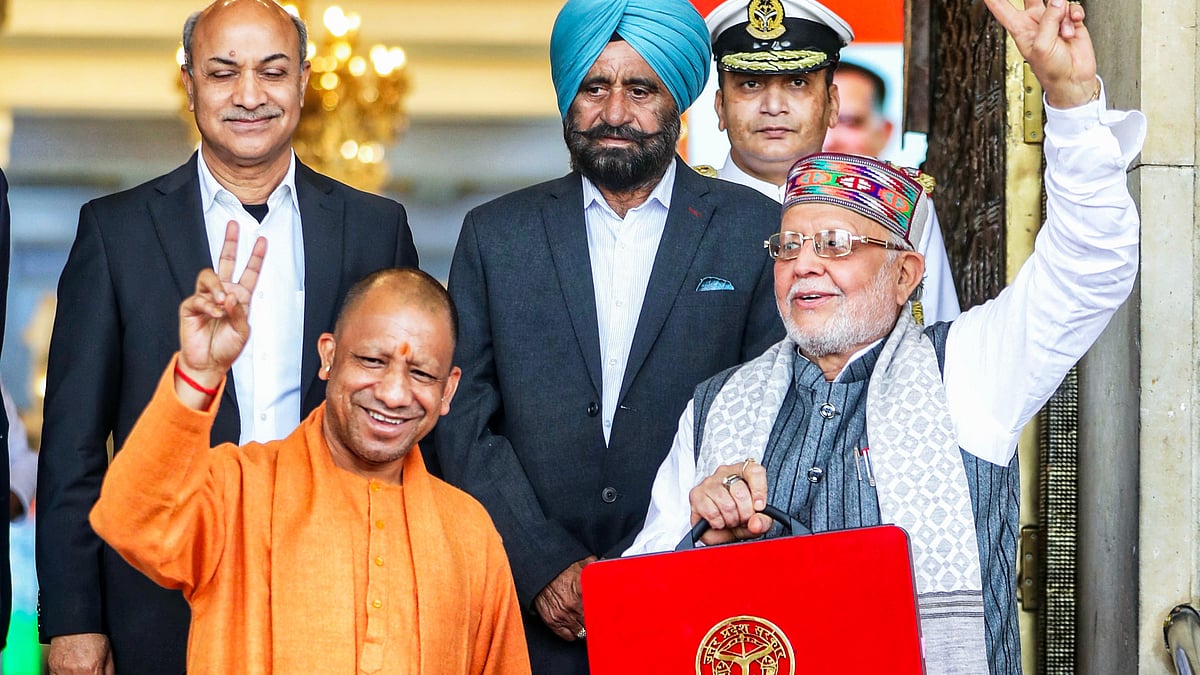
Lucknow: Finance and Parliamentary Affairs Minister of Uttar Pradesh, Suresh Kumar Khanna, on Wednesday presented the Budget for the Financial Year 2026-27 of the Yogi Government in the Assembly. Presented on the theme “ Nav Nirman Ke 9 Varsh”, the total size of Budget 2026-27 is Rs 9,12,696.35 crore, which is approximately 12.9 percent larger than the financial year 2025-26.
In terms of size, the Yogi Government has presented the largest budget in its history so far. Finance Minister Suresh Kumar Khanna informed the House, "This budget is the result of the state’s growing economic capacity, investment friendly environment and strong fiscal management. This budget not only reflects the economic strength of the state but also presents a clear roadmap for long term fiscal stability and sustainable development. Budget 2026-27 reflects the government’s vision in which development, financial discipline and future preparedness have been given equal importance. The budget takes care of every section including Annadata Kisan, youth, women, students and others.
Priority to education, health and agriculture
The Finance Minister stated, 19.5 percent of the budget is provided for capital expenditure, which will give new momentum to infrastructure, industrial development, roads, energy and urban rural infrastructure. Capital investment will generate employment and strengthen economic activities. The Yogi Government has given prominent space to social sectors in the budget. Out of the total budget, 12.4 percent is allocated for education, 6 percent for health and medical services and 9 percent for agriculture and allied services. This clearly indicates that the government considers human resource development and enhancement of farmers’ income as the core of development.
Fiscal deficit within 3 percent limit
He informed, in accordance with the recommendations of the 16th Central Finance Commission, the fiscal deficit limit for the FY 2026-27 is fixed at 3 percent, which will remain applicable till 2030-31. The government has made it clear that it will not compromise on fiscal discipline at any level.
He stated, "The fiscal deficit for the financial year 2026-27 is estimated at Rs 1,18,480.59 crore, which is 2.98 percent of the estimated Gross State Domestic Product (GSDP) of the state. This is within the prescribed limit of 3 percent and underlines the government’s commitment to fiscal discipline. In the overall perspective, while Budget 2026-27 expands development oriented new schemes, it also makes a clear effort to maintain financial stability through revenue savings and a controlled fiscal deficit.
A major step from diesel to solar
Under the Agriculture Department, a provision of Rs 637.84 crore is made for the ambitious scheme to convert diesel pump sets into solar pumps. This will reduce farmers’ dependence on diesel, lower costs and promote the use of clean energy. This step is being considered significant towards green energy transition in the agriculture sector.
International Women Farmers Year and strengthening of FPOs
In view of the United Nations declaring the year 2026 as International Women Farmers Year, the government has decided to establish a corpus of Rs 150 crore under the Revolving Fund Scheme for Farmer Producer Organisations (FPOs) in collaboration with NABARD’s participating institution “Naib Kisan.”
The government will contribute Rs 75 crore to this corpus. Each eligible FPO will be provided a credit limit of up to Rs 50 lakh. Additionally, under UP AGRIS, a provision of Rs 245 crore is made for establishment of Agri Export Hub in the state. The objective is to promote export of agricultural products and connect farmers with global markets. A budget provision of Rs 38 crore is made under Mukhyamantri Krishak Samriddhi Yojana. Along with this, an additional food grain storage capacity of 2 lakh metric ton will be developed in the state, for which Rs 25 crore has been provided.
In addition, the budget provides a major benefit to sanitation workers by making a provision to transfer Rs 16 to 20 thousand directly into their accounts. Preparations for this have been almost completed and the scheme benefits will soon be provided to sanitation workers.
Cashless medical facility for teachers and employees
A proposal of Rs 357.84 crore is made to provide cashless medical facilities to teachers working in Basic Education Council schools, Shikshamitras, special teachers, instructors, personnel of Kasturba Gandhi Balika Vidyalaya and cooks of PM Poshan Yojana along with their dependents. For teachers of secondary schools, Rs 89.25 crore is provided.
A provision of Rs 300 crore is made to provide free sanitary napkins to girl students studying in schools across the state, which is expected to improve health, hygiene and school attendance. A provision of Rs 10 crore is made for AI certification fee reimbursement scheme for graduate and postgraduate students. Additionally, Rs 30 crore is proposed under Mukhyamantri Vidyalakshmi Yojana for additional interest subsidy on education loans for meritorious students.
Promotion of MSME and employment
Under the Micro, Small and Medium Enterprises Department, Rs 575 crore has been provided for establishment of Sardar Vallabhbhai Patel Employment and Industrial Zone. A provision of Rs 75 crore is made for One District One Dish (ODOD) scheme, which will give recognition and market access to local food products. At the same time, under the Infrastructure and Industrial Development Department, special focus is being given to advancing the International Film City project, which will create new opportunities in the film industry and employment in the state.
UP AI Mission and digital infrastructure
Under the IT and Electronics Department, ‘Uttar Pradesh AI Mission’ (UPAI Mission) will be launched, under which programmes of approximately Rs 2000 crore will be implemented in phases over the next three years. A budget provision of Rs 225 crore has been made for this. Rs 100 crore has been provided for State Data Centre 2.0. In addition, under the Planning Department, Rs 10 crore has been allocated for establishment of State Data Authority. To promote industries, ‘Jan Vishwas Siddhant’ will be implemented in 53 departments, for which Rs 10 crore is provided.
Rs 80 crore budget for Shramjeevi Mahila Chhatravas
Under Mukhyamantri Shramjeevi Mahila Chhatravas Yojana, construction work is underway in Gautam Buddha Nagar, Ghaziabad and Lucknow. For expansion in other districts Ayodhya, Bareilly, Aligarh, Mirzapur, Saharanpur and Moradabad, a budget of Rs 80 crore has been proposed. Keeping in mind public health, Rs 359 crore has been provided to start quaternary health care facility at SGPGI.
Along with this, under Cancer Mission, cancer treatment facilities will be strengthened on the hub and spoke model through coordination between the State Health and Medical Education Departments and the private sector.
City Economic Region Scheme: Varanasi Region selected
Under the Central Budget 2026-27, 7 regions have been identified under the City Economic Region Scheme, including Varanasi Region. According to the January 2026 report of NITI Aayog, there is a proposal to develop the Kashi Vindhya region as an ‘Economic Hub,’ under which integrated development will be undertaken in health, education, skills, tourism, manufacturing, energy and housing sectors through 34 priority projects.
Special emphasis on economic empowerment of women
The UP Budget has placed special emphasis on economic empowerment of women. A provision of Rs 200 crore is made under Uttar Pradesh Mahila Udyami Credit Card Yojana to promote women associated with self help groups as entrepreneurs. Through this, easy, interest free and phased capital will be provided to accelerate the ‘Lakhpati Didi’ target.
Additionally, Rs 100 crore has been allocated under Mukhyamantri Mahila Udyami Utpad Vipanan Yojana to ensure sale of products manufactured by women entrepreneurs. Under this scheme, showrooms and shops operated by women will be set up at railway stations, bus stations, airports and major markets, and their rent will be borne by the state government for the first three years.
Major achievement of Yogi Government in debt management
The Finance Minister stated that in 2016-17, the state inherited a debt GSDP ratio of 29.3 percent, which was reduced to 27.9 percent by 2019-20. However, due to the Covid-19 pandemic, this ratio increased to 33.4 percent in 2021-22, but through planned fiscal management it has been brought down again below 27 percent in 2024-25.
The government has set a target to reduce the debt GSDP ratio to 23.1 percent in the financial year 2026-27. Furthermore, in the medium term fiscal policy presented along with the budget, the commitment to bring it below 20 percent in a phased manner has been reiterated. The objective is to ensure long term fiscal stability and sustainable development of the state.
A major step towards new schemes and strong financial structure
The state government has included new schemes worth Rs 43,565.33 crore in its budget, aimed at accelerating infrastructure development, strengthening the social sector and promoting productive investment. This provision is being considered an important step towards long term economic growth and inclusive development of the state.
The total receipts of the state have been estimated at Rs 8,48,233.18 crore. Out of this, revenue receipts are estimated at Rs 7,28,928.12 crore and capital receipts at Rs 1,19,305.06 crore. In revenue receipts, tax revenue constitutes a major share of Rs 6,03,401.76 crore. This includes own tax revenue of Rs 3,34,491 crore and the state’s share in central taxes amounting to Rs 2,68,910.76 crore.
This financial structure clearly indicates that the role of the state’s own resources in its income is steadily strengthening, making the state more economically self reliant and empowered.
Clear emphasis on capital investment
The state government has proposed a total expenditure of Rs 9,12,696.35 crore, with special priority given to capital investment. Out of this, Rs 6,64,470.55 crore has been earmarked as revenue account expenditure and Rs 2,48,225.81 crore as capital account expenditure. This high level of capital expenditure reflects a clear commitment to creation of long term assets, expansion of infrastructure and acceleration of economic activities in the state.
The Finance Minister stated, after deducting total expenditure from the receipts of the Consolidated Fund, a deficit of Rs 64,463.17 crore is estimated. Net receipts of Rs 9,500 crore are estimated from the Public Account. After adjusting both, the net outcome of all transactions is estimated at Rs 54,963.17 crore negative, indicating the need for balanced financial management.
The Finance Minister further stated, "After adding the opening balance of Rs 96.41 crore negative, the closing balance is estimated at Rs 55,059.58 crore negative. A positive indicator is that revenue savings are estimated at Rs 64,457.57 crore, which shows that the state’s regular income exceeds its regular expenditure and is helping in maintaining fiscal balance".
RECENT STORIES
-
-
-
-
-