NASA Introduces Athena: A Supercomputer That Cracks In One Day What A Typical PC Would Take 500 Years To Finish
NASA has brought online Athena, its most powerful supercomputer to date, delivering over 20 petaflops of peak performance. Housed at the Ames Research Center, the system replaces the older Pleiades supercomputer. Athena will power simulations for rocket launches, planetary missions, climate studies and AI models, supporting NASA’s future lunar and Martian ambitions.

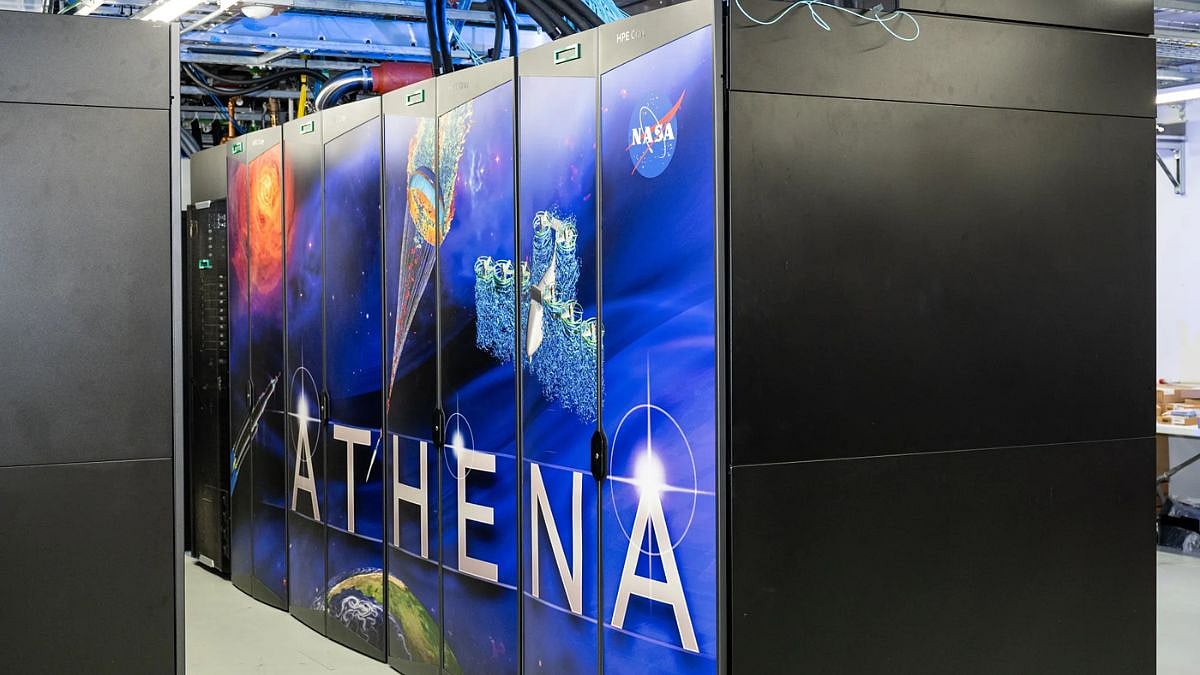
NASA has introduced its newest supercomputer, named Athena, which delivers over 20 petaflops of peak performance and becomes the most powerful system in the agency's current fleet. Athena is housed in the Modular Supercomputing Facility at NASA's Ames Research Center in California's Silicon Valley. The system was rolled out this month to existing users following a period of beta testing. It replaces the decommissioned Pleiades supercomputer, which had a peak of around 7 petaflops.
The name Athena, chosen through an internal contest in March 2025 among the High-End Computing Capability workforce, refers to the Greek goddess of wisdom and half-sister of Artemis.
NASA Supercomputer: Performance and hardware details
The supercomputer achieves a theoretical peak performance of 20.13 petaflops, equivalent to 20 quadrillion calculations per second. It consists of 1,024 nodes based on AMD Epyc Turin CPUs, with a total of 264,144 cores and 786TB of memory. The system uses an HPE Cray EX4000 architecture across four racks.
Athena surpasses its predecessors, including Aitken and Pleiades, in both raw computing power and energy efficiency. Its modular design helps reduce utility costs for the agency through improved cooling and resource management.
Why is Athena special?
Athena stands out as NASA's most powerful supercomputer to date, delivering over 20 petaflops of peak performance - equivalent to more than 20 quadrillion calculations per second. This marks a significant leap over its predecessor Pleiades, which peaked at around 7 petaflops, enabling far more complex simulations for missions like rocket launches, planetary exploration, and aircraft design. Its modular architecture at the Ames Research Center's facility allows efficient scaling of computing resources, while advanced cooling reduces utility costs and improves energy efficiency compared to older systems.
The scale of Athena's capability becomes clear when compared to everyday hardware - complex calculations that Athena completes in a single day would take a typical personal computer roughly 500 years to finish. This immense speed supports round-the-clock processing for NASA's demanding workloads, from climate modelling and AI training to trajectory analysis for asteroids and future lunar or Martian missions, all while maintaining lower operational demands on resources.
Applications in NASA missions
Athena forms part of NASA's High-End Computing Capability project and is managed by the Office of the Chief Science Data Officer. It supports simulations for rocket launches, planetary landers, next-generation aircraft designs, and asteroid trajectory tracking. The system also handles large-scale data analysis for climate studies, aeronautical engineering, and training of artificial intelligence models.
It integrates with commercial cloud platforms as part of a hybrid computing strategy to address the growing demands of space exploration, including lunar and Martian missions.
“Exploration has always driven NASA to the edge of what’s computationally possible,” said Kevin Murphy, chief science data officer and lead for the agency’s High-End Computing Capability portfolio. “Now with Athena, NASA will expand its efforts to provide tailored computing resources that meet the evolving needs of its missions.”
Access to Athena is available to NASA researchers and external scientists supporting agency programmes through application processes.
Published on: Friday, January 30, 2026, 12:57 PM ISTRECENT STORIES
-
-
-
-
-