FPJ Exclusive | From Teenage Sensation To Chasing Asian Games Glory: Indian Trap Shooter Shapath Bharadwaj's Grit-Filled Journey
Indian trap shooter Shapath Bharadwaj spoke to The Free Press Journal ahead of the Asian Games 2026, opening up about his journey from double trap to trap, mental preparation, training, nutrition and overcoming setbacks. Bharadwaj said his focus is on executing his process, giving 110% effort and making India proud while seeking fans’ love and support.

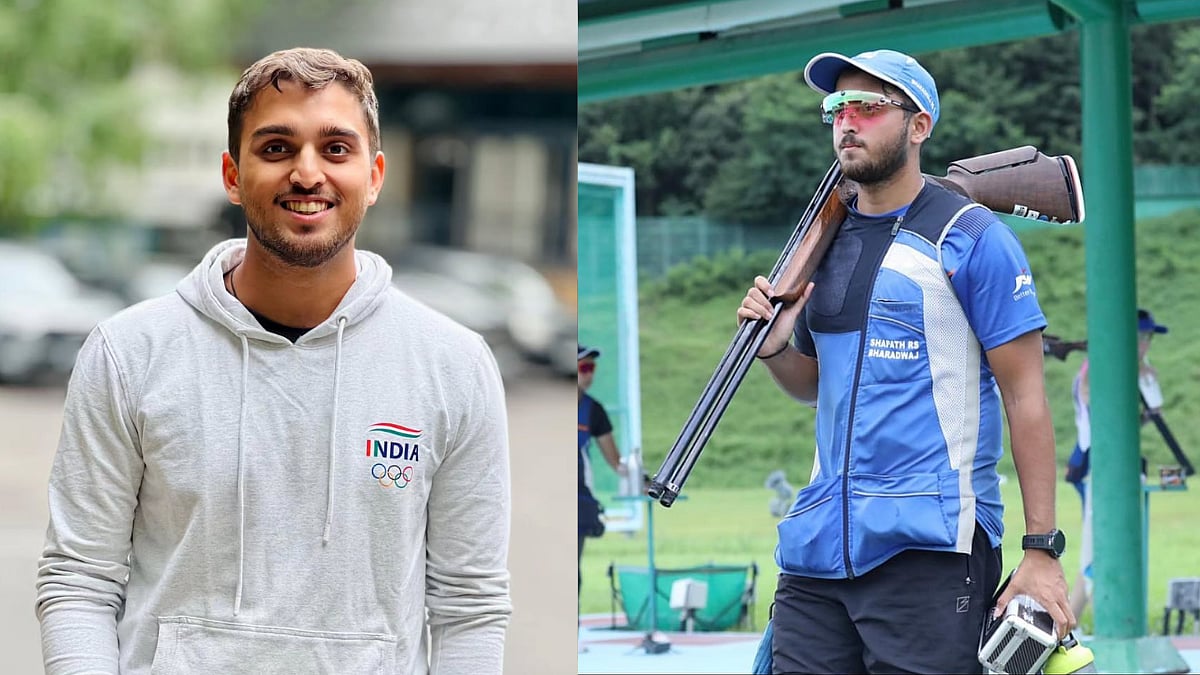
Shapath Bharadwaj/Instagram
Shapath Bharadwaj is set to represent India in trap shooting at the Asian Games 2026, bringing with him years of experience, resilience and lessons from a career that has seen him transition from double trap to trap.
In an exclusive conversation with The Free Press Journal, Bharadwaj opened up about his journey in shooting, his early days, the challenges of switching events, his training and mental preparation, and his expectations from the Asian Games.
Excerpts...
1. Can you tell us a little about your background and how shooting became a part of your life?
I used to be a double trap shooter. Now, I’m a trap athlete. I did my Master’s in Science from Greece, at the IOC’s university there. My parents are journalists, and my elder brother is a finance analyst.
When I was a kid, I started shooting very early. I was 11 when I started training and 12 when I started competing. I was really fascinated with guns as a young kid, and my parents always told me to stay away from guns whenever possible.
My dad, being a journalist, once had to interview a shooting coach, so I accompanied him to the shooting range. My brother shot for a little while, so I used to accompany him when I was seven or eight years old just to watch people shoot. I didn’t get to shoot back then because I was too young.
As soon as I turned 11 and, after a few months, was able to shoot, I asked my dad if I could take up shooting as a sport. I think the fascination with guns and with competing in general just stuck with me, and so did shooting.
2. Since you grew up in Meerut, how did your environment and family shape your sporting ambitions?
I do not know how much my environment in Meerut helped me as such because I used to travel a lot to shoot, especially in the early days when I was in school. I had to come to the Karni Singh Shooting Range to train, which back then was almost a four-hour drive on average. Sometimes, it would take five or five-and-a-half hours as well without the highway that we have now.
So, I was travelling a lot, and for that I very often had to wake up early. I was studying in the car a lot. My mother would be with me, my dad would be driving me to the range at times, and I would be studying in the car with my mother as a young kid, or I would be studying by myself.
I think what all those early mornings and late evenings taught me, along with giving exams, leaving school after half a day, studying in the car and then shooting, was the value of having grit. Just sheer grit, not giving up and continuing to work no matter what is happening.
At the same time, it also teaches you a sense of discipline. Waking up early on all those mornings as a kid is something that is very normal for me now. But for someone else, waking up at 5, 5.30 or 6 in the morning every day for months and months, and years and years, might seem like a big effort. So, it is the discipline that that part of my life taught me.
3. When you look back at your journey so far, what stands out as the most defining phase of your career?
What stands out as the most defining phase of my career? I would say there are two periods in general. The first was when I had to switch from double trap to trap. I was shooting double trap and was 17 back then. I was already ranked 18th in the world. I had competed in a World Cup final as a senior, so basically, I was on top of the world back then. I was being talked about as a name to look out for in the next generation.
Then, when double trap eventually got dropped from the Olympics, most of us had to switch. That period of going from double trap to trap taught me a lot mentally because you essentially had to start from zero. You do have expectations of yourself because you have been competing at such a high level for such a long time. As a kid back then, you don’t really understand why expectations can change and how you need to change your expectations.
I think that was a phase of my professional growth that taught me very early in life that you need to have a dream, a goal, and you have to temper your expectations according to the situation to keep going and keep yourself mentally strong. That period was very tough mentally, starting again from zero. But I think that phase, the sacrifices I made and the suffering I had to go through, so to say, defined me a lot in my later years.
The second period that defined me a lot was when I was actually away from shooting and doing my Master’s in Greece. I had almost 12 or 14 months of not shooting or training. I would just come home one week before a competition, maybe shoot the competition, and I wasn’t shooting the trials or anything.
I think that period away from the sport taught me a lot about myself as a person and as a professional. It gave me an identity that was not just about shooting, but also an identity as a professional. I think I learnt that to be a professional athlete, you have to have an identity as a professional as well. You have to learn that side of things too. So, I think those two would be the most prominent periods for me in terms of development.
4. Whenever we hear “shooting”, people tend to think only about pistol and rifle. Trap is somewhat of a niche event and not many people know much about it. What do you think about that?
I mean, it’s just a cycle of sports, isn’t it? If you had asked someone 10 years ago, or if I had told someone, “Oh, I’m going for shooting,” they would probably have imagined that I was going for a movie shoot or filming something. They would have asked me, “What movie are you going to film?” Now, if you tell someone, “Oh, I’m going shooting,” they’ll ask, “What event do you do, rifle or pistol?”
Eventually, in four or five years, with the support we have and the growth that we have seen in the sport, it will be, “Oh, so what are you going to do? Is it rifle, pistol or shotgun? Is it trap or skeet?”
So, it’s just a cycle of sports. It’s how sports grow. You have to be patient with it. You have to see it grow. From the evidence we have seen, it is growing, so I am pretty positive that it will keep going.
5. How important are your stance and grip in maintaining consistency and accuracy during a competition?
It is very important to have the same stance and grip throughout the competition. Obviously, it will not be 100% the same all the time, especially in a sport like trap, where you’re outdoors. It could be windy or raining, and things might differ because everything is soaked and wet. So, you also have to be ready to be perfect with the imperfections that are happening in the moment.
At the same time, it is very important to get the basics right. You need to have the right balance with your stance and weight distribution, as well as the right balance and pressure with your grip.
Some people prefer to grip the gun more firmly with their right hand. Some people prefer to grip it more firmly with their left hand. So, those things are important.
But at the end of the day, you have to realise and learn that it’s also about being perfect with the imperfections. You don’t have to keep thinking that if your stance isn’t perfect for all 125 targets, something will go majorly wrong. You just have to keep going through them one by one, doing your best, applying yourself fully and committing yourself fully to every target.
6. How important is it to keep external factors such as wind and weather conditions in mind while training for a competition?
I think it comes down to the experience you have and the years of training and competing that you have done. This is something that you learn over the years and with time.
We have had competitions in places like Cyprus, where the range would be in the middle of a wind farm, so it would be very windy. Then we have had competitions in places like Peru, where the range is on a military base, so you would see helicopters taking off in the background. At the same time, we have had competitions in Delhi, where it would be very hot at times, while at other times, like during the last trial, it would be raining a lot.
So, you just have to go through those conditions and, as I said before, try to do your best in them. From what you experience in those conditions, you go back to the drawing board and tell yourself, “OK, it was very rainy during this competition. I did these things which I liked a lot and which worked, while one or two of these things didn’t work as well, so I need to improve on those.”
Then you discuss that with your team because you will have people in your team who have more experience than you and have a different perspective on things. They can give you a solution or a suggestion, and then you pick the best solution that you think might work, take it to the next competition and see whether it works or not.
7. How do you work on consistency of the shot, especially when you know that one missed target can completely change the outcome?
To work on consistency, a lot of work goes into training. It’s not just technical training when you’re shooting at the range, but also work with the psychologist and work on visualising targets and different scenarios.
Let’s say you visualise the last five targets of a competition, the first five targets of a competition or 15 targets somewhere in the middle of a competition. So, there’s a lot of visualisation work and a lot of work with your psychologist to execute the process time and again on every target to the best of your ability.
As for your thoughts, I wouldn’t say that you just push them away or keep them away, but you keep them with yourself until you finish shooting. After you’re done with the targets, you have time to think about whatever you want to think about.
So, you just bring your mind back to what you’re doing when you’re shooting in that situation. After you’re done with the targets, you have time to rest and you can let your mind wander.
It’s a lot of work in terms of visualising, and we do a lot of mock competitions at the range during camps. All those things help you experience these situations and learn on the training ground and through visualisation. Then you can execute those things better in a competition.
8. Do you have a pre-shot routine that helps you switch off everything around you and focus only on the target?
I do have a pre-shot routine. I don’t know how much of a ritual I would call it, but I have the same routine every time. Before lifting my gun, I always like to adjust my glasses or just, you know, feel my shoulder where I would mount my gun.
Those are the two things that I do before a shot every time. It’s part of my pre-shot routine. I don’t know how much of a ritual I would call it before every target because we don’t have a lot of time before we get to shoot.
So, there’s a lot of focus on breathing and on your execution. But those two things, I think, if you watch me shooting, you’ll see me doing them every time.
9. Can you walk us through your usual training routine and what sort of diet plan you tend to follow?
The diet plan is controlled by my nutritionist from OGQ. So, all the dietary supplements, the diet in general, how much liquid and what kind of liquids I’m consuming, and what food I’m consuming are all controlled by her.
It keeps changing every 15 to 20 days just so there’s no redundancy. There are a lot of buffets, a lot of home-cooked meals, protein shakes, obviously, and a lot of supplements. So, it’s very controlled when it comes to nutrition, thanks to OGQ.
In terms of general preparation, I think most of it is controlled and supported by OGQ for me. They help me prepare with all the details about everything, and I just have to follow them. I have to follow the directives and give them feedback on what worked and what I think we can do better.
10. Do you allow yourself cheat meals and enjoy your favourite foods?
Every once in a while. I wouldn’t say just in the off-season. I think I have cut out sugar a lot in my day-to-day life, but maybe once in two or three months, if I’m really, really craving it, I would have aloo paratha or something.
I mean, you have to work a lot in the gym after that, but I wouldn’t deprive myself of it. I would have it, especially considering how much work we put in at the range and in training.
We don’t usually have an off-season in shooting. I think we only get about a month when we are not competing, so we don’t really have an off-season like that.
I wouldn’t say that I have some of my favourite meals only in the off-season. It’s more about balancing it out. You can always have whatever you want, your cheat meals or your favourite meals, throughout the year. You just have to balance it out, space it out and not deprive yourself either because you want to be happy doing what you’re doing. You don’t want to be upset about the fact that you cannot eat anything.
11. Trap shooting is a very physically demanding sport. To train your physique for competing at the highest level, which aspect of your body do you tend to focus on more?
There’s a lot of focus on the whole body in the gym. I am in the gym six times a week, so there’s a lot of focus on all the body parts, on growing and developing them and increasing mobility as well.
Generally, there’s more focus on my core strength and back strength because we are standing for a large part of the day. Those parts of your body have to be stronger, especially for the rotations on every target and to be able to support your body as a whole.
Apart from that, I personally had an ACL tear about 18 to 20 months ago, so I have to put in extra work on my right leg as well. There’s a lot of mobility work and strengthening for the right leg, apart from the usual core and back strengthening.
12. I do believe in this concept that shooting requires both physical and mental toughness. Do you practise meditation, breathing exercises or any form of mindfulness to improve your concentration?
I mean, as I told you before, there’s a lot of visualisation, and I feel that, to an extent, visualisation is a sort of mindfulness exercise and is meditative.
Apart from that, there are also designated breathing sessions for us. It involves very controlled breathing. There is a controlled breathing pattern in terms of how many breaths per minute we have to take and how we inhale and exhale.
So, all of that is very controlled. It’s very meditative as well, and I think it helps you stay in the present a lot more, even during the day in general. As you said, the sport is very mentally demanding as well, so those 10 to 15 minutes help you calm down, clear your head and lower your heart rate.
13. Trap shooting is such a fast-paced event that if you miss a shot, you don't have a breather to reflect because the very next second you have to take another shot. So, how do you reset and regroup quickly and be ready for action?
I think the thing with trap shooting is that, unlike rifle and pistol, we are not just lowering our heart rate. We have to stay in what we call a positive heart-rate range, or a delta, where we want to be. It’s neither too low nor too high a heart rate.
What happens when you miss a target is that you might have too high a heart rate because you might have a reaction in the moment or you might just have a thought in the moment. When you are starting out, that can happen, but experience and training teach you over time to just keep going through the targets one by one.
It’s like this: you step inside the station and it’s one target. You come out, and it’s all relaxed and calm. Then you go in, amp yourself up for just that one target, come out and then go in again. It does not matter what happened on the target before. It has no bearing on what you’re doing now because, well, what’s gone is gone.
If you hit the target, you absolutely smashed it and smoked the target. Good. You cannot do anything about it now. If you missed the target and absolutely shanked your shot or shot below the target, well, you know what to do on the next one. You analyse it in two seconds and then move on because you cannot do anything about it now.
At the end of the day, the situation for the next target is the same. You cannot do anything about the target that just happened. You have to focus on the target you’re going for now.
14. What goes through your mind before taking a penultimate shot? Do you get nervous or have butterflies in your stomach?
I do not get nervous, and there aren’t any butterflies in my stomach either. It’s very calm and relaxed. It’s literally the same thing. I would give a shot in the middle of the competition, let’s say the 15th or 16th target of the day, the same importance as the last target. Like I said before, when you go in, it’s one target, then one and then one. So, it’s literally the same. The whole focus is on executing your process on every target.
The level of attention and the attention to detail in executing the process all remain exactly the same. For me, at least, there’s no change based on the number of the target. It just keeps going on one by one, and after you’re finished, you can have all the thoughts you want.
15. A lot of times, we see players competing incredibly well in trials, national and international competitions, but when it comes to the Olympics or Asian Games, they struggle to convert those performances into a medal. Why do you think that happens?
I would say it’s all about learning and experiencing things. I think a lot of the time, there’s a lot of extra pressure that athletes might have when it comes to the Olympics or the Asian Games. But I think that’s also down to the fact that a lot of athletes don’t understand what the Olympic movement is as a whole or what the Olympic movement was founded for.
At times, you have to have some bad competitions. You have to go through some sort of suffering, so to say, just to learn where you can be better and what you can do better in the next stages. I wouldn’t say that if you have a not-so-good competition and do not meet the expectations you had of yourself, that’s the end of the world. It’s about who can dust themselves off, come back better, go back to their team, start working again and work on being better than before.
Sooner rather than later, when you keep working in that positive direction, it translates into results and takes you towards where you eventually want to be in your career. So, it’s all about how resilient you are as an athlete.
There’s a quote from Roger Federer that I absolutely love. He is maybe one of the greatest athletes in any sport of all time. He said that he lost a lot of points and won only 52% of the points in his entire career. So, if a legend like that can lose points and still be one of the athletes to have won 20 Grand Slams, and he is telling you that you have to be OK with losing at times but learn from it, then, at the end of the day, it’s about who dusts themselves off the best.
That’s the perspective we should be looking at rather than saying, “Oh, you did well in three competitions, but you did not do well in another competition.” It’s just a process. You keep going and keep learning over time. Your time will come. Until then, you just stay positive and keep working one day at a time.
16. Before the start of any tournament, you tend to work with your coaches, physio, nutritionist and so on. But when the tournament starts, it's just you and your shotgun. Can you describe that feeling?
Well, that is probably one of the toughest questions I have ever had because that feeling is unique. There’s literally nothing that can be compared to it. I’m sure that if you could somehow bottle up that feeling, the expression and the emotions that you have at that point in time, and sell it in the world somehow, I am pretty sure it would be the most expensive thing in the world. So, I do not really know how I can explain it to you because that is something that, even as a philosophy student, always leaves me lost for words. But, yeah, I think the best way to somehow put it on a scale would be to say that if you put it in a bottle and started selling it around the world, it would be the most expensive thing in the world.
17. What are your personal expectations from the Asian Games?
My expectation from the Asian Games is the same as from any other competition, every competition that I step into. It’s to make my country proud. It’s to carry and represent the flag and the Indian contingent, and to wear the name of India on my chest with pride and bring honour to my country. The only expectation I have from the competition is to give 110% of my effort, execute my process and maintain that 110% effort from the start until the end.
18. Any final message you would like to share with the Indian fans who will be cheering you on at the Asian Games?
The only message I would have is to thank all the fans who will be cheering us on, supporting us and being there in spirit with us during the Asian Games, or in person if people are travelling to Japan as well. The only message I would have for them is that the Indian contingent will be giving its 110% for sure in every event and every athlete will be giving their all. The only thing we want is their love and support, so that 110% becomes 220% with the 110% of love and support that we get from them.
RECENT STORIES
-
-
-
-
-